
Profitable on Paper, Broke in Reality: The Cash Flow Crisis Hiding Inside Independent Physician Practices
Your P&L says you made money. Your bank account disagrees. Here is what is actually happening and what to do about it.
Independent physician practices are getting squeezed from every direction right now. What makes it worse is that most of them will not see the financial crisis coming until it is already a payroll problem.
Why This Matters to Your Practice Right Now
You pull up your P&L and it looks fine. Revenue is up. You made money last quarter. Then you check your bank account and start doing math on whether you can cover Friday's payroll.
This is not unusual. It is one of the most common financial problems in independent physician practices.
Operating costs are rising faster than reimbursements. Staffing, EHR contracts, malpractice premiums, and supplies are all climbing at a pace that Medicare fee schedules and commercial contracts are not matching. The consolidation pressure is real. Private equity, hospital systems, and payer-owned medical groups are circling, and the practices most vulnerable to a bad deal are the ones with cash flow problems they have not solved.
The window to fix this is not unlimited. If you want to stay independent, or at least make that choice on your own terms, the financial fundamentals have to be in order. That starts with understanding why your P&L and your bank account are telling completely different stories.

Bold headline graphic reading "Profitable on Paper, Broke in Reality" with subtitle on the physician practice cash flow gap
The Payer Is the Variable You Cannot Control
Here is the structural problem at the center of everything.
Your costs are immediate. Payroll hits every two weeks. Rent is due on the first. Malpractice premiums, supply invoices, EHR maintenance fees: all on a schedule you can see coming.
Your revenue is not.
You deliver care today. You bill today. When the money actually arrives depends entirely on the payer. Commercial insurers routinely take 20 to 30 days. Prior authorization delays, documentation requests, and denial cycles push that timeline out further. When a payer denies a claim, you start over — except you have already spent the money to deliver the care.
Accrual-based accounting records revenue when it is earned, meaning when you submit the claim, not when the money arrives. Most practices above $5 million in annual revenue are required to use it. So your P&L says you made $435,000 last month. Your bank account received $362,000. The $73,000 gap is sitting in accounts receivable, on the payer's schedule, not yours.
That gap is normal until it is not. The moment a payer changes its authorization requirements, a denial spike hits, or a coding change creates a documentation mismatch, the accrual profit disappears from your bank account before you understand why.
What Happens When the Gap Widens
In a stable practice, the accrual-to-cash gap reaches equilibrium. January's uncollected claims become February's deposits. It is a lag, not a loss, and most practices learn to live with it.
The problem is what happens when that equilibrium breaks.
Adding a new provider creates a surge in billed revenue before collections from their patients begin flowing. Switching EHR or practice management systems creates a two to four week billing disruption where claims slow but expenses do not. A single payer rolling out a new prior authorization platform can spike your denial rate in ways that do not show up clearly until your A/R aging starts to look wrong.
In every one of those scenarios, the accrual P&L keeps showing healthy profit. The bank account deteriorates. The practice owner checking the income statement does not see the problem developing until a payroll shortfall forces an emergency draw on the line of credit.
A/R Aging Is Your Early Warning System
The single most actionable number in a physician practice is the percentage of accounts receivable older than 60 days.
The collection probability data tells you why. Claims in the zero to 30 day bucket collect at roughly 95%. At 31 to 60 days, you are at 82 to 88%. At 61 to 90 days, 65 to 72%. Beyond 90 days, below 50%. Beyond 120 days, you are collecting between 12 and 22 cents on the dollar, depending on the payer and the denial reason.
The target: no more than 15% of your total A/R should be older than 60 days. If your over-60-day percentage exceeds 20%, you have a problem costing your practice real money every month.
Pull the aging report by payer, by rendering provider, and by age bucket. You are looking for concentrations that reveal systemic problems, not random variation.
If one payer represents 55% of your over-90-day A/R, you likely have a payer-specific issue: a contract term, a prior authorization requirement your billing team is not consistently meeting, or a credentialing gap for a specific provider. If one provider has disproportionately aged A/R while everyone else in the practice is clean, the issue is usually documentation timing or coding patterns triggering automatic review.
Faster collection starts with knowing exactly where your friction lives. A general push to collect faster does not fix a payer-specific contract problem.
Your Billing Team Is Working Backward
There is an operational cost to aged A/R that does not appear anywhere on your income statement.
Every aged claim requires active follow-up. Phone calls to payer representatives. Resubmission with corrected information. Formal appeals. Patient statements for balances shifted to patient responsibility. Your billing team is spending most of their working hours chasing claims with the lowest probability of payment. Newer claims, the ones with the highest collection probability, are getting less attention because the queue is saturated with old work.
This is a cycle that causes your overall collection rate to decline even as the billing team works harder.
The fix is not adding billing staff. It is reducing the volume of rework by improving the front end. Eligibility verified 24 to 48 hours before the appointment. Accurate demographics and insurance data at intake. Prior authorization tracked before the patient arrives. Realistic patient cost estimates that reduce bad debt before it starts.
From the payer side, the authorization submission quality gap is more visible than practices realize. Submissions with incomplete documentation, mismatched codes, or prior encounters that do not map cleanly to the service being requested get routed to clinical review queues that run on completely different timelines than clean auto-adjudication. At the practice level, that delay reads as payer slowness. Often it started in the front office.
When I was leading integration of financial data flows across clinical, billing, and payroll systems for a community health provider group, the pattern was consistent. Practices with the tightest intake processes had the most predictable cash flow, even when they were operating in the same payer mix as practices that were struggling. I covered how upstream workflow failures compound into billing losses that are hard to trace back to their source in my earlier piece on when the front office fails.
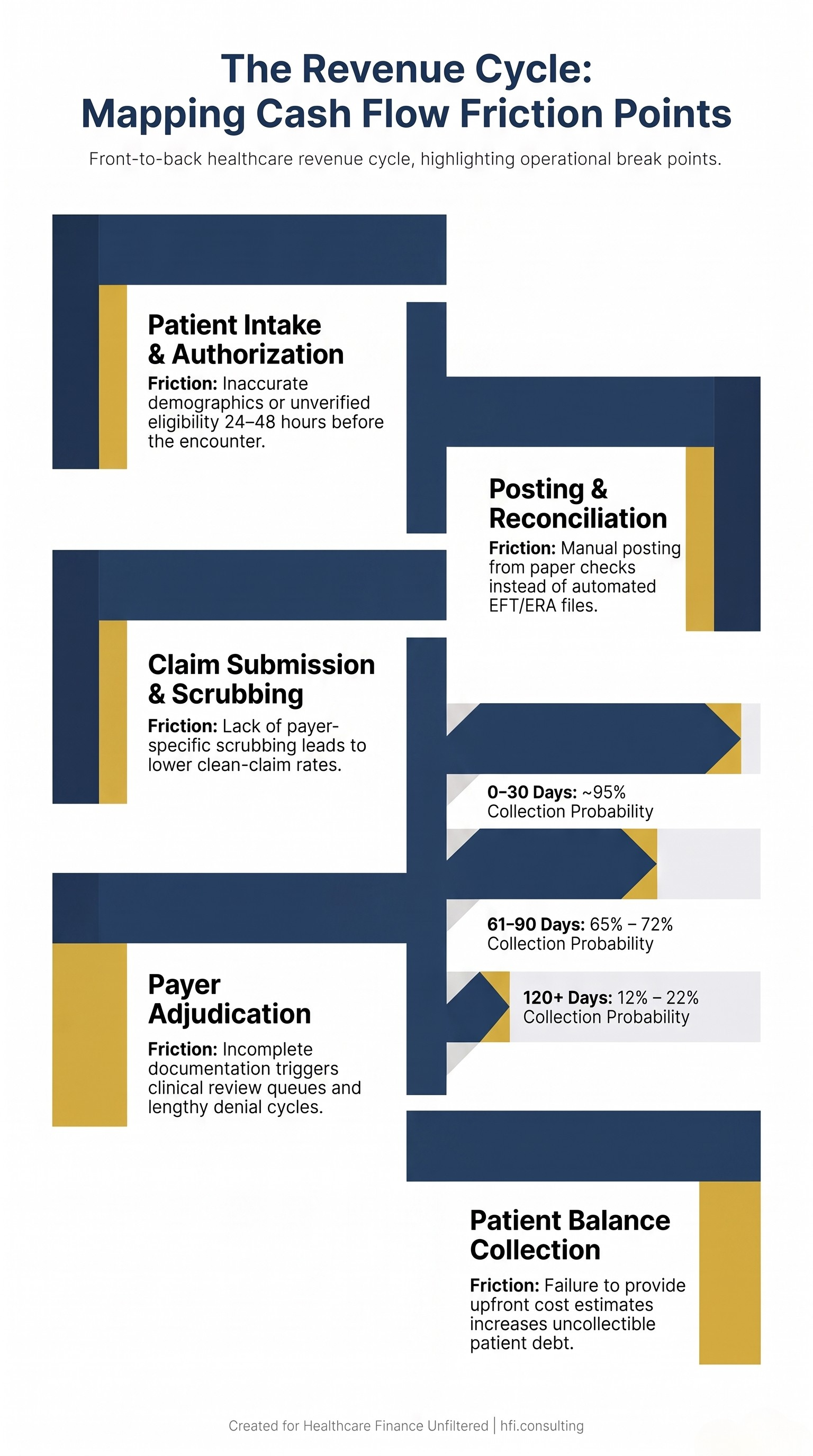
Revenue cycle process flow from patient intake to cash posting, with common friction points and their cash flow impact labeled at each stage
What Clean Claims Actually Require
A clean claim is one that adjudicates without a human touching it on the payer side. The operational requirements to get there consistently are not complicated. The follow-through is.
Standardized intake so insurance data is correct before the encounter. Payer-specific claim scrubbing for your highest-volume insurers and most complex services. Documentation consistency across providers so the same service generates the same claim quality regardless of which physician saw the patient.
EFT and ERA setup is the second lever most practices have not fully configured. Electronic funds transfer means the payer pays by ACH rather than paper check. The electronic remittance advice, the standardized 835 file, tells your practice management system exactly what was paid, denied, or adjusted and why. When both are working together, payment posting becomes largely automated. Reconciliation time drops significantly. Most practices still receiving paper checks and manually posting remittances are spending far more staff time on the collection cycle than they realize. The automation gap inside payment reconciliation is larger than most practice owners know, and I broke down exactly where it hides in my earlier piece on payment reconciliation for small medical practices.
Track days in A/R, denial rate, clean claim rate, and patient payment velocity weekly. Not as an academic exercise. Because the four-to-six week trend tells you whether front-end changes are working before they show up in a quarterly review.
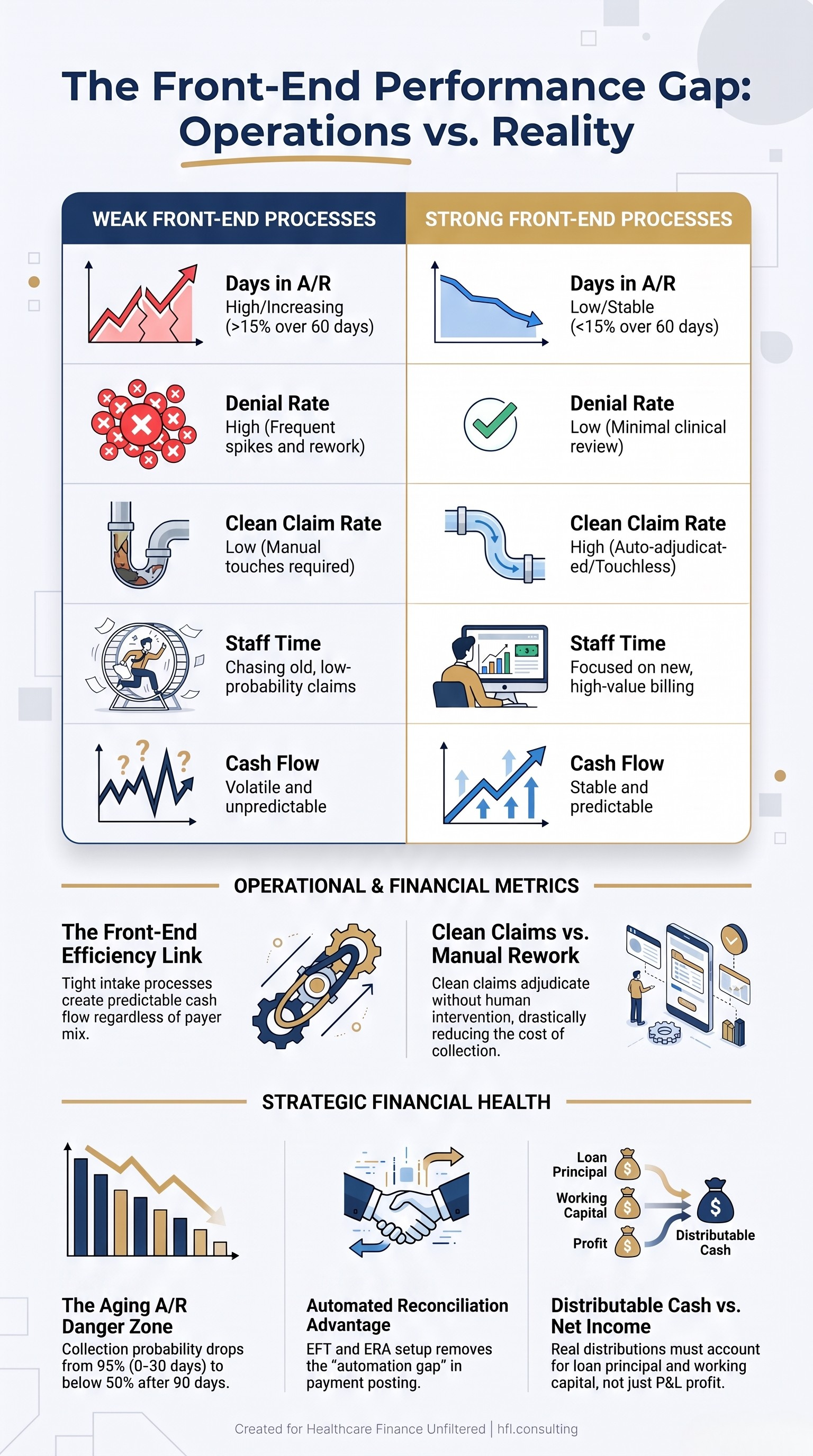
Comparison table showing financial and operational metrics for practices with weak versus strong front-end revenue cycle processes
The Distribution Problem Nobody Talks About at Partnership Meetings
There is a third layer to the profitable-but-broke problem. It is the one that creates the most severe financial crises and the one practice owners are most reluctant to confront.
Your P&L says the practice earned $650,000 in net income last year. Three partners. Each took $216,667 in distributions. The math appears to work.
It does not.
The $650,000 in reported net income does not account for loan principal payments, which reduce your bank balance but are not income statement expenses. It does not account for capitalized equipment purchases, where only the first year of depreciation appears on the P&L. It does not account for A/R growth, where your P&L counted the revenue but your bank account did not receive it. And it does not account for estimated tax payments, which are not operating expenses and do not appear on the P&L at all.
The formula that reflects what you can actually distribute: net income plus depreciation and amortization, minus loan principal payments, minus capital expenditures net of any financing, minus the increase in net working capital, minus a tax reserve.
That is your distributable cash. Not your reported net income.
Running distributions against P&L profit without this calculation is the slow-motion financial crisis that eventually arrives as an emergency. If you are not running it quarterly, before setting your distribution amount, you are missing the most important financial control your practice has. The bookkeeping infrastructure that makes this calculation routine is the subject of my earlier piece on bookkeeping for medical practices.
The Five-Year Window Is Closing
The consolidation pressure on independent practices is real. According to the American Board of Family Medicine, roughly 60% of family physicians were independent two decades ago. That number is now around 33%.
That trend does not reverse on its own.
The practices most likely to make a bad deal, or to have no deal options at all, are the ones with cash flow problems, aging A/R, and financial statements that have not been maintained to the standard a lender or acquirer expects.
If you want to stay independent, your financial infrastructure needs to support that choice through the next five years of cost pressure. CMS reimbursement is not going to solve the staffing cost problem. Commercial contracts are not accelerating. The practices that retain their independence will be the ones that treated cash management as an operational competency, not a quarterly conversation with their CPA.
That means knowing your A/R aging by payer and by provider. Running a cash receipts report alongside your P&L every month. Calculating distributable cash before authorizing distributions. And building the front-end revenue cycle processes that give you clean claims, fast cash, and a collection cycle as independent from payer timing variability as you can make it. The revenue cycle posture that makes independence sustainable is something I covered in depth in the medical group revenue cycle framework.
The financial complexity is not going down. The time to build these disciplines is before the cash shortfall arrives, not after.
If you are working through cash flow challenges in your practice and want a framework for identifying where the friction is and what to fix first, HFI Consulting can help. Visit hfi.consulting to learn more about how we work with physician-owned practices.
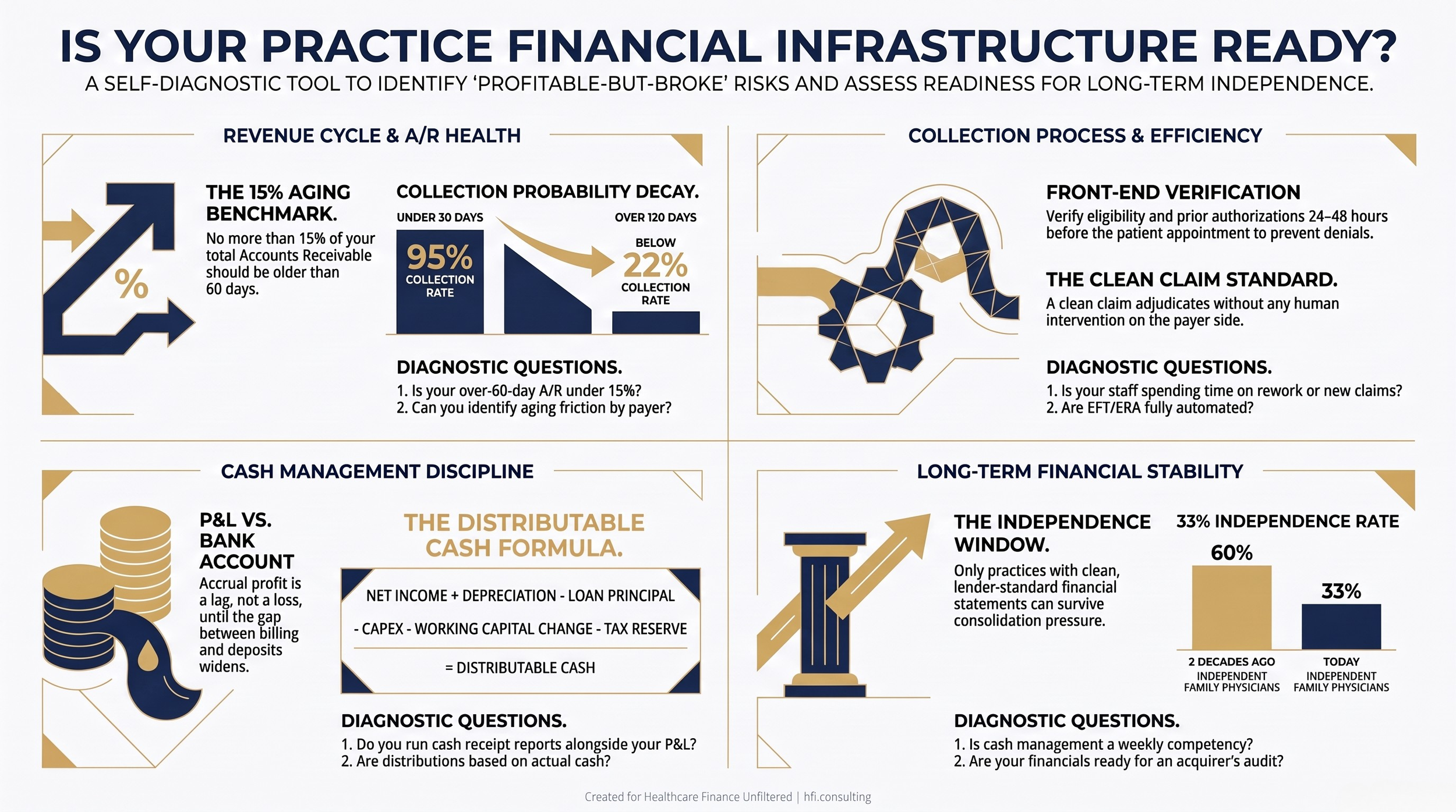
Four-quadrant self-assessment framework for physician practice financial infrastructure covering A/R health, collection processes, cash management discipline, and financial stability
The environment for independent physician practices is not getting easier. Five years from now, the practices still standing on their own terms will be the ones that built real financial discipline while they had time to do it deliberately. HFI Consulting works with physician-owned practices on the financial infrastructure that makes independence sustainable. Start the conversation at hfi.consulting.
P.S. What is the single cash flow metric you watch most closely in your practice? Days in A/R, denial rate, patient payment velocity, or something else? Hit reply and tell me. I am tracking what finance leaders are actually watching in the field.
