Payment Reconciliation for Small Medical Practices: The Automation Gap That Is Quietly Draining Your Revenue
Three in four healthcare organizations still reconcile payments manually. Here is how independent practices close that gap without an enterprise budget.
Your billing software posted the ERA. Your bank shows the deposit. But does anyone on your team actually know those two numbers match? For most independent practices, the honest answer is: not until month-end, not without a spreadsheet, and not without someone spending hours they do not have.
A Wells Fargo survey conducted by HFMA in September 2025 found that just 3.5% of healthcare organizations have fully automated their reconciliation processes. More than 22% still rely on mostly manual workflows. And 72% describe their processes as only partially automated. Those numbers came from a sample that included large hospital systems with full finance departments and enterprise technology budgets.
For a practice with 3 to 8 providers, the gap is almost certainly larger.
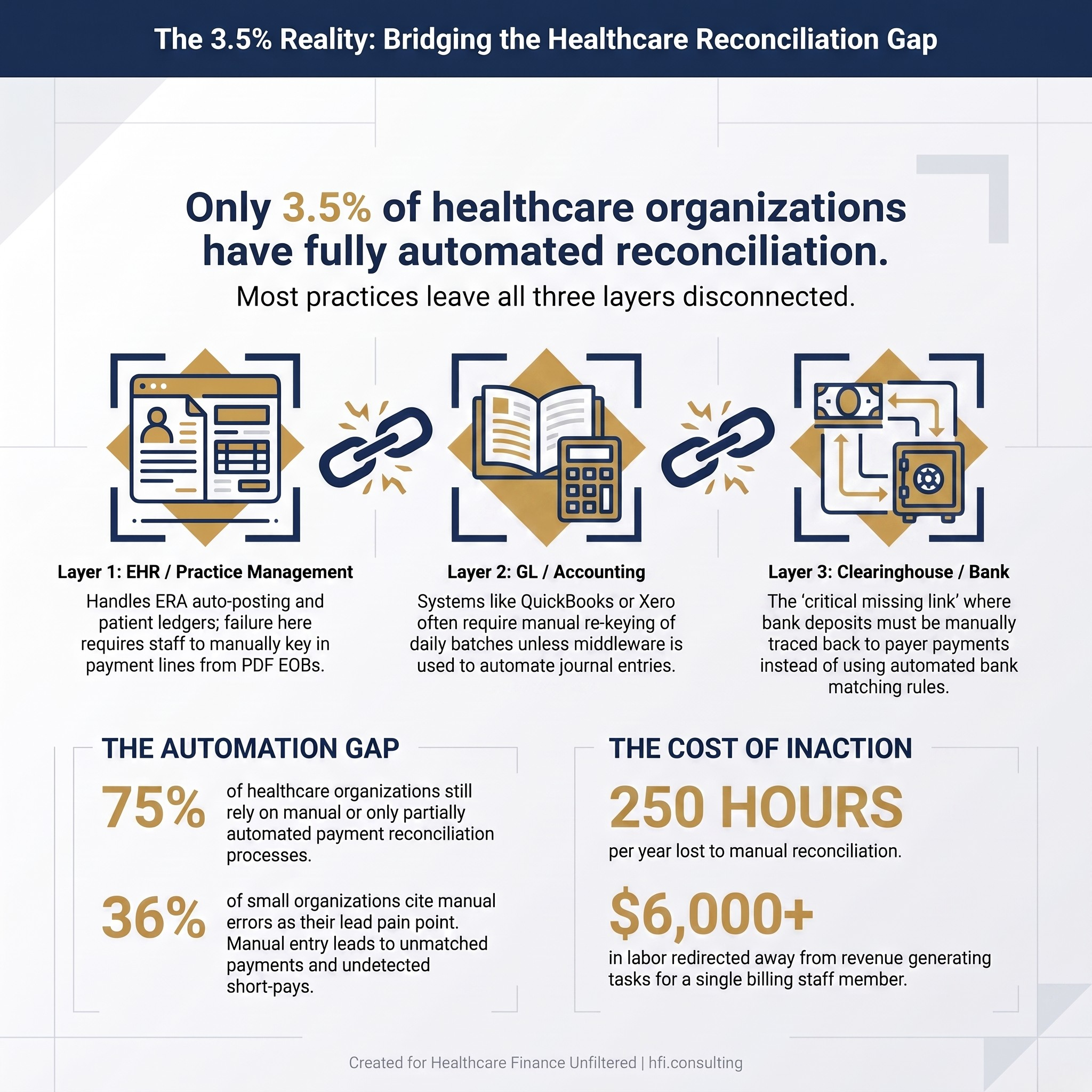
Infographic showing only 3.5% of healthcare organizations have fully automated payment reconciliation, with three disconnected system icons representing the gap
Why This Problem Is Worse at Small Practices
The HFMA survey identified something important: the challenges are not the same across organization sizes. Larger health systems struggle with data inconsistency and integration failures between enterprise platforms. Smaller organizations face a different problem entirely. Staffing.
Forty percent of the smallest organizations in the survey named staffing limitations as their primary reconciliation pain point. For a small practice, that often means one billing person who handles claims submission, payment posting, patient statements, and denial follow-up. Reconciliation is what happens when everything else is done. Which means it often does not happen.
The result is not just inefficiency. It is financial risk. Manual data entry errors are cited by nearly 36% of small organizations as the leading cause of reconciliation problems. Each unmatched payment, each duplicate posting, each short-pay that slips through without follow-up is money that either left the practice quietly or never arrived at all.
If you are still running a spreadsheet to reconcile what your clearinghouse says you received against what your bank actually deposited, you are operating with a lag. And in a thin-margin environment, that lag has a cost.
The Three-Layer Problem Most Practices Are Not Solving Together
Payment reconciliation in a medical practice runs across three distinct systems: the EHR or Practice Management platform, the clearinghouse, and the bank. Most practices have addressed one or two of these. Almost none have connected all three.
Layer 1: ERA Auto-Posting in the PM System
Electronic Remittance Advices should be posting automatically to the patient ledger. If your billing staff is manually keying payment lines from a PDF explanation of benefits, that is your first and most impactful point of intervention. Platforms like Waystar, Availity, and Claim.MD each offer direct 835 ERA delivery with auto-posting rules that match payments to claims without manual input.
If you are on a modern all-in-one PM platform like Tebra, AthenaOne, or CharmHealth, native ERA auto-posting is already built in. The question is whether it has been configured and whether someone verified it is working.
This is where I often start when working with smaller practices. The configuration step is not complicated. The follow-through on whether it is actually running cleanly is what gets skipped.
Layer 2: GL Integration Between Your PM System and QuickBooks or Xero
Most small practices run their accounting in QuickBooks Online or Xero. Most also have their clinical billing in a separate PM system. Getting those two to talk without manual re-keying is the step that eliminates the largest category of reconciliation errors.
Middleware tools like Anatomy Financial and Kazoo are built specifically for this gap. They translate the daily closed batch from your PM system into a summarized journal entry in your GL, mapping revenue by payer type, adjustments, and refunds. Custom API connectors through platforms like Zapier or Make can accomplish the same thing for cloud-native EHRs with open APIs.
The goal is to produce a Daily Sales Summary in QBO or Xero automatically. Instead of individual transactions cluttering the ledger, you get one clean entry per day mapped to the right accounts. Month-end reconciliation becomes a matching exercise, not a reconstruction project.
Layer 3: Bank Feed Matching
This is what the HFMA survey identified as the critical missing link across organizations of every size. Banks are not integrated into the reconciliation workflow. The money arrives, the bank feed records a deposit, and someone manually traces that deposit back to the payer payment it represents.
QuickBooks Online and Xero both support direct API bank feeds and automated matching rules. The setup is straightforward. When an EFT deposit arrives from a payer like Optum or a Medicare payment batch, an automated bank rule matches it against the pending accounts receivable entry created by the GL middleware. The match either clears or flags an exception.
A clearing account structure reinforces this. Payer deposits hit an Insurance Clearing account. The billing summary clears the balance. If that account carries a balance at month-end, it tells you exactly how much in ERA deposits is unmatched. The unmatched amount is your problem list.
This is the same conceptual structure that large health systems implement with BAI file feeds and ERP engines. The architecture for a 5-provider practice is simpler. But the logic is identical.
I wrote more about this in the context of the broader billing infrastructure question in my earlier piece on remote bookkeeping for independent medical practices. The automation question is closely connected to whether your bookkeeping function is built to catch these gaps or built to process transactions.
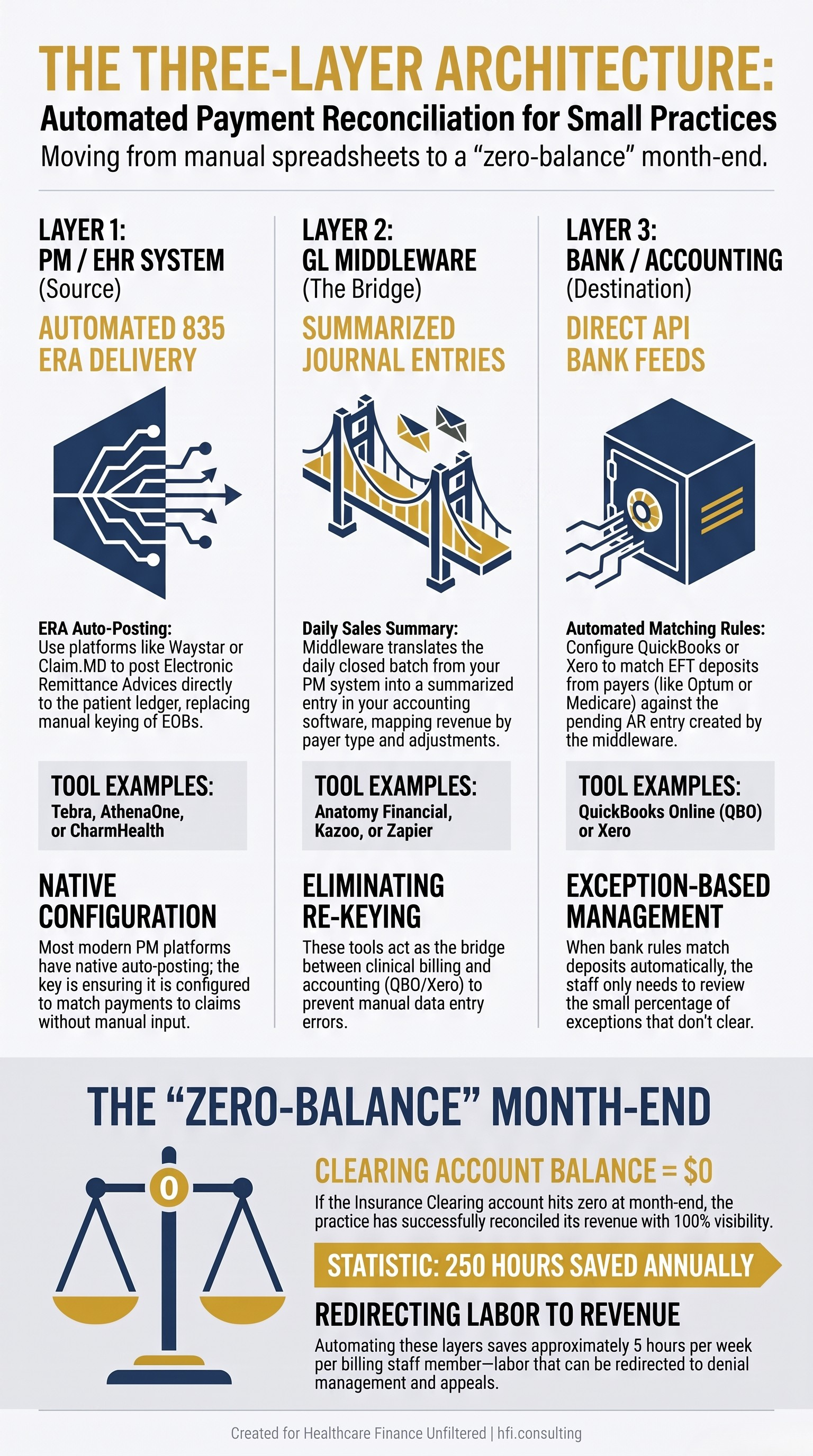
Three-column process flow diagram showing ERA auto-posting, GL middleware integration, and bank feed matching as the three layers of automated payment reconciliation for small medical practices
What This Costs When You Do Not Fix It
The financial case for automation is not theoretical. Consider what manual reconciliation actually consumes.
If your billing person spends five hours per week on manual reconciliation tasks that should be automated, that is 250 hours per year. At a fully-loaded cost of $25 per hour for a billing staff member, that is $6,250 in labor redirected from work that actually drives revenue. In a 5-provider practice billing $3 to 5 million annually, that is not a rounding error.
Short-pays are the bigger exposure. Payers routinely apply contractual adjustments, coordination of benefits reductions, and bundling logic that reduces what they owe. Without systematic reconciliation, those short-pays are not identified until they are too old to appeal or follow up on effectively. For many practices, this represents revenue that is permanently lost.
The HFMA survey found that reconciliation errors have at least occasional impact on financial operations and strategic decision-making in the majority of organizations surveyed. Only 10% reported significant impact. But that self-assessment does not account for what organizations do not know they are missing.
You cannot find what you are not looking for.
If you are a practice owner or administrator wondering whether your current reconciliation setup has undetected gaps, HFI Consulting works with independent practices to assess, configure, and manage payment reconciliation workflows. We specialize in connecting the layers most practices have left disconnected. Visit hfi.consulting to learn more.
The Implementation Path for a 3 to 8 Provider Practice
Getting from manual to automated does not require a multi-year project or a vendor contract with a six-figure price tag. A lean, well-configured tech stack can achieve near-complete three-way reconciliation at a cost structure appropriate for a small practice.
Start with ERA auto-posting. Confirm with your PM vendor that 835 ERA auto-posting is enabled and configured. Test it by running a comparison of auto-posted amounts against the corresponding bank deposits for a two-week period. Identify the exceptions. Every exception is a process failure.
Connect your PM to your GL. Evaluate whether your current EHR or PM platform has a native QBO or Xero integration. If not, explore middleware options. Anatomy Financial is well-suited for practices already using a billing-focused workflow. Zapier-based API connectors work well for modern cloud EHRs with open architectures.
Set up bank rules. Once the GL integration is producing clean Daily Sales Summaries with appropriate clearing accounts, configure automated bank matching rules in QBO or Xero. This step has the highest leverage ratio of any configuration you will do. Once rules are running, exceptions surface automatically instead of hiding in the reconciliation backlog.
Add a clearing account review to your close checklist. At month-end, the Insurance Clearing account and Credit Card Clearing account balances should be zero. Any balance tells you where the problem is. That is a five-minute check that replaces hours of forensic work.
This is also relevant context for practice owners thinking about staffing and billing structure. I outlined the broader practice efficiency argument in when the front office fails, including how upstream workflow failures compound into billing losses that are hard to trace back to their source.
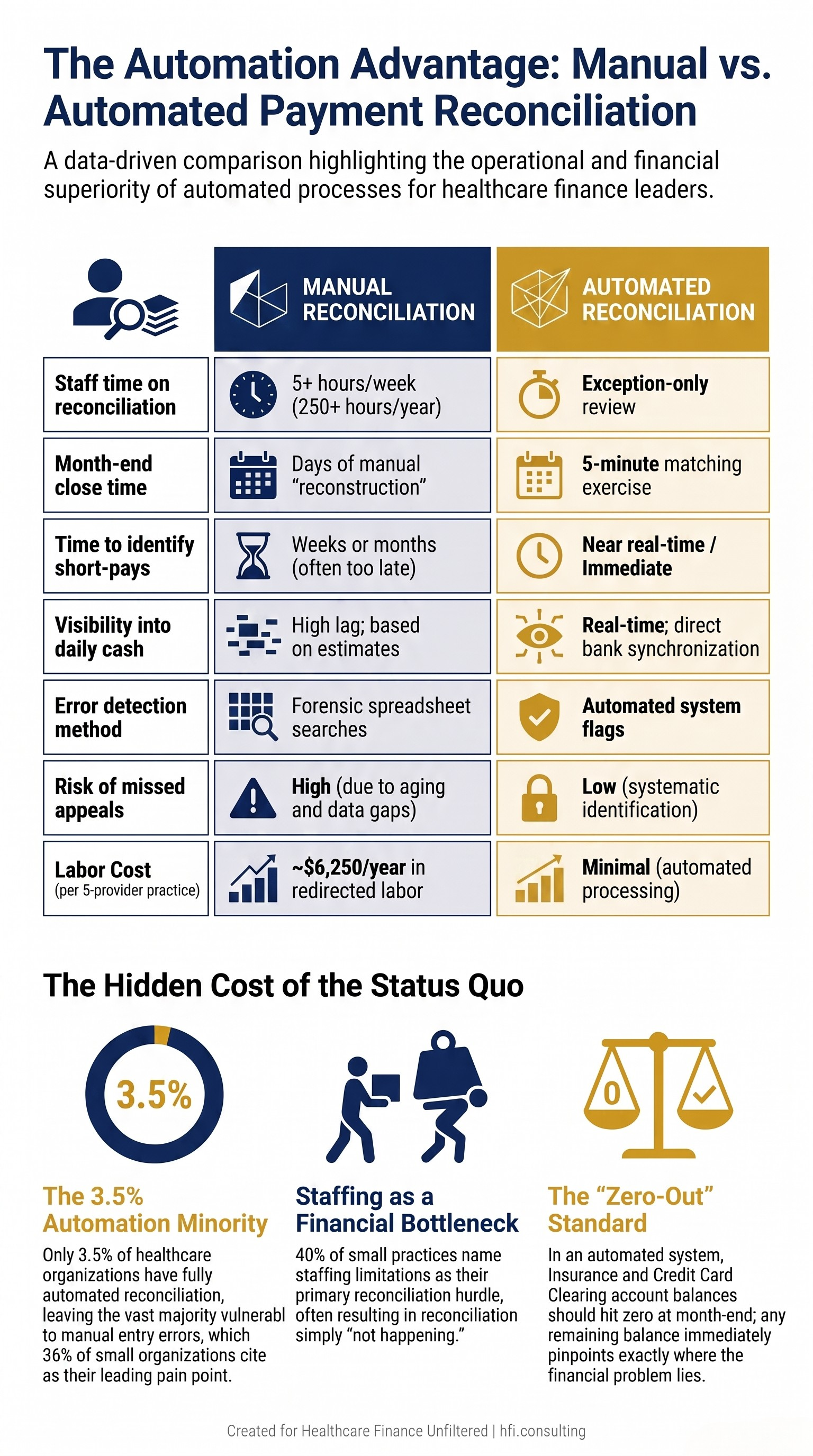
Side-by-side comparison table showing manual versus automated payment reconciliation outcomes for independent medical practices, covering time, visibility, and error risk.
What This Makes Possible Beyond Efficiency
The most important argument for automated reconciliation is not the labor savings. It is what the data becomes capable of telling you once it is clean and current.
When your bank feed, your GL, and your PM system are synchronized, you know your daily cash position without waiting for a statement. You know which payers are consistently short-paying before the pattern compounds over a quarter. You know when an ERA did not arrive and can follow up before the claim ages past the appeal deadline.
For practices carrying a line of credit or managing seasonal cash flow variation, accurate daily visibility into reconciled cash is a material operational advantage. For practices considering expansion, the clean financials that automated reconciliation produces are a prerequisite for any meaningful strategic conversation.
The revenue cycle conversation at the practice level often focuses on denials and collections. Those are downstream problems. Reconciliation is the upstream infrastructure that makes it possible to know whether you actually got paid for what you delivered.
For context on how this connects to the broader revenue cycle posture for medical groups, the framework I outlined in medical group revenue cycle strategy addresses the same underlying truth: the practices that manage margin most effectively are the ones where finance infrastructure matches the volume and complexity of clinical operations.
The Role of Outside Support
For some practices, the right path is to build internal capability. For others, especially those with limited administrative bandwidth, the right answer is to bring in a partner who manages the configuration and ongoing monitoring as a service.
HFI Consulting works with independent practices to assess current reconciliation workflows, identify where the three layers are not connected, configure automation tools appropriate to the practice's existing PM and accounting platforms, and establish the monitoring checks that keep the system running cleanly. The goal is not to replace your billing team. It is to get them out of the reconciliation spreadsheet and back into work that requires judgment.
The HFMA survey found that organizations of all sizes are working to improve reconciliation processes through automation. The tools exist. The integration paths are documented. The technology does not require an enterprise budget.
What it requires is a decision to treat reconciliation as infrastructure rather than a monthly task. Practices that make that shift spend less time chasing their own numbers and more time understanding what those numbers mean.
If your clearing account does not zero out at month-end, that is the place to start.
For more analysis on practice-level finance operations, visit hfi.consulting.
P.S. What does your current reconciliation process look like? Are you closing the loop between your clearinghouse, PM system, and bank manually or with automation? Hit reply and tell me. I read every response and I am building a follow-up piece on where practices are actually getting stuck.
