McKesson Data Breach: The CFO's Guide to What a "Contained" Cyberattack Actually Costs
McKesson says operations are stable. Here is what the financial exposure actually looks like and what CFOs on both sides of the market should do now.
McKesson confirmed a cyberattack on August 25, 2026, and has since told the market that core distribution operations remain intact. What it has not told the market is what this will actually cost. That number is still being built.
That is exactly what CFOs need to understand right now.
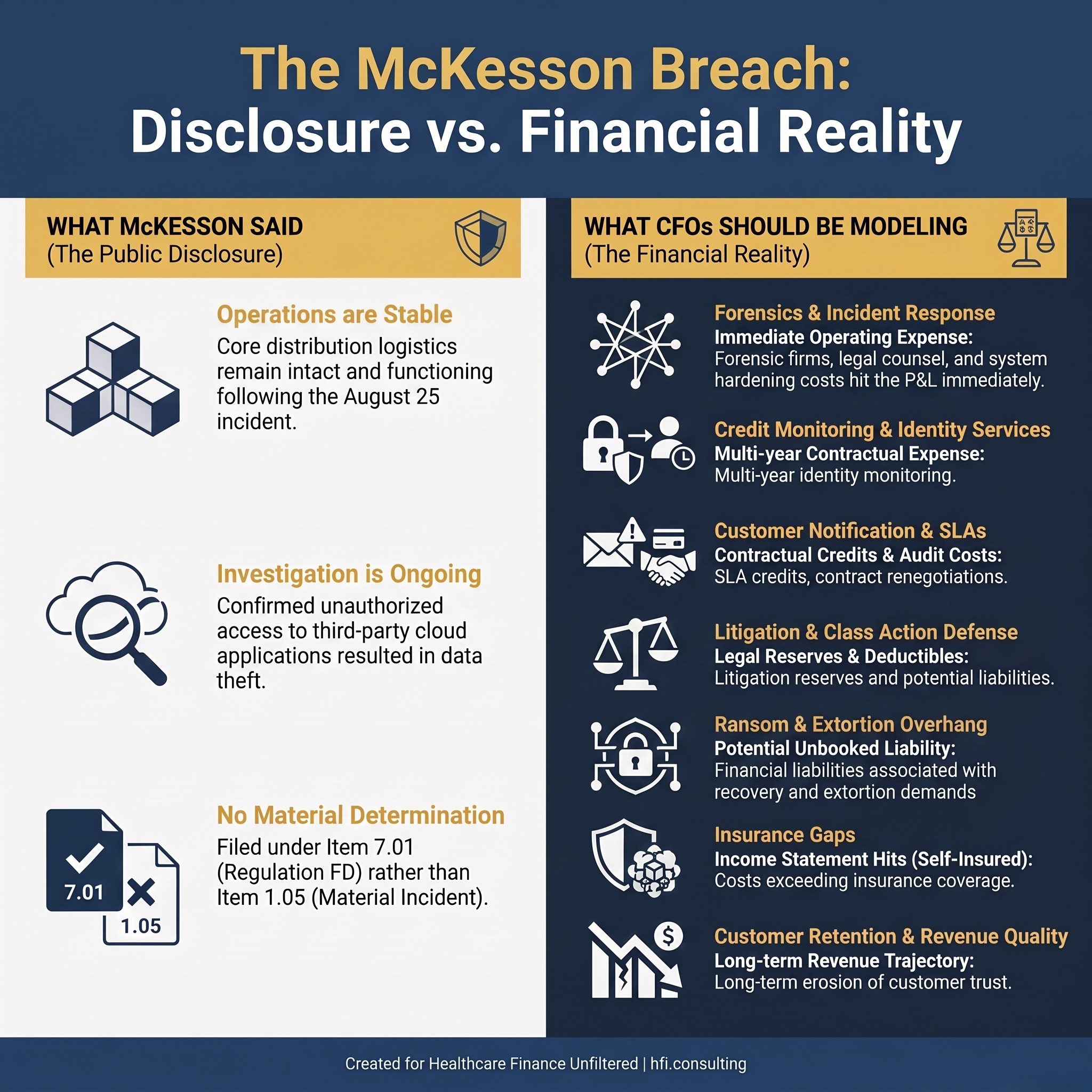
Infographic comparing McKesson's official breach disclosures to the seven financial cost categories healthcare CFOs should be modeling.
What McKesson Actually Disclosed, and What It Signals
McKesson filed an 8-K with the SEC on August 28, 2026. The filing disclosed the incident under Item 7.01, which covers Regulation FD disclosures: general company information the market should have access to. It was not filed under Item 1.05, which is the specific provision that applies to material cybersecurity incidents.
That distinction matters. Item 1.05 requires a company to describe the material aspects of the nature, scope, and timing of a breach, along with its impact or reasonably likely impact on the company's financial condition and results of operations. By disclosing under Item 7.01 instead, McKesson is signaling that, as of the filing date, management did not view this as a balance-sheet event.
That is not the same as saying it will not become one. It means the financial picture had not yet resolved enough to require that determination.
McKesson confirmed that unauthorized access to third-party applications resulted in data theft affecting customers in its Oncology and Multispecialty and Medical-Surgical business units. The company stated it has reasonable assurance of no ongoing unauthorized activity and that distribution operations are functioning.
The hacking group ShinyHunters claimed responsibility, telling cybersecurity news outlet BleepingComputer it used voice phishing to compromise employee accounts and access cloud applications. ShinyHunters claimed the breach exposed approximately 284 million patient records and issued a reported ransom demand in the range of $55 million. McKesson has not confirmed either figure. Both should be treated as unverified claims until the company's investigation produces confirmed numbers.
What McKesson has confirmed is the category of exposure. What it has not confirmed is the dollar amount. That is where CFO-level analysis begins.
The Seven Cost Categories McKesson Is Preparing to Absorb
This is not a ransomware attack like the 2024 Change Healthcare incident, which collapsed billing operations for weeks across the industry. McKesson's core logistics network has stayed up. But the financial exposure from a confirmed data theft at this scale has a predictable anatomy, even when the total is still unknown.
1. Incident Response and Forensic Investigation
The first dollars out the door are always the same: outside cybersecurity firms, legal counsel, digital forensics, and system hardening. These costs hit operating expense immediately. For a company of McKesson's size and complexity, with confirmed access to cloud platforms including Salesforce and Snowflake according to ShinyHunters' claims, a forensic investigation of this scope typically runs into eight figures before it closes.
These costs are expensed as incurred, not reserved in advance. That means they will show up in quarterly results before any other financial impact is visible.
2. Credit Monitoring and Identity Protection Services
McKesson has already committed to providing complimentary credit monitoring and identity protection services for affected individuals, along with a dedicated support line. This is a multi-year expense. The per-person cost of credit monitoring contracts typically runs $15 to $25 annually, depending on the tier of coverage and the vendor.
The total exposure here depends entirely on how many unique individuals are ultimately confirmed as affected. That number is not yet known. If the affected population runs into the millions across oncology, multispecialty, and medical-surgical customers, this line item alone becomes material.
3. Customer Notification and Contract Exposure
The affected business units serve oncology and surgical customers. These are not anonymous payer relationships. They are contractual partners with SLAs, data security addendums, and audit rights. Finance teams should expect to manage customer credits, service level disputes, additional security audit requirements from institutional buyers, and possible contract renegotiation demands.
For CFOs at health systems and ASCs that purchase through McKesson's specialty units, this is the moment to pull your vendor contract and read the breach notification and liability provisions. What your contract says about McKesson's obligations, and yours, matters now.
4. Litigation and Class Action Risk
Law firms began filing and investigating within days of the public disclosure. This is standard pattern following a large healthcare data breach. Typical claims include inadequate security safeguards, delayed breach notification, and harm from exposed PHI and PII.
Even in cases where defendants ultimately prevail or settle at lower figures, legal defense costs are immediate and real. Insurance may cover portions of this, but deductibles apply and coverage limits vary. This will require a litigation reserve in a future quarter if exposure crosses the materiality threshold.
As a reference point, my implementation consulting work with McKesson through Change Healthcare gave me direct visibility into how embedded these data flows become across a customer network. When breach exposure reaches that depth of integration, the litigation surface area is larger than most vendor agreements anticipate.
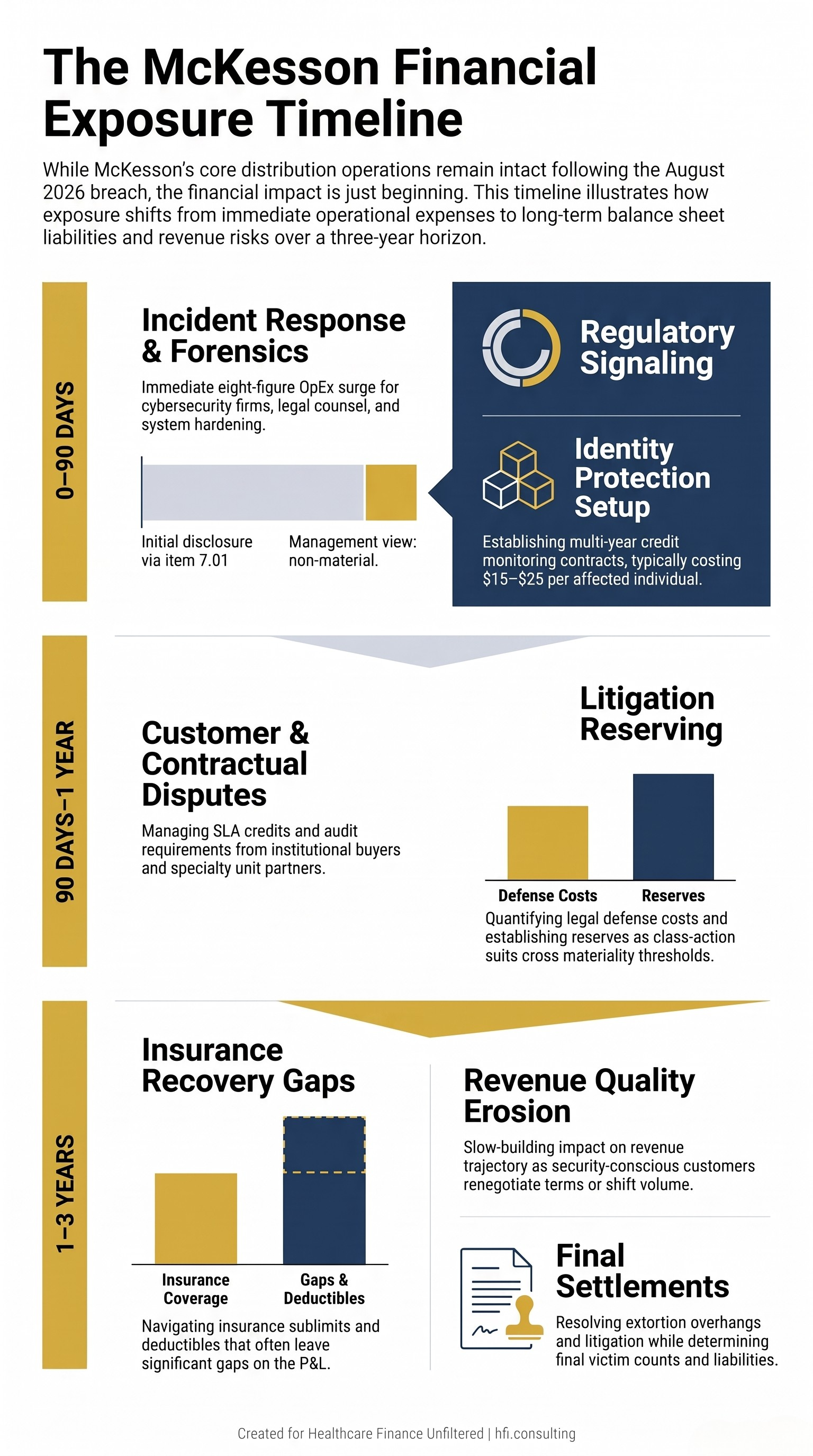
Three-phase cost timeline showing how McKesson's cyberattack financial exposure unfolds across immediate, near-term, and long-term categories.
5. Extortion and Ransom Overhang
ShinyHunters reportedly demanded approximately $55 million in exchange for deleting the stolen data. McKesson has not confirmed receiving or responding to that demand. From a finance standpoint, management is navigating two scenarios simultaneously.
The first scenario: no payment, data released publicly, litigation and reputational cost increases. The second scenario: a negotiated resolution, potentially covered in part by cyber insurance, that closes the extortion exposure but does not eliminate the underlying legal and remediation costs.
Neither scenario appears as a booked liability in the current 8-K. Both scenarios have real dollar consequences that finance leaders at McKesson, and at organizations with analogous vendor concentration, should be modeling.
6. Insurance Recovery, Deductibles, and Disclosure Timing
Cyber insurance typically covers forensics, breach notification, credit monitoring, and some legal costs. It rarely covers all of them. And coverage limits, sublimits, and deductibles create gaps that land directly on the income statement.
The more significant finance question here is the disclosure trajectory. McKesson filed under Item 7.01. If later facts cross the materiality threshold (confirmed victim count, confirmed ransom outcome, quantified customer contract liability), the company will need to refile under Item 1.05 and provide a quantified impact estimate.
CFOs watching peer companies' breach disclosures should track this carefully. The gap between "not material" and "material" is not always obvious from outside, but the transition in filing type is a clear signal. Watch for it in McKesson's next quarterly filings.
7. Specialty Unit Revenue and Customer Retention Risk
This is not a one-time P&L line. It is a slow-building revenue quality question. If oncology and medical-surgical customers, who often have specific security compliance requirements, respond to this breach by tightening contract terms, demanding additional audit rights, or shifting purchasing volume, the impact shows up in revenue trajectory rather than a single charge.
This is the financial impact that is hardest to model in advance and easiest to underestimate. It does not appear in a reserve or an accrual. It appears in next year's revenue line.
What This Means If You Are a CFO on the Provider Side
If your health system or ASC purchases through McKesson's Oncology and Multispecialty or Medical-Surgical units, you have three immediate finance actions.
First, pull your vendor contract and read the breach notification provisions, the liability cap, and the data security addendum. If your contract does not include a cyber incident SLA with defined remediation timelines, you have a gap that should be addressed in the next renewal cycle.
Second, assess whether your organization has any PHI co-mingled in the affected data flows. McKesson supplies and distributes across deeply integrated ordering and distribution systems. If your patients' data passed through affected third-party applications, your HIPAA breach notification obligations may be triggered independently of McKesson's own notification process.
Third, review your own cyber insurance coverage and check whether your policy covers downstream liability from a vendor breach. Many healthcare organizations have coverage for direct breaches but limited coverage for third-party vendor incidents. That gap is common and expensive.
For context on what vendor breach liability looked like at a smaller but structurally similar incident, the CareCloud breach earlier this year illustrates exactly how third-party exposure lands on the CFO's desk before the vendor has finished its own investigation. That analysis is in this CareCloud article..
What This Means If You Are a CFO on the Payer Side
If your plan contracts with McKesson for specialty drug distribution or relies on McKesson's data infrastructure for formulary management and specialty pharmacy fulfillment, your exposure differs from the provider side but is not smaller.
Specialty pharmacy data for oncology members is among the most sensitive PHI in your plan's data ecosystem. If ShinyHunters' claimed data types (prescription records, predictive health data, medical diagnoses) are confirmed at scale, your member-facing obligations under HIPAA may be triggered. So may your state-level breach notification requirements, which vary and in some cases are more stringent than federal standards.
From my time in payer operations, the pattern I watched repeatedly was this: payers were often the last to know when a distribution or pharmacy vendor had a data incident, because the first notification path ran from the vendor to the provider, not directly to the plan. Check your vendor agreements to confirm McKesson's notification obligation runs directly to your plan, not only through the provider channel.
The second payer concern is formulary continuity. McKesson's distribution network has stayed operational. But if customer trust in the specialty units erodes or contract disputes create supply chain friction, your specialty drug access commitments to members may be affected. Model that scenario now, before it becomes a member access complaint.
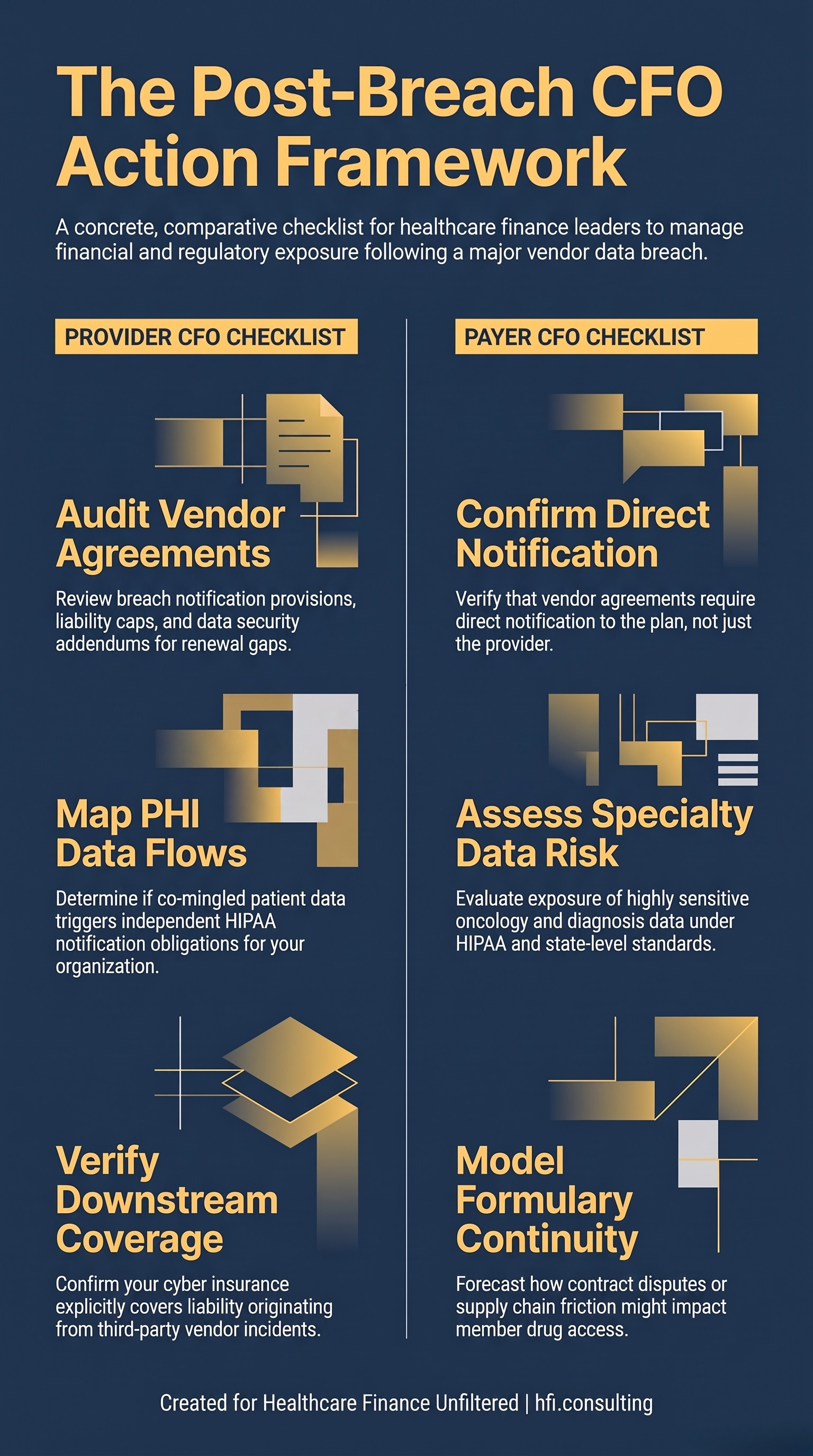
Two-column CFO action checklist comparing immediate response priorities for provider-side and payer-side healthcare finance leaders following the McKesson breach.
The Bigger Pattern: Embedded Intermediaries and Concentrated Financial Risk
The Change Healthcare attack in 2024 was described by AHA's deputy national adviser for cybersecurity Scott Gee as a "single point of failure" because of its share of billing and insurance transaction processing. McKesson occupies a different but structurally analogous position. The company makes approximately 40,000 deliveries daily to nearly every type of care site in the country. That reach is what makes its data ecosystem so large, and what makes a breach at this depth so financially consequential even when operations stay up.
The McKesson incident is not Change Healthcare. The operational collapse did not happen here. But both events are teaching the same lesson: when a vendor is deeply embedded across the industry, a data theft event at that vendor is not a single company's problem. It is a distributed financial risk that lands on every CFO table in the affected network.
Your EHR vendor, your clearinghouse, your specialty pharmacy distributor, your prior authorization platform: each of them sits in an analogous position. The legal liability framework for what happens when any of them is breached is still being built in real time through litigation like the Epic interoperability cases and settlements like the CareCloud incident. That landscape is analyzed in depth at Epic Ransomware article.
The question is not whether your vendor network contains this kind of concentration risk. It does. The question is whether your contracts, your insurance coverage, and your downtime procedures are built to manage the financial exposure when a breach hits.
If you want a structured framework for auditing your vendor contracts for cyber incident liability provisions and building a breach financial reserve model, that is exactly the kind of project HFI Consulting supports. Start the conversation at hfi.consulting.
The CFO Bottom Line
McKesson is managing this as a contained operational incident with an unresolved financial tail. That framing is probably accurate for Q3 earnings. It may not hold through Q4 if the victim count is confirmed at scale, litigation advances, or a ransom resolution requires disclosure.
The finance story here is not a write-down. Not yet. It is cost containment and liability management across seven cost categories that will play out over the next 12 to 36 months. Every CFO in McKesson's customer network has a version of this story playing out in their own vendor portfolio.
The ones who read their contracts now, model the scenarios now, and close the insurance gaps now will have better options when it is their vendor that makes the headlines.
A comprehensive cybersecurity financial planning framework for healthcare CFOs, including budget modeling, vendor contract provisions, and insurance gap analysis, is at Healthcare Cybersecurity.
P.S. CFOs and finance leaders: does your current cyber insurance policy explicitly cover downstream liability from a third-party vendor breach, or only direct breaches of your own systems? Hit reply and tell me. I am tracking this for a follow-up piece on the insurance gap in healthcare vendor risk.
