
Bookkeeping for Medical Practices: What Your CPA Wishes You Knew Before You Walked In the Door
The financial foundation every independent practice needs, from day one setup to year-end cleanup and the analysis in between.
Tax season is when the truth comes out. Every year, medical practices hand their CPA a shoebox of records, or worse, a QuickBooks file with years of workarounds baked in, and wonder why the process takes so long and costs so much. The answer is almost always the same: the books were not built for a medical practice. They were built for a generic small business, and healthcare is not a generic business.
If you are opening a new practice, cleaning up years of financial disorganization, or trying to get ahead of your next filing, this article is for you.
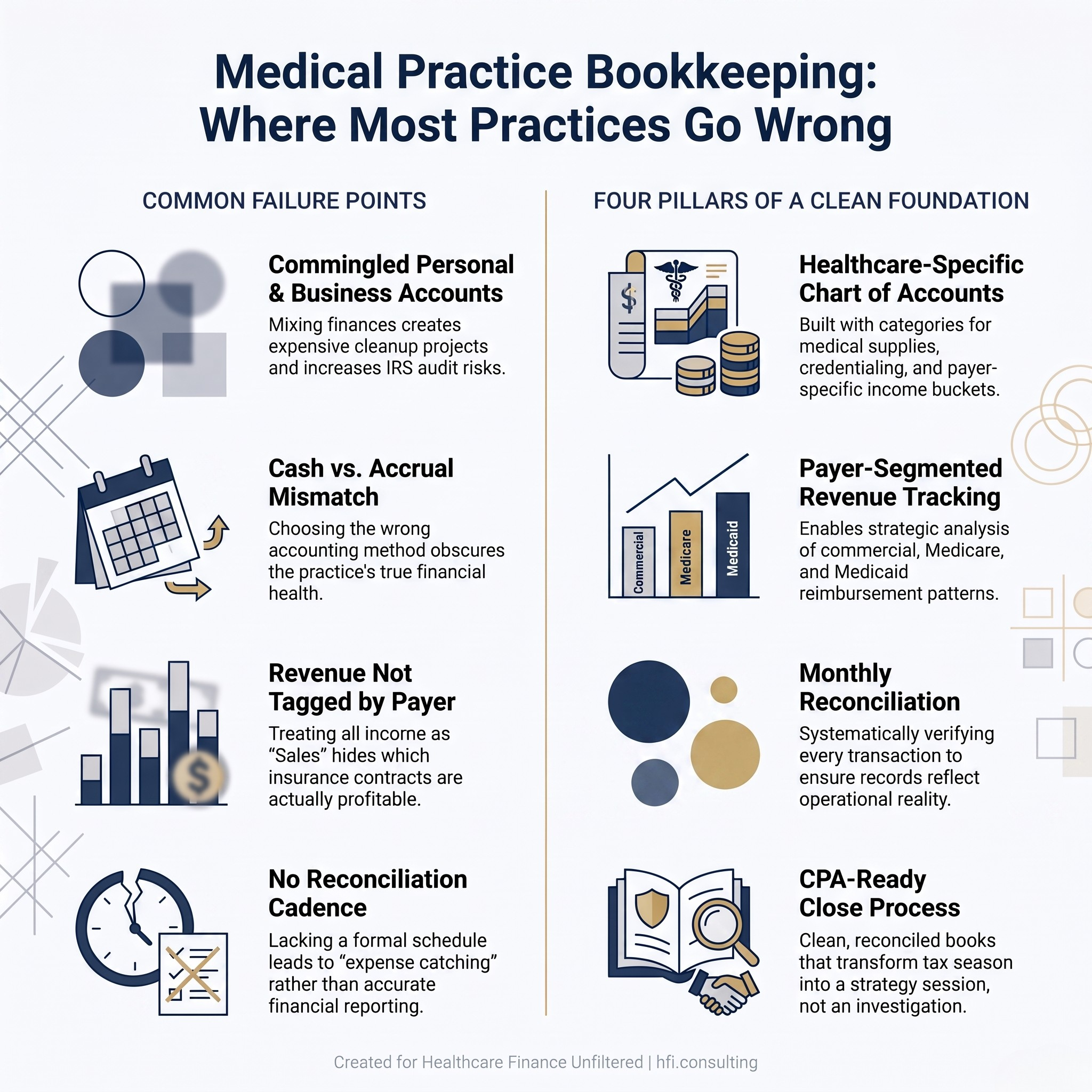
Infographic showing four common bookkeeping failure points in medical practices and the four pillars of a clean financial foundation
Why Medical Practice Bookkeeping Is Not Like Any Other Business
Most small business bookkeeping advice does not apply to healthcare. A restaurant owner tracks meals sold. A law firm tracks billable hours. A medical practice tracks insurance reimbursements that may arrive 30 to 90 days after the encounter, patient copays collected at the front desk, adjustments mandated by payer contracts, write-offs required by Medicare rules, and HIPAA-adjacent financial record requirements that no general-purpose accounting software anticipates by default.
That complexity is not an edge case. It is the operating model.
When I managed financial operations across seven hospitals at Ascension, the chart of accounts alone required ongoing maintenance to stay aligned with how payers categorized payments. A commercial insurer, a Medicare plan, and a Medicaid managed care organization can all pay for the same CPT code at different rates, on different schedules, and with different denial patterns. If your books treat all of that as undifferentiated revenue, you will never know where the money is actually coming from or where it is leaking out.
Independent practices face the same complexity at a smaller scale with fewer people to manage it.
Setting Up the Books Right: What New Practices Get Wrong
The most expensive bookkeeping mistake is the one made on day one: treating the practice like a sole proprietorship personal expense account.
If you are launching a new practice, the financial infrastructure needs to exist before you see a single patient. That means a dedicated business checking account, a separate business credit card, and a chart of accounts that reflects how medical revenue actually flows. It does not mean downloading a generic QuickBooks template and mapping your income as "Sales."
The chart of accounts is the foundation. For a medical practice, that means separate income categories for each major payer type: commercial insurance, Medicare, Medicaid, self-pay, and any ancillary revenue streams such as telehealth, in-office labs, or cash-pay services. On the expense side, it means categories for clinical supplies, medical waste disposal, licensing and credentialing fees, malpractice insurance, and billing service costs. These do not exist in a standard small business template.
The accounting method choice has real consequences. Cash basis accounting records revenue when you receive the check or EFT. Accrual basis records revenue when the service is rendered, even if payment arrives months later. For most independent practices with straightforward payer mixes, cash basis is simpler and easier to maintain. For practices that carry significant accounts receivable, work with multiple payers on different payment cycles, or are planning to seek a loan or bring in an investor, accrual basis gives a more accurate financial picture. Get this decision right before you file your first return, not after.
Separate your finances before you see your first patient. Personal and business expenses mixed together are the single most common problem I encounter when a practice owner comes looking for a financial cleanup. Reconstructing two or three years of commingled transactions is expensive in both time and accounting fees. The IRS does not look favorably on it either.
The HIPAA Factor: Why Your Financial Records Have Compliance Implications
Most practice owners think of HIPAA in clinical terms. But financial records in a medical practice often carry protected health information by default.
An explanation of benefits tied to a specific patient encounter, a payment record linked to a diagnosis code, a billing dispute file that includes clinical notes. All of these may contain PHI. The accounting system that holds this data, and the people who have access to it, need to be part of your HIPAA compliance framework.
This is one of the most overlooked differences between bookkeeping for a medical practice and bookkeeping for a restaurant or law firm. Your financial software needs access controls. Your bookkeeper, whether in-house or outsourced, needs to be covered under a Business Associate Agreement. Your record retention policy for financial documents needs to align with your HIPAA retention requirements, not just IRS rules.
If you are using a general-purpose bookkeeper or a firm that does not have healthcare experience, these gaps are often invisible until they are not.
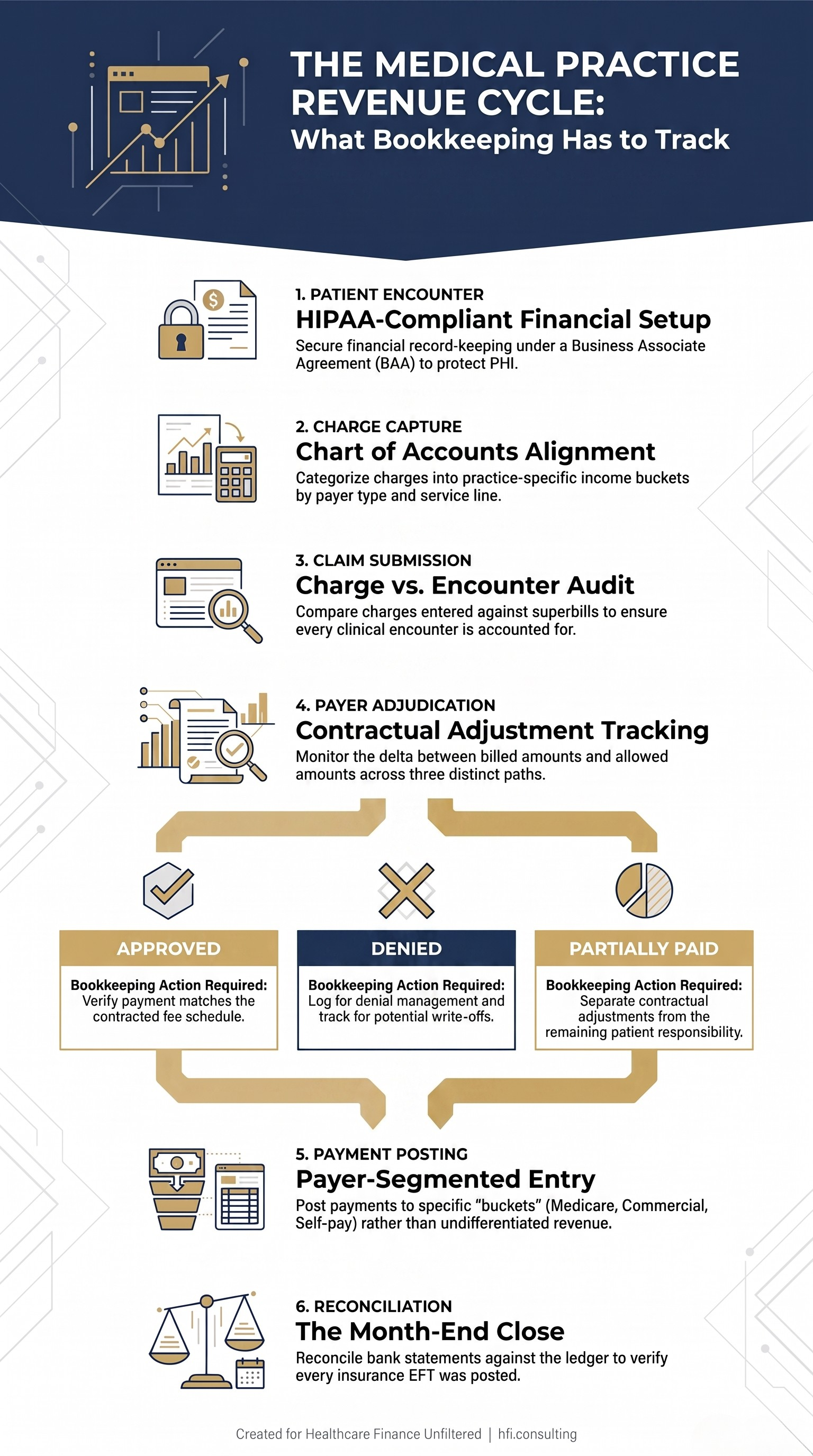
Diagram of the medical practice revenue cycle showing the bookkeeping action required at each stage from patient encounter through payment reconciliation.
Revenue Tracking: The Payer Mix Problem Most Small Practices Ignore
Here is where independent practice bookkeeping diverges most sharply from generic business accounting: revenue is not revenue.
A $150 office visit billed under a commercial insurance plan may generate a $95 payment. The same visit billed under Medicare may generate $72. A Medicaid managed care plan may generate $54. A self-pay patient who owes $150 may pay $25, pay nothing, or pay on a 12-month installment plan. Every one of those scenarios needs to land in a different bucket if you want to understand the financial health of your practice.
Payer-segmented revenue tracking tells you which payers are profitable, which payer contracts need to be renegotiated, and where your collection rate is below acceptable. Without it, you are looking at total revenue as if all patients are the same. They are not.
This is especially critical for practices that are considering whether to accept or drop a specific payer, negotiate contract rates, or evaluate whether adding a service line makes financial sense. The analysis depends entirely on having clean, segmented revenue data.
I have seen practices where the owner was certain they were making money on Medicare patients because their total revenue looked healthy. When we broke the revenue down by payer and subtracted the actual cost of delivering those visits, including the administrative overhead of billing Medicare, they were underwater on every Medicare encounter. That is not a billing problem. It is a bookkeeping problem that was hiding a strategic problem.
For a detailed look at how revenue cycle management intersects with payer strategy in independent practices, the framework in Medical Group Revenue Cycle: CFO and Director Strategies for the High-Deductible Patient Era applies directly to small practices even though it is framed for larger medical groups.
Accounts Receivable: The Number That Tells You Everything
Days in Accounts Receivable is the single most important financial metric for an independent medical practice. It tells you how long you are waiting, on average, to get paid for services you have already delivered.
A healthy A/R for most practices falls between 30 and 45 days. When that number climbs above 60, you have a cash flow problem in the making. When it climbs above 90, you have a collections and billing operations problem that is affecting your ability to pay your own bills.
The A/R aging report should be reviewed monthly, at minimum. It needs to be broken down by payer so you can see which insurance companies are paying slowly and which patient balances are becoming uncollectible. An overall A/R number that looks acceptable can mask a serious problem with one or two payers if you are not looking at the breakout.
The front office plays a bigger role in this number than most practice owners realize. Eligibility verification errors, registration mistakes, and missing prior authorizations all create denials that inflate your A/R. When the Front Office Fails: What Medical Practice Inefficiency Really Costs Patients and CFOs documents the direct financial cost of upstream administrative failures. The bookkeeping catches these failures after the fact. Prevention requires looking at the operational source.
The Month-End Close: What It Is and Why It Matters
Most independent practices do not have a formal month-end close process. They have a bookkeeper who posts transactions when they have time and reconciles bank statements before tax season. That is not a close process. It is expense catching.
A real month-end close is a systematic set of steps performed on a defined schedule to verify that every financial transaction for the month has been accurately recorded, categorized, and reconciled. For a medical practice, that includes:
Bank and credit card reconciliation against your accounting records
Verification that all insurance payments received have been posted against the correct claim and payer
Review of unposted payments and outstanding claims
Comparison of charges entered against superbills or encounter records
Payroll verification against hours worked and pay rates
Review of accounts payable for any open vendor invoices
This process is not glamorous. It is also not optional if you want financial statements that mean something.
The month-end close is also what makes your CPA's life manageable at year end. When every month has been closed cleanly, the tax prep process is a review, not an investigation. When months have been skipped or rushed, the tax prep process becomes a reconstruction project that costs you money and time and creates risk of error on your return.
Expense Management: What Deductions You Are Probably Missing
Medical practices have a broader set of deductible expenses than most small businesses, and a more specific set of IRS rules governing how those expenses are categorized and documented.
Common medical practice deductions that get missed or miscategorized include:
Medical equipment depreciation and Section 179 deductions for qualifying purchases
Malpractice insurance premiums
Continuing medical education costs, including travel and registration fees
Credentialing and licensure fees
HIPAA compliance costs, including software, training, and BAA administration
Medical waste disposal contracts
Clinical reference subscriptions and diagnostic tool licensing
The business use portion of a mobile phone used for patient communication and on-call coverage
The documentation requirement for all of these is real. The IRS wants receipts, but it also wants a clear paper trail connecting the expense to a business purpose. A bookkeeper who categories everything as "Office Expense" is not helping you capture these deductions. A healthcare-experienced bookkeeper who maintains a proper chart of accounts will code each expense correctly as it is incurred, making the documentation trail automatic.
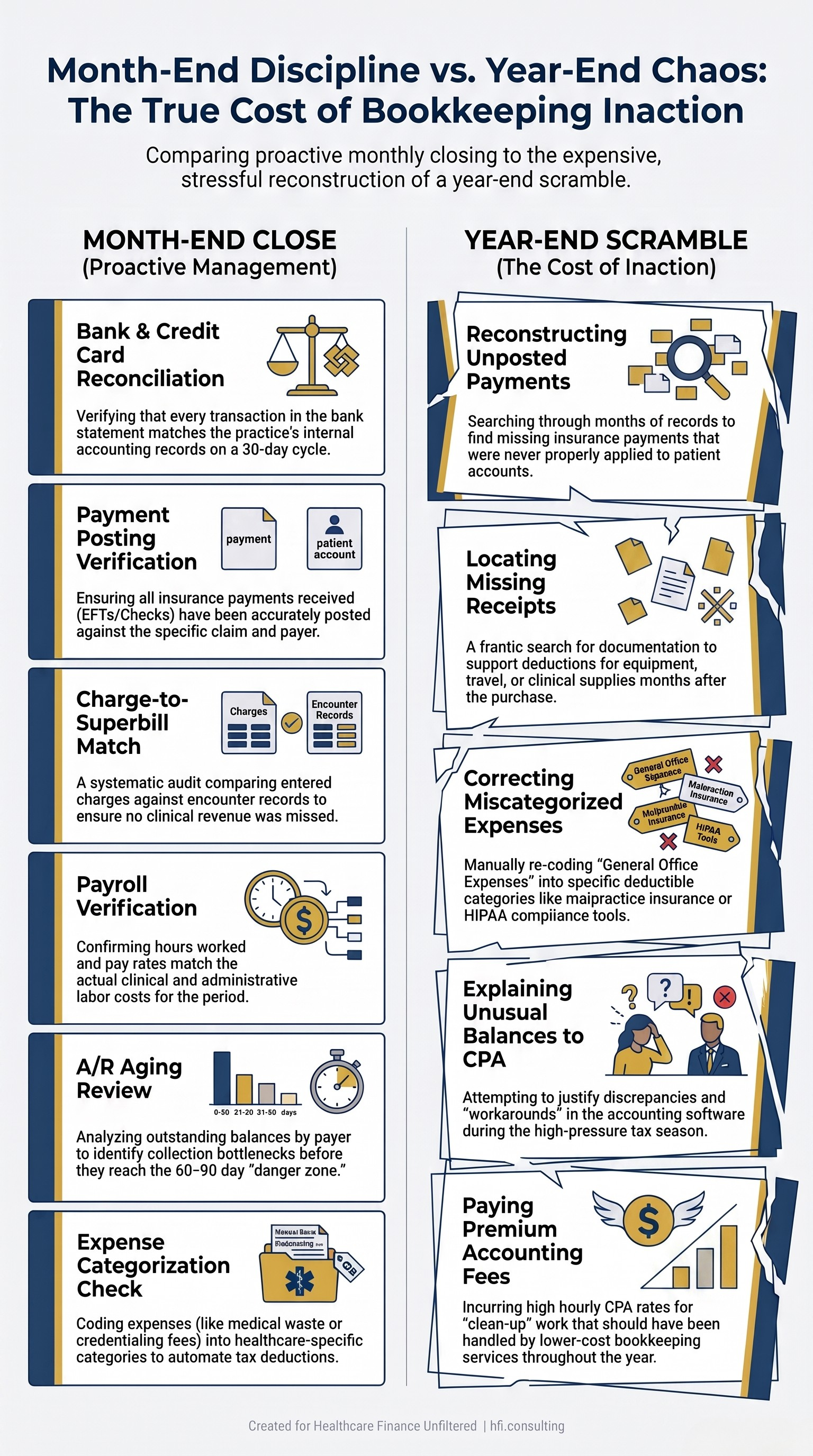
Side-by-side comparison showing the tasks of a monthly close process versus the chaotic year-end scramble that results from skipping it.
Getting Ready for Your CPA: What Clean Books Actually Look Like
Your CPA is not a bookkeeper. That distinction matters more than most practice owners realize.
A CPA reviews your financial records, advises on tax strategy, prepares your return, and signs off on the accuracy of the filing. They are not paid to sort through 12 months of uncategorized expenses or reconcile two years of commingled transactions. When they have to do that work, they bill for it at rates that far exceed what good bookkeeping services cost.
The practice owners who get the most value from their CPA relationship show up with clean books. That means:
Bank and credit card accounts reconciled through December 31
All income categorized by payer type and properly coded
All expenses categorized using the practice-specific chart of accounts
Payroll records reconciled and W-2s ready
A list of major asset purchases from the year with the acquisition date, cost, and expected useful life
Any loans or lines of credit with current balance and interest paid
A clean aging receivables report
When a practice arrives at the CPA's office with this documentation in order, the tax strategy conversation can happen at the beginning of the meeting instead of the end. Depreciation elections, retirement contribution optimization, S-corp distribution strategy: all of these decisions require accurate underlying numbers to execute correctly.
The Technology Question: Software Tools and Their Limits
QuickBooks Online is the most common bookkeeping platform for independent medical practices. It is functional, widely supported by CPAs, and capable of handling the complexity of medical practice accounting when set up correctly.
The setup is the critical word. A default QuickBooks configuration is not a healthcare configuration. The chart of accounts needs to be customized. The class or location tracking features need to be enabled if you are managing multiple providers or locations. Bank feeds need to be connected and monitored. The system does not automatically know the difference between a Medicare payment and a commercial insurance payment.
Some practices opt for specialty practice management software that includes billing and financial reporting. These systems can reduce double data entry and improve the connection between your clinical and financial records. They also introduce their own complexity: if the financial module is not integrated with your general ledger correctly, you may end up with records that look reconciled but are not.
Regardless of the platform you use, the software is a tool. It does not replace the judgment of someone who understands how medical practice revenue flows and what the numbers should look like.
Payment Reconciliation for Small Medical Practices: The Automation Gap That Is Quietly Draining Your Revenue documents exactly where technology alone falls short and where the human oversight layer is not optional.
The Financial Analysis Layer: Beyond Basic Bookkeeping
Clean books are the starting point. The real value of having accurate financial records is what you can do with them.
A practice with well-maintained books can answer questions that drive strategic decisions. Which service lines generate the best margin per encounter? What is the actual cost of adding a provider, including credentialing, benefits, and the ramp time before they reach full productivity? How much of your revenue depends on your two highest-volume payers, and what is your exposure if either of those contracts changes?
These are not hypothetical questions. They are the questions that determine whether your practice grows, plateaus, or finds itself in a financial crisis it did not see coming.
The key metrics every practice should track monthly include:
Net collection rate: What percentage of your adjusted charges (after contractual allowances) did you actually collect? A healthy target is 95% or above.
Days in A/R: Target 30 to 45 days. Trend matters as much as the current number.
Clean claim rate: What percentage of your claims are accepted on the first submission? Target 95% or higher. Below 90% means your billing process has a systematic problem.
Revenue per encounter by payer: This tells you which payers are worth the administrative overhead of participating.
Overhead ratio: What percentage of your revenue is consumed by operating expenses, excluding provider compensation? Most practices target 40 to 60 percent depending on specialty and overhead structure.
Tracking these numbers monthly requires that the underlying bookkeeping be accurate. You cannot calculate a meaningful net collection rate if your revenue posting is three months behind. You cannot identify a deteriorating A/R trend if your reconciliation happens once a year.
If your practice books are not where they need to be, whether that means setting up a proper chart of accounts, cleaning up years of disorganization, or building the monthly reporting infrastructure your CPA keeps asking for, HFI Consulting works directly with independent practice owners and administrators on exactly this.
You do not need to come in with everything figured out. You just need to be ready to build a financial foundation that actually supports your practice.
Visit hfi.consulting to learn more or reach out directly.
When to Bring in Outside Help: A Honest Assessment
Every practice reaches a point where the owner or practice manager is spending more time on financial administration than the work is worth in dollars per hour. That point usually arrives earlier than people expect.
The triggers worth paying attention to include: tax prep fees that keep climbing because the CPA has to clean up the books first; cash flow problems that appear without warning; denial rates that seem high but no one can trace to a root cause; and the general sense that the numbers do not reflect what the practice feels like operationally.
For some practices, the answer is a part-time bookkeeper with healthcare experience who can maintain the accounts on an ongoing basis. For others, the answer is outsourced bookkeeping that covers both the day-to-day posting and the monthly close. The article Remote Bookkeeping for Independent Medical Practices breaks down the cost comparison and what to look for when evaluating an outside provider.
The important distinction is healthcare experience. A general bookkeeper who has never seen a remittance advice, does not know what a contractual adjustment is, and has never built a payer-segmented revenue report is going to create as many problems as they solve. This is one area where domain expertise is not a nice-to-have. It is the whole point.
The Bottom Line: Bookkeeping as Clinical Infrastructure
Physicians spend years learning to read a patient chart. The financial chart of your practice deserves the same discipline.
Clean books protect you during an audit. They make your CPA relationship more valuable and less expensive. They give you the information you need to make decisions about hiring, payer contracts, service lines, and growth. And they are the foundation of every meaningful financial analysis your practice will ever need.
The practices that struggle financially are almost never struggling because they lack clinical skill. They are struggling because the financial infrastructure was never built correctly, and by the time the problem is visible, it has been compounding for years.
Build it right, maintain it monthly, and review it with intention. That is not accounting advice. It is practice management.
If you are a practice owner or administrator ready to get your financial foundation right, HFI Consulting can help you design the bookkeeping framework, clean up existing records, and build the reporting infrastructure that supports real financial decisions. Visit hfi.consulting to start the conversation.
P.S. What is the single biggest bookkeeping or financial administration challenge you are dealing with in your practice right now? Is it the year-end cleanup, understanding your payer mix profitability, or something else entirely? Hit reply and tell me. I read every response, and the patterns help me decide what to write next.
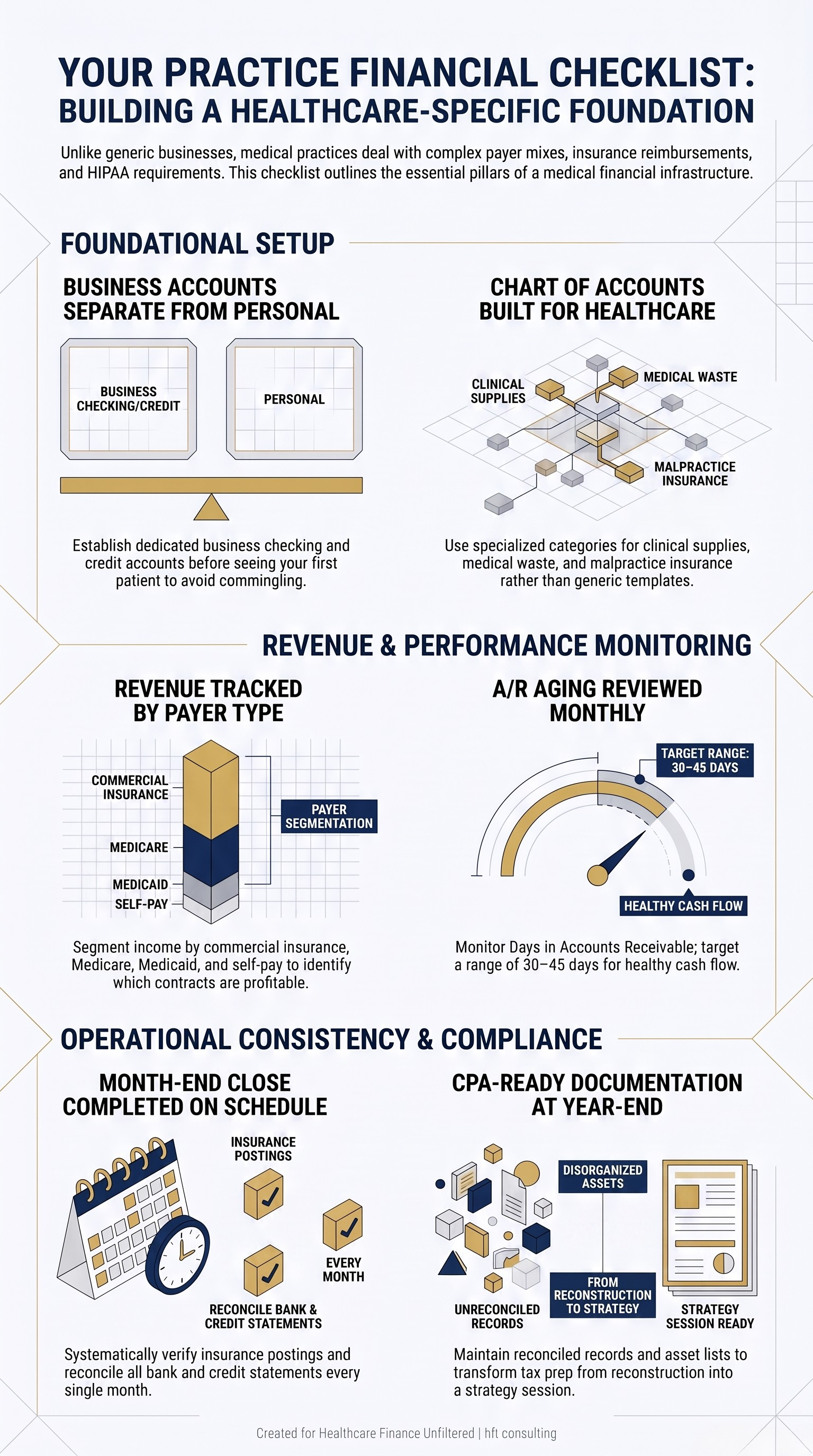
Medical practice financial checklist showing six essential bookkeeping steps from account separation through year-end CPA preparation
