
There Is No Single Path to the Healthcare CFO Chair. These Women Prove It.
Three recent CFO appointments reveal what actually builds a healthcare finance career — and it is not what most people assume.
If you have spent any time in healthcare finance, you have probably constructed a mental picture of what a CFO career is supposed to look like. A straight line upward through progressively larger organizations, ideally with a prestigious system name or two along the way. A controller role somewhere in the middle. A VP title before 40. Maybe a CPA before the MHA or MBA.
That picture is not wrong exactly. But it is incomplete. And for women early in their healthcare finance careers, that incomplete picture has a way of becoming a quiet source of anxiety, a measuring stick that makes a perfectly solid career trajectory feel like it is somehow behind schedule.
Three CFO appointments from August 2026 tell a different story. And it is worth paying attention to.
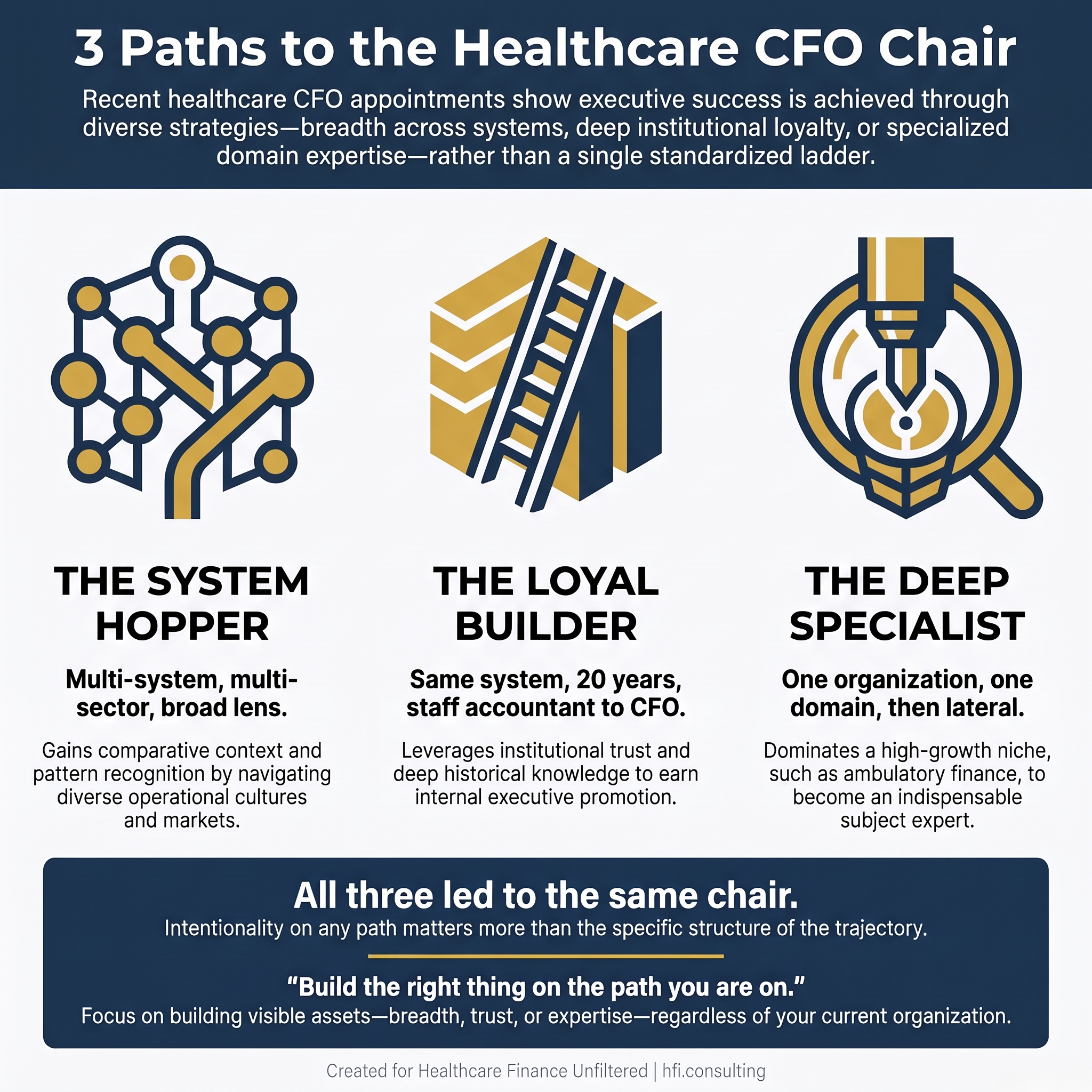
Infographic showing three distinct career path archetypes for women in healthcare finance, each leading to the CFO chair through a different route.
Three Women. Three Paths. One Title.
In early August, Becker's Hospital Review reported a cluster of CFO appointments worth reading together rather than separately.
Patty Allen was named CFO of Rockford, Illinois-based Mercyhealth. She came in with more than 20 years of healthcare financial leadership experience, having served as market CFO at UnityPoint Health and CFO for care delivery at Hospital Sisters Health System. Two large multi-site systems, two distinct market contexts, a career built on breadth across organizations.
Erin Gerner was appointed vice president and CFO of the physician and ambulatory division at Clearwater, Florida-based BayCare Health System. She spent 13 years at Oklahoma City-based Integris Health, moving from accounting manager to CFO of the Integris Medical Group and eventually to CFO of Integris' acute care facilities in the Oklahoma City metro. Before BayCare, she served as CFO of ambulatory services at PeaceHealth. Deep functional expertise within one organization, then a deliberate lateral move into a specialized division at a larger system.
Trista Mullin was promoted to CFO of Lowville, New York-based Lewis County Health System. She began her career at Lewis County more than 20 years ago as a staff accountant and most recently served as controller, overseeing finance, purchasing, accounts payable, and materials management. She did not leave to prove herself somewhere else. She built her credibility in place, and the organization recognized it.
Three women. Three entirely different career architectures. All arriving at the same destination in the same month.
Path One: The System Hopper
Patty Allen's career is the one most younger finance professionals picture when they think about building toward a CFO role. Move between organizations. Accumulate breadth. Build a network that spans systems and markets. Arrive at each new role with a wider lens than the person before you.
This path has real advantages. Multi-system experience gives you pattern recognition that is genuinely hard to develop any other way. When you have managed budgets across two or three different operational cultures, you stop assuming that the way your current organization does things is the only way. You bring comparative context to every conversation, and that context tends to be visible to leadership.
The system hopper path also builds a professional network that compounds over time. Every organization you leave becomes a source of future referrals, collaborators, and advocates. The CFO you worked under at one system may be the board member who hears your name at the next one.
The risk in this path is the perception of instability, particularly for women, who are sometimes held to a different standard when it comes to organizational loyalty. The counter to that perception is intentionality. Allen's career shows deliberate progression, not restlessness. Each move expanded the scope or complexity of the role. That distinction matters when someone is reading your resume.
From my own experience moving between Baptist Health, UF Health, McKesson, Ascension, and Florida Blue, the multi-system path builds something that stays with you regardless of where you land next: the ability to read a new organization quickly, identify where the real financial risk lives, and build credibility with leadership who did not hire you because they already knew you. That skill is harder to develop than most finance training programs suggest.
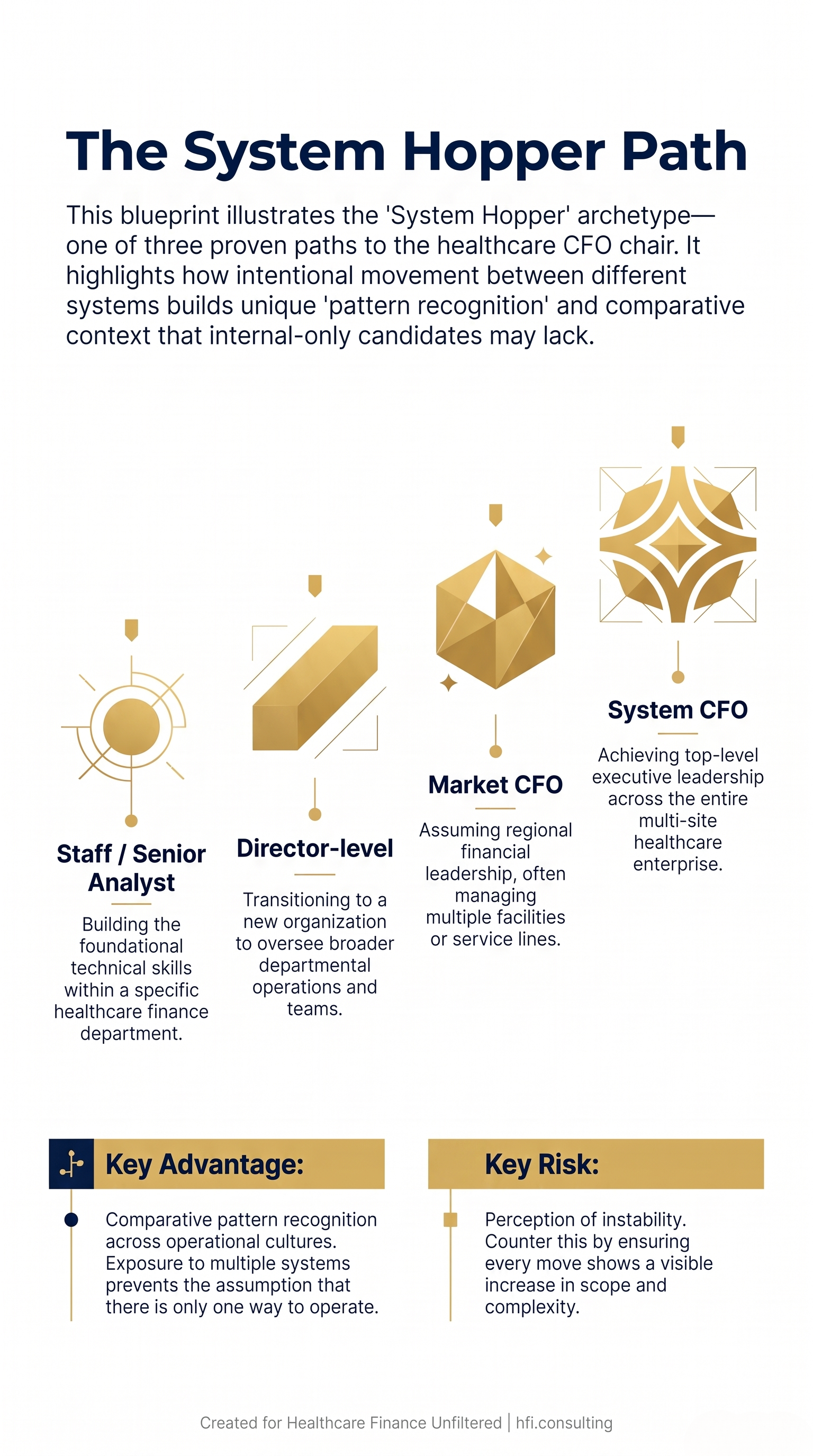
Career timeline diagram showing the system hopper path to healthcare CFO, with multiple organizational stops and increasing scope at each transition.
Path Two: The Loyal Builder
Trista Mullin's path is the one that gets the least credit in career development conversations, and it deserves more.
Twenty years at one organization. Starting as a staff accountant. Building through the controller role. Being promoted to CFO when the person above her moved up to CEO.
This is not a story about someone who could not find opportunities elsewhere. It is a story about someone who understood that depth has value, that institutional knowledge is a competitive advantage, and that trust built over two decades is an asset that does not transfer when you change organizations.
The loyal builder path works when a few specific conditions are in place. The organization has to be one that actually promotes from within rather than defaulting to external hires for senior roles. The finance leader above you has to be someone worth learning from and someone who will advocate for you when the time comes. And you have to be willing to take on visible, high-stakes work inside the organization rather than staying in a lane that feels comfortable but does not build the track record that earns a CFO appointment.
Mullin's trajectory through finance, purchasing, accounts payable, and materials management suggests she did exactly that. She did not wait for the organization to hand her a CFO-shaped career. She built one from the inside.
For women who are three, five, or eight years into a tenure at one organization and wondering whether they should leave to prove something, Mullin's appointment is worth sitting with. The question is not whether you have been somewhere long enough. The question is whether you have been doing the right work while you were there.
Path Three: The Deep Specialist
Erin Gerner's path is the most nuanced of the three, and in some ways the most instructive for where healthcare finance is heading.
Thirteen years at Integris Health. Not thirteen years in the same role, but thirteen years of progressive depth within one organization, moving from accounting manager to medical group CFO to acute care CFO across a metro market. Then a move to PeaceHealth to lead ambulatory services finance. Then to BayCare to run the physician and ambulatory division.
What Gerner built was not just organizational tenure. She built domain expertise in a specific and increasingly valuable corner of healthcare finance: the physician enterprise and ambulatory environment. That is a space that has grown dramatically in financial complexity over the past decade as health systems have acquired physician groups, built out ambulatory surgery centers, and wrestled with the reimbursement dynamics that make outpatient finance categorically different from hospital finance.
The deep specialist path requires a strategic choice that not everyone makes explicitly: deciding early that you are going to own a domain rather than generalize across everything. That choice can feel limiting when you are in year four or five and watching colleagues move laterally into roles that seem broader. But when the market catches up to the domain you chose, the depth becomes the differentiator.
For women considering this path, the practical implication is deliberate. Pick a domain that is growing in complexity and strategic importance to health systems, whether that is ambulatory finance, population health finance, risk adjustment, or revenue cycle. Go deep. Build the credibility that makes you the person leadership calls when that domain becomes a problem they need to solve.
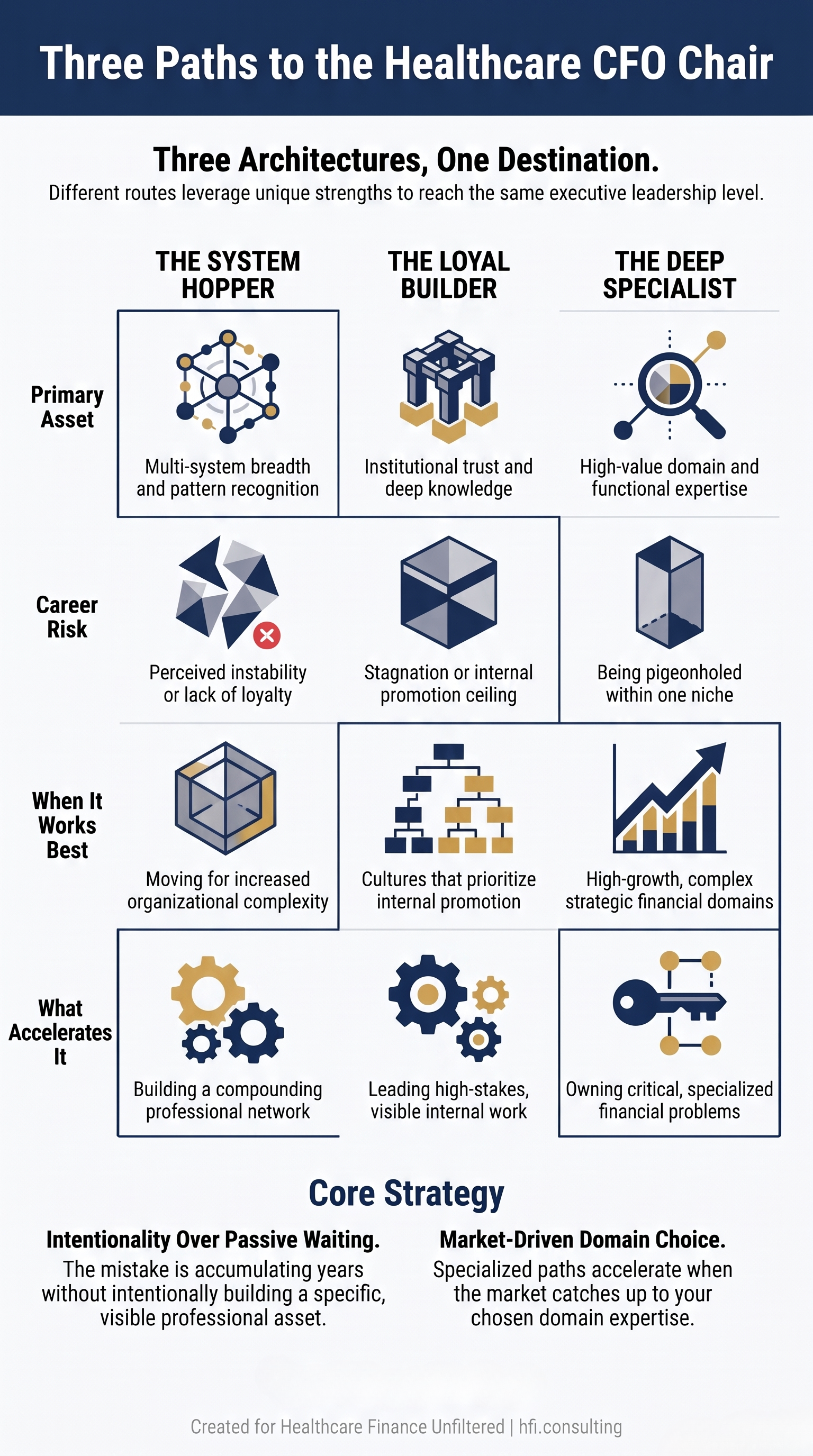
Three-column comparison table contrasting the System Hopper, Loyal Builder, and Deep Specialist career paths for women in healthcare finance, with key advantages, risks, and acceleration factors for each
What This Means for You
The myth worth busting is not that one of these paths is better than the others. It is that there is a single correct path at all.
Healthcare finance organizations need all three archetypes. They need CFOs who have seen five different systems and can benchmark without being asked. They need CFOs who know where the bodies are buried institutionally and can navigate internal politics with twenty years of relationship capital behind them. They need CFOs who own a domain so completely that no one else in the organization can see what they see.
The anxiety that drives younger women in healthcare finance to second-guess their trajectories usually comes from comparing their path to an imagined standard rather than to the actual range of paths that lead to senior roles. August 2026 gave us a clean data point: three women, appointed CFO in the same two-week window, via three routes that share almost nothing in common structurally.
If you are early in your career, the most useful question is not "am I on the right path" but "am I building the right thing on the path I am on." Allen built breadth and comparative context. Mullin built depth and institutional trust. Gerner built domain expertise and functional credibility. Each of those is a legitimate asset. The mistake is accumulating years without intentionally building any of them.
For a deeper look at the specific career moves that position women for senior finance roles, the earlier piece on Women Healthcare CFOs: The Career Moves Finance Leaders Need to Make on the Path to the C-Suite covers the foundational strategy in more detail.
A Note on the Current Job Market
There is one more thing worth naming, briefly.
The 2026 job market in healthcare has made a lot of finance professionals more risk-averse than they might otherwise be. Health system consolidation, CFO turnover, and margin pressure have created a climate where staying put feels safer than moving. That instinct is understandable, and for some people in some situations, it is the right call.
But risk-aversion has its own career cost. Staying in a role that is not building anything because the market feels uncertain is still a choice about how you spend your career years. Mullin, Allen, and Gerner each made active choices about how to spend their time and where to build their credibility. None of their paths looks like passive waiting.
The market will shift. The question is what you will have built by the time it does.
Building Your Own Case
Whether you are a system hopper, a loyal builder, or a deep specialist, the work is the same: make the asset you are building visible to the people who make promotion decisions.
That means taking on high-stakes, high-visibility work inside your current role rather than waiting for someone to offer it to you. It means building relationships with people who have the influence to say your name in rooms you are not in. It means being able to articulate, clearly and specifically, what you have built and why it matters.
The Bottom Line
There is no single path to the healthcare CFO chair. There is no standard timeline. There is no one credential, one system name, or one organizational tenure that guarantees arrival.
What the women appointed to CFO roles in August 2026 share is not a common career architecture. It is a common orientation: they each spent their careers building something specific, making it visible, and positioning themselves for the moment when the organization needed exactly what they had built.
That is the career strategy. The path is yours to choose.
P.S. Which of these three paths looks most like yours right now: the system hopper, the loyal builder, or the deep specialist? Hit reply and tell me. I am building a follow-up piece on what each path looks like in the first five years, and I want to hear from women who are living it.
Rachel Barksdale, MHA, CHFP, is a healthcare finance consultant and the founder of HFI Consulting.
