
ASC Financial Operations: The CFO Playbook for Surgical Volume Migration
When surgical cases move from hospital ORs to ASCs, the margin model changes completely. Here is what perioperative finance leaders must get right.
The migration of surgical cases from hospital inpatient ORs to Ambulatory Surgery Centers is no longer something CFOs can plan around as a future state. CMS and commercial payers accelerated this years ago. What is different now is the scale. The financial mechanics of an ASC are fundamentally different from anything the hospital accounting model prepares you for, and that gap is where margin disappears.
If your perioperative finance strategy still treats the ASC as a smaller version of the main OR, the leakage is already happening.
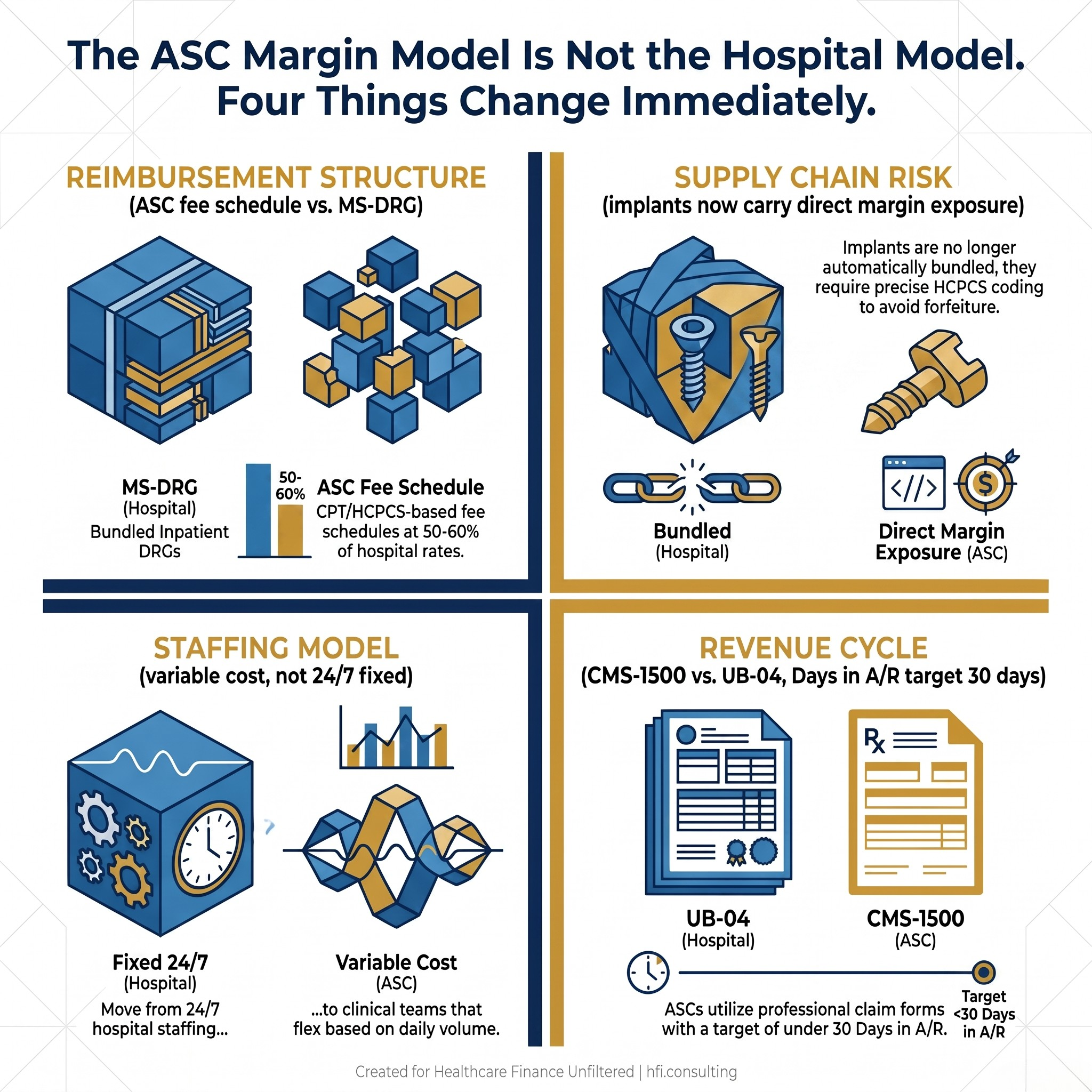
Establish immediately that this is a financial framework piece, not a clinical operations piece. Anchors the CFO reader in the four pillars before the article begins.
The Reimbursement Gap Is Not a Rounding Error
ASC facility reimbursement rates average 50 to 60 percent of Hospital Outpatient Department rates for identical CPT codes. That is not a minor discount. On a total knee arthroplasty, the reimbursement difference between an ASC and HOPD setting can exceed $3,000 per case before you even get to supply costs.
This is the foundational assumption behind every capacity and site-of-care decision. The ASC margin model only works when the cost structure moves with the volume. Throughput efficiency, predictable case duration, and supply chain discipline are not nice-to-have operational features. They are the entire financial model.
Here is where hospital finance training fails you in an ASC setting. Inpatient procedures are reimbursed under MS-DRGs via a UB-04 form. Single bundled payment. Implants get absorbed into the DRG weight. The billing team does not think much about them.
ASC claims go out on CMS-1500 forms using CPT and HCPCS Level II codes. High-cost devices require a separate invoice submission, correct HCPCS code, and payer-specific pass-through authorization. Miss any one of those steps and the facility absorbs the full device cost with zero reimbursement.
On a single total knee case with a $4,200 implant, a missing invoice or wrong HCPCS code reduces gross margin by more than $4,000. That turns a profitable procedure into a break-even or loss case after you layer in fixed overhead and staffing. I covered the full mechanics in Implant Costs Are a Contribution Margin Problem, Not a Billing Problem. The billing workflow is a margin protection function. Most billing teams don't treat it that way.
Capacity Strategy: What Volume Actually Tells You
The instinct in a volume-driven environment is to maximize case counts. In an ASC, that instinct needs real adjustment.
The metric that matters is contribution margin per OR minute, tracked by payer, procedure category, and surgeon. Not all high-volume procedures are high-margin. Not all shifted cases create financial accretion. I have watched health systems move cases into an ASC with legitimate excitement about the volume growth, then realize six months later that the case mix was wrong for the setting and the per-case economics were worse than projected.
The case mix discipline that defines ASC financial performance is non-negotiable. When Becker's recently asked perioperative executives how ambulatory shifts are affecting their strategy, the responses were consistent: ASCs work when patients are straightforward, surgeons are comfortable operating outside highly resourced quaternary centers, and procedures are reliable and predictable. The financial gains disappear quickly when that selection discipline breaks down. Stephen Estime at UChicago Medicine said it directly: the efficiency disappears when the selection discipline is less rigorous.
For health systems managing both a main OR and ASC capacity, the site-of-care decision is a margin question dressed as a scheduling question. Moving lower-acuity cases, uncomplicated total joints and straightforward scopes, out of the hospital main OR only makes financial sense if the freed capacity gets backfilled with higher-acuity, higher-margin tertiary and quaternary work. Complex spine, robotic oncology, multi-stage cardiac. If that backfill does not materialize, you have moved margin down without replacing it.
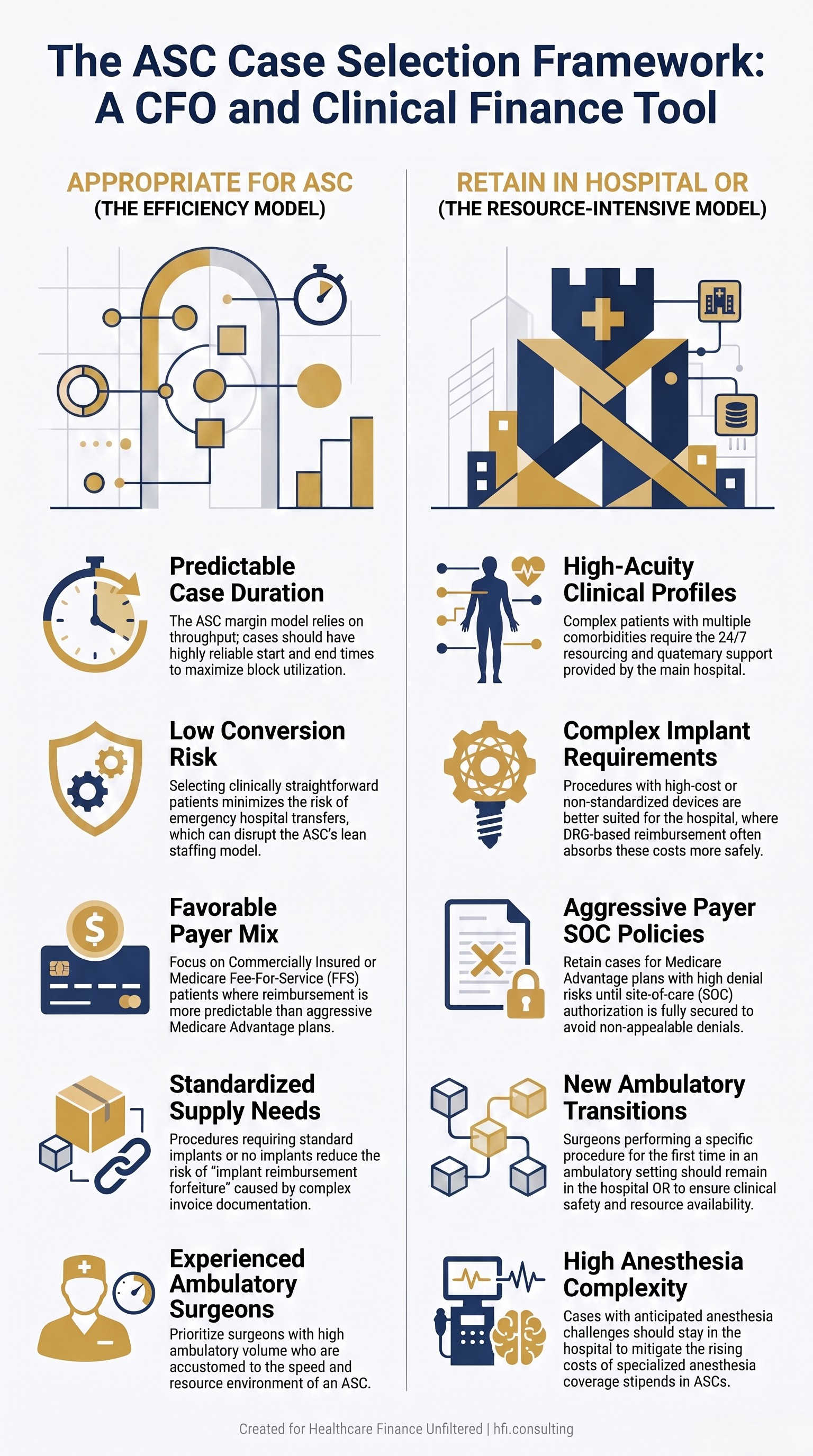
Give readers a reusable decision matrix that moves this article from analysis to operational tool.
Staffing Economics: The Model Has to Be Different
Labor is the largest variable expense in perioperative care. The hospital model is built around 24/7 fixed staffing: dedicated pre-op, intra-op, and PACU teams regardless of whether case volume on any given day supports that headcount. That model does not translate to a 6 a.m. to 6 p.m. ambulatory environment.
ASC financial efficiency runs on cross-trained clinical staff who flex against daily case flow. Non-productive hours are the primary labor cost driver in ambulatory settings that do not enforce block utilization discipline. The 75 to 80 percent auto-release threshold for surgeon block time exists precisely to prevent unused OR time from converting fixed overhead into margin erosion. If block utilization isn't being actively managed and enforced, the math falls apart.
The anesthesia problem deserves its own honest conversation. Nationwide shortages have made coverage stipends and subsidies one of the steepest growing cost centers in ambulatory surgery. This isn't evenly distributed. It concentrates in the specialty cases, orthopedics, spine, complex GI, where anesthesia time is longest and case complexity is highest.
Finance leaders building ASC pro formas need to model anesthesia on a per-case or per-operating-hour basis and build that reality into every payer contract renegotiation. A contract signed two or three years ago almost certainly underprices anesthesia coverage against the current market. That gap does not close on its own. It gets worse every renewal cycle where it goes unaddressed.
I managed financial operations across seven hospitals at Ascension. The supply chain and staffing conversations that actually moved the surgical margin needle were almost always physician-facing, not back-office. Getting surgeon preference card standardization right, getting anesthesia scheduling aligned with block time efficiency, getting physician buy-in on unblinded cost data. That is where the real money was. The billing system improvements mattered, but they were never the primary lever.
Physician Alignment: Equity Is a Finance Tool
Surgeons determine volume, supply utilization, and site-of-care decisions. They also hold the leverage in every ASC joint venture negotiation. That is not a soft observation. It is the structural reality that either works in your favor or against you depending on how the alignment is structured.
The three-way JV model, health system plus management or development company plus physician investors, is the dominant ASC ownership structure because it works. Physician equity distributions tied to EBITDA performance create an incentive structure that hospital employment agreements cannot replicate. The surgeon who owns a stake in the ASC has a financial reason to care about block utilization, turnover time, and preference card standardization. The surgeon who does not has much less reason to engage with any of those conversations.
For health systems evaluating ASC acquisitions or joint venture entry, physician alignment analysis belongs in the financial due diligence, not the clinical operations review. Volume commitments, referral arrangements, and case mix projections should be stress-tested before you sign an LOI. I covered the broader ASC acquisition picture in The Great Hospital Sell-Off and the physician enterprise finance considerations in Physician Enterprise Finance. Both are worth revisiting as volume migration accelerates.
The supply chain standardization payoff is where alignment earns its money most directly. Orthopedic and spine implants can represent 30 to 50 percent of total case cost in high-acuity ambulatory procedures. Getting surgeons aligned to standard, cap-priced vendor contracts is the single fastest way to widen contribution margin per case. That conversation is always difficult. The math behind it is not.
Revenue Cycle: Four Operational Failures That Create Immediate Margin Loss
The RCM mechanics in an ASC are not a simplified version of hospital billing. They are a different system with a different failure mode profile. If you bring hospital billing workflows into an ASC without redesigning them, you will learn that the hard way through your A/R aging report.
Pre-authorization and site-of-care enforcement is the first point of risk. Commercial payers and Medicare Advantage plans enforce SOC policies aggressively. Performing a procedure in an inpatient setting when it qualifies for ambulatory triggers a total denial for lack of medical necessity. ASCs face the inverse: billing for a procedure outside the CMS Covered Procedures List, or without explicit pre-authorization, produces non-appealable denials. The pre-auth workflow is not paperwork. It is the first revenue protection gate. Treating it as administrative overhead is how you generate clean claim submission failures.
Implant billing is the second and often the costliest failure mode. Three-way matching between purchase orders, clinical implant logs, and vendor invoices must happen before the claim drops. Not after. Not during the appeal. Before. The revenue leakage on a single high-cost orthopedic or spine case is not a recoverable amount if the appeal window closes.
Patient financial clearance is the third. ASCs handle elective, scheduled procedures. There is no ED buffer absorbing uncompensated care. Upfront financial clearance, verifying benefits, calculating exact patient liability, and collecting prior to or on date of service, is not a policy preference. It is a collections reality. Uncollected patient balances post-procedure carry collection costs that can approach or exceed the patient's own share of the reimbursement.
Days in A/R is the fourth metric that separates the well-run ASCs from the struggling ones. The industry benchmark is under 35 days. Clean claim submission rates should exceed 95 percent. A/R over 90 days should stay below 12 to 15 percent of total. These are not aspirational. If your ASC A/R profile is tracking toward HOPD norms, the failures are upstream, in the front end, and that is where you have to fix them.
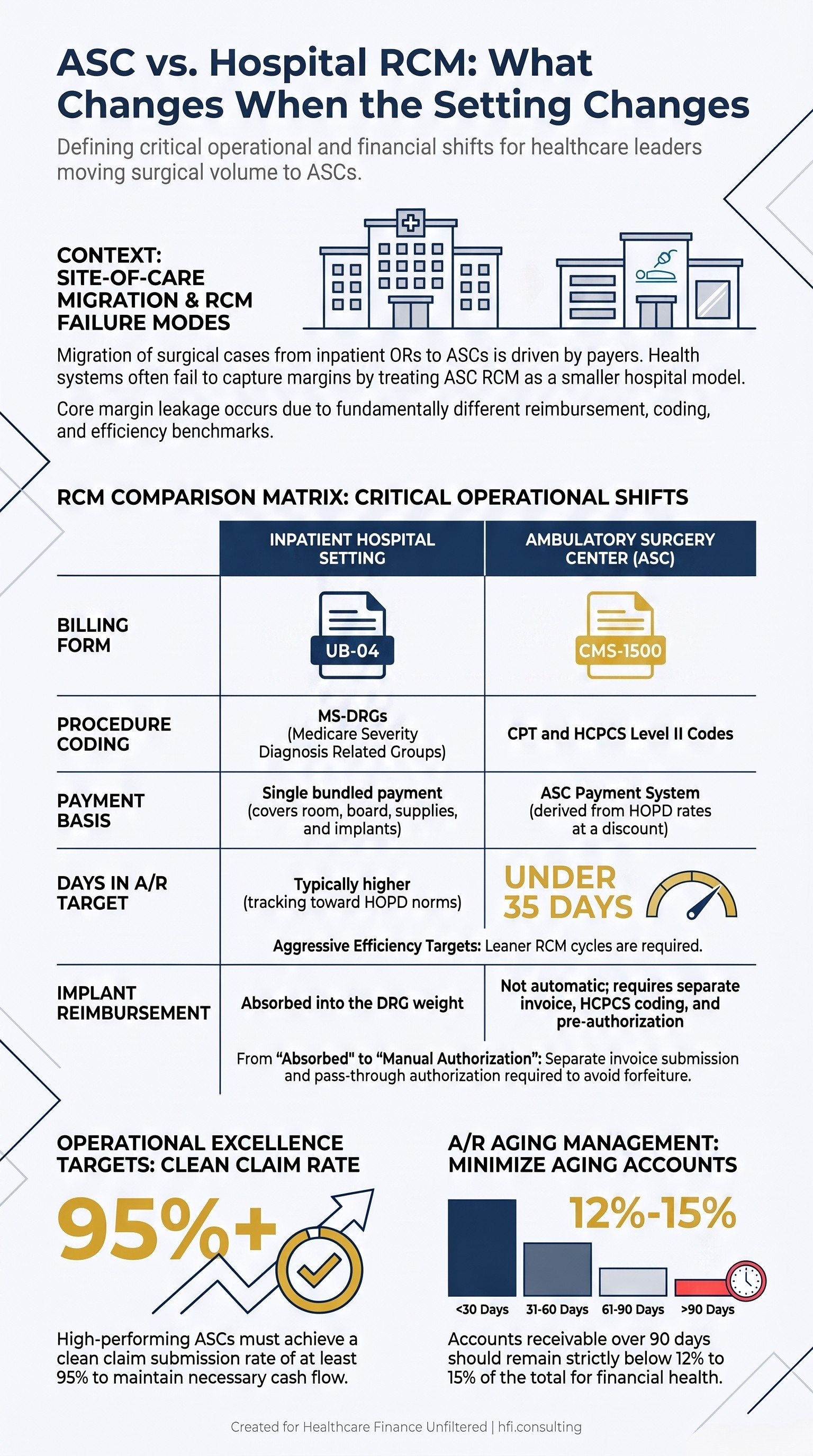
Give finance and RCM leaders a reference table they will save and use, anchoring the article as a resource they return to.
The KPI Benchmarks That Separate High-Performing ASCs
For ASC finance leaders and health system CFOs managing ambulatory operations, the ASCA and VMG Health Intellimarker benchmarks define what you are managing toward.
EBITDA margins for well-run ASCs run 25 to 40 percent or higher depending on specialty mix. Supply costs as a percent of net revenue should run 18 to 26 percent, with orthopedic and spine sitting higher around 30 percent and GI and ophthalmology sitting lower around 12 to 15 percent. Staffing labor should run 20 to 28 percent of net revenue when scheduling flexes properly. Net revenue per case varies significantly by specialty, from around $1,200 for GI to $10,000 or more for spine.
If your ASC is underperforming on any of these, the root cause is almost always one of four things. Case mix that does not match the ASC model. Supply chain contracts that have not been renegotiated since the volume shifted. Anesthesia costs that were not built into payer contracts. Or RCM workflows that were imported from the hospital without redesign.
These are solvable. But they require an assessment with ASC-specific tools, not hospital accounting frameworks applied to a different operating model.
If your organization is evaluating ASC performance or planning a joint venture, HFI Consulting works with health systems, physician groups, and ASC operators on financial diagnostics, payer contract strategy, and RCM workflow redesign. Visit hfi.consulting to learn more.
What Payer-Side Dynamics Mean for ASC Finance Leaders
CMS and commercial payers are not neutral in the site-of-care migration. They are driving it, and they have enforcement infrastructure built around it.
Medicare Advantage plans impose SOC requirements aggressively. A procedure that qualifies for ASC reimbursement is often not covered at inpatient rates regardless of physician preference. For health systems with high MA penetration, this creates a direct financial linkage between physician scheduling decisions and payer adjudication outcomes. A surgeon who insists on a hospital OR for a straightforward case in a high-MA market is not making a clinical preference call in isolation. That decision has a specific dollar exposure that finance leaders need to be able to quantify and communicate.
From my time in payer operations, SOC enforcement was not treated as a compliance function. It was a cost containment lever. The criteria for inpatient versus ambulatory designation live in plan-level policy documents that most hospital finance teams have not read carefully, if at all. The payer contract matrix that applies to hospital contracting applies equally to ASC contracting, with additional complexity around pass-through provisions and covered procedure lists.
The bundled payment programs currently in CMMI's portfolio also intersect with perioperative finance in ways most ASC CFOs are not fully modeling. For orthopedic and cardiac procedure lines where ambulatory migration is most active, bundled payment exposure is a forward-looking risk that belongs in today's financial planning, not a future cycle. I covered the TEAM and CJR-X implications in Value-Based Payment Models.
The Fractional CFO Model for ASCs
A growing share of the ASC market is physician-owned or joint venture structures with lean administrative teams that do not carry a full-time CFO. I hear this regularly. The organization is running $6 or $8 million in annual revenue, navigating payer contract renegotiations, implant cost disputes, and joint venture equity accounting, with no dedicated financial leadership at the executive level.
The financial complexity these organizations are managing is not small-organization complexity. It is health system complexity at a smaller revenue base. The stakes on a bad payer contract or an undiscovered implant billing gap are proportionally higher when the margin cushion is thinner.
The fractional CFO model exists for exactly this environment. Strategic financial leadership at a scope and cost structure that matches an ASC's operating profile, without the overhead of a full-time hire. If your ASC is above $5 million in annual revenue and does not have dedicated financial leadership with ASC-specific expertise, that is a gap worth addressing before the next payer renegotiation cycle.
For organizations navigating this question, hfi.consulting is a resource for understanding what ASC-specific financial oversight looks like in practice.
What to Build This Quarter
The migration of surgical volume to ASCs is operational and financial reality. Not a trend to monitor. The organizations that are capturing margin from it built specific tools: an ASC-calibrated RCM workflow, a supply chain contract matrix with payer-level pass-through documentation, a staffing model that runs as a true variable cost against block utilization, and a physician alignment structure that converts equity interest into operational discipline.
Without those tools, you are absorbing margin leakage on every case that moves. The leakage is predictable, and most of it is preventable.
The good news is that these are known problems with known solutions. The finance leaders who build the infrastructure now have a structural advantage as volume continues to shift. The ones waiting for a stable operating environment to plan around will find that environment does not arrive.
P.S. For ASC CFOs and perioperative finance leaders: what is the single biggest financial operations gap you are navigating right now in your ambulatory surgery environment? Supply chain and implant billing, anesthesia cost modeling, payer contract terms, or something else entirely? Hit reply and tell me. It shapes what I write next.
