
Non-competes quietly prop up downstream margin. Here is how finance leaders plan as the rules change around them.
A federal bill introduced this month would void every physician non-compete, hospitals included, one year after enactment. It will probably go nowhere this session. The rules are tightening anyway, and if your downstream margin depends on a covenant you have never valued, that is a 2027 budget question.
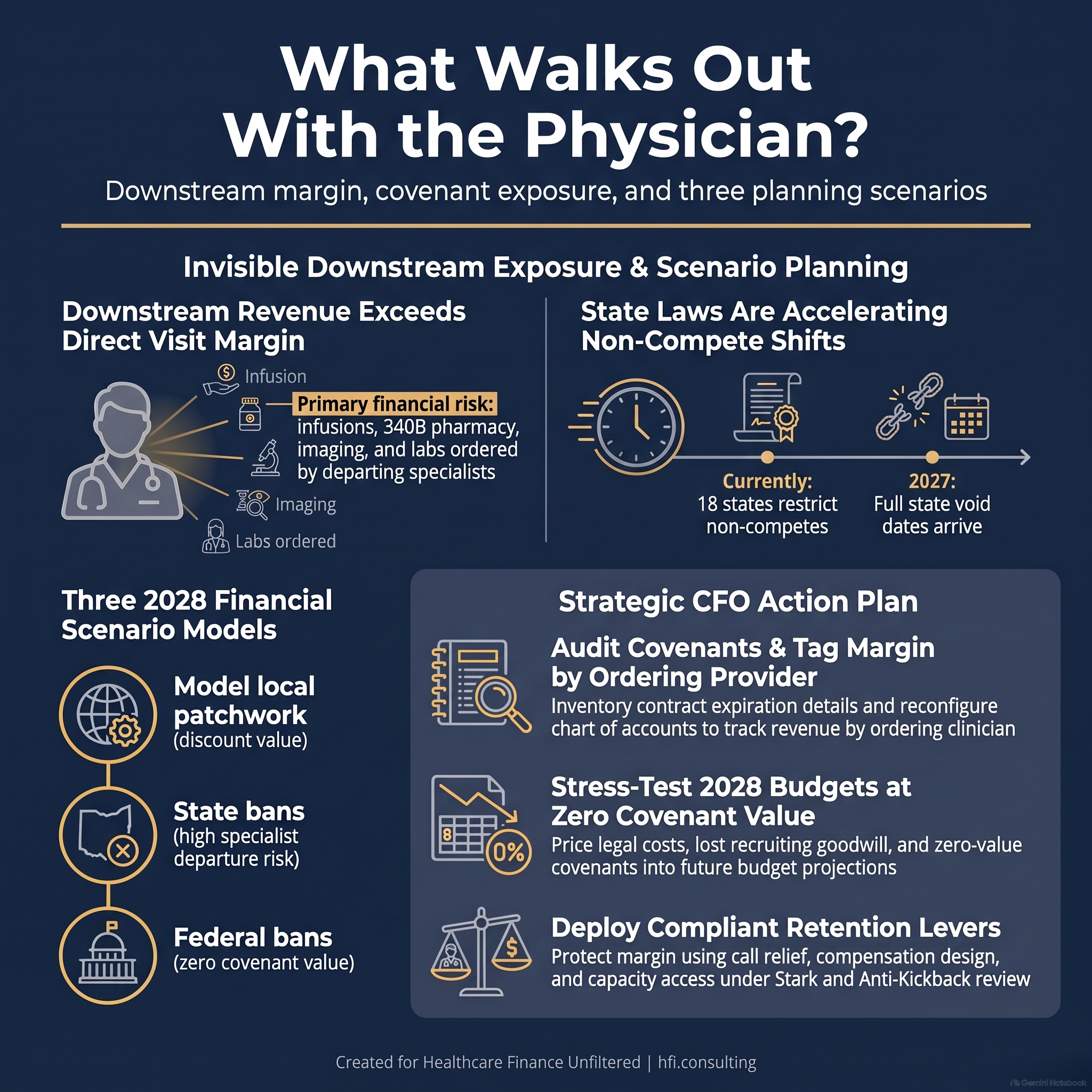
Title graphic reading What Walks Out With the Physician, covering downstream margin, non-compete exposure, and three CFO planning scenarios.
A Federal Bill Would Void Every Physician Non-Compete. Do Not Plan Around It.
HFMA covered the Stop Corporate Takeovers of Physicians Act of 2026 on October 16. The bill's headline provision targets private equity and other corporate ownership of medical practices, and it exempts hospitals. The non-compete provisions do not.
If enacted, the bill would bar non-competes, non-disclosure agreements, and non-disparagement clauses with licensed physicians and advanced practice clinicians. Existing agreements would be voided one year after enactment. Violators would face FTC enforcement, state attorney general actions, and private suits with treble damages.
The only exception covers a clinician who owns 25 percent or more of the practice. That rules out most hospital-employed physicians by definition.
The odds are low. Policy advisors cited by HFMA do not expect the bill to advance in 2026. The 119th Congress ends January 3, and the bill would need to be reintroduced.
Treat it as a planning input, not a forecast.
What Finance Leaders Actually Face: The Law Is Moving Without Congress
The federal rule is gone. A federal court vacated the FTC's 2024 non-compete ban, and the agency dropped its appeal in September 2025.
That did not end federal interest. The FTC said it would pursue case-by-case enforcement and sent warning letters to health care employers about their non-compete provisions.
States are doing the real work. A September 2026 state-by-state review from Tucker Arensberg, reported by Becker's, counts eighteen states that generally ban or void physician non-competes.
Texas limits them to one year and five miles and caps buyouts at annual salary. Virginia's ban on new agreements took effect July 1.
Washington is the date to circle. Per the same guide, all non-competes there become void on June 30, 2027, no matter when they were signed.
Florida still permits them. Section 542.336 voids a physician non-compete only where one entity employs or contracts with every physician in that specialty in the county. Courts can also narrow an overbroad covenant instead of striking it.
Check your own state. In Florida, the answer can change by specialty and by county.
A Radius, a Measuring Tape, and No Court Date
Here is a situation I know of, told as a composite with the details changed. A specialist in a cognitive specialty left a health system to open an independent practice. His contract carried a ten-mile radius.
He found a location and signed a lease. His former employer measured from his old office to the new address in a straight line and concluded the site sat just inside the line. The margin was roughly the length of a parking lot.
He did not move. The employer never filed. Nobody ever tested whether the covenant would have held.
I was not a party to it, but I know it happened. In a referral-driven market, stories like this travel, and the physicians still inside the system hear them.
I cannot tell you whether that covenant would have survived a judge. I can tell you what it was meant to protect.
What the Covenant Protects Was Never the Office Visit
The visit is the small part. Rheumatology and allergy are cognitive specialties, so evaluation and management codes produce modest margin on their own.
The margin sits downstream. Infusion suites and drug administration, billed with a facility fee when run as a hospital outpatient department.
Add imaging and in-office diagnostics. Add recurring lab panels. Add specialty pharmacy fills, including 340B margin where the hospital qualifies.
I watched this play out from FP&A at a multi-hospital system. A specialist whose practice leaned on in-office pulmonary function and bronchodilator response testing left to practice independently. The testing and the lab volume left with him.
On that physician's own P&L, none of this shows up. It lands in the lab, diagnostics, and infusion cost centers, so the visit margin is all the specialist's line ever displays.
From the payer side, the same infusion looks different. Site-of-care programs exist to move biologic infusions out of hospital outpatient departments. The margin one side defends is the savings the other side is chasing.
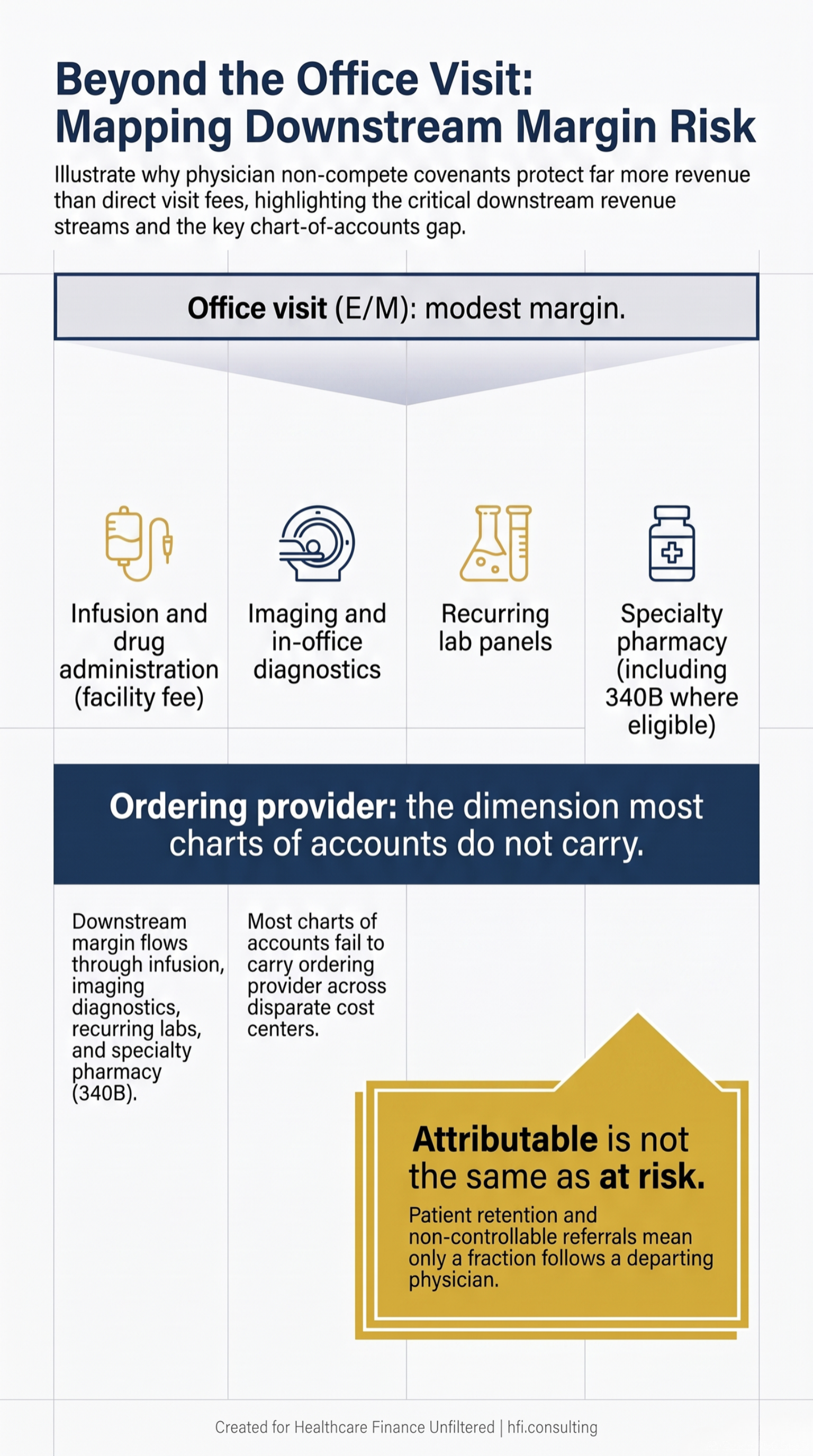
Diagram of a small office visit margin above four larger downstream margin streams, all tied to the ordering provider in the chart of accounts.
Why Your Books Cannot Price It: The Chart of Accounts Gap
Most finance teams cannot put a number on what a covenant protects. The infusion suite, the lab, the imaging center, and the pharmacy each live in their own cost center. The ordering physician is not a dimension anywhere.
That is a chart of accounts decision, and it is fixable. In Oracle, NetSuite, or Sage Intacct, ordering provider can be a segment or dimension. In QuickBooks or Xero, a smaller practice can approximate it with classes or tracking categories.
The analysis I would run first is net revenue by ordering physician, even for specialties like allergy and rheumatology. Work down to margin as your cost accounting allows.
I wrote about how chart of accounts design errors hide exactly this kind of signal in my earlier piece on healthcare chart of accounts errors for medical practices. The same logic applies to the dashboard problem I covered in contribution margin integrity.
This is the kind of ordering-provider view Healthcare Finance Innovations helps finance teams build into a chart of accounts.
One caution. Margin attributable to a physician is not margin at risk.
Some patients stay. Some referrals were never the physicians to control. Model a share that follows, not 100 percent.
Enforcement Has a Cost Your Budget Does Not Show
Counting what a covenant protects is half the analysis. The other half is what it costs to use.
Legal time is the visible part. The less visible part is what your own medical staff learns from how you treat the physician who leaves.
Ask your recruiting team whether candidates raise restrictive covenants during negotiations. If they do, enforcement posture is a recruiting variable, and it belongs on the list.
Scenario Planning: Plan for 2028 Without Betting on It
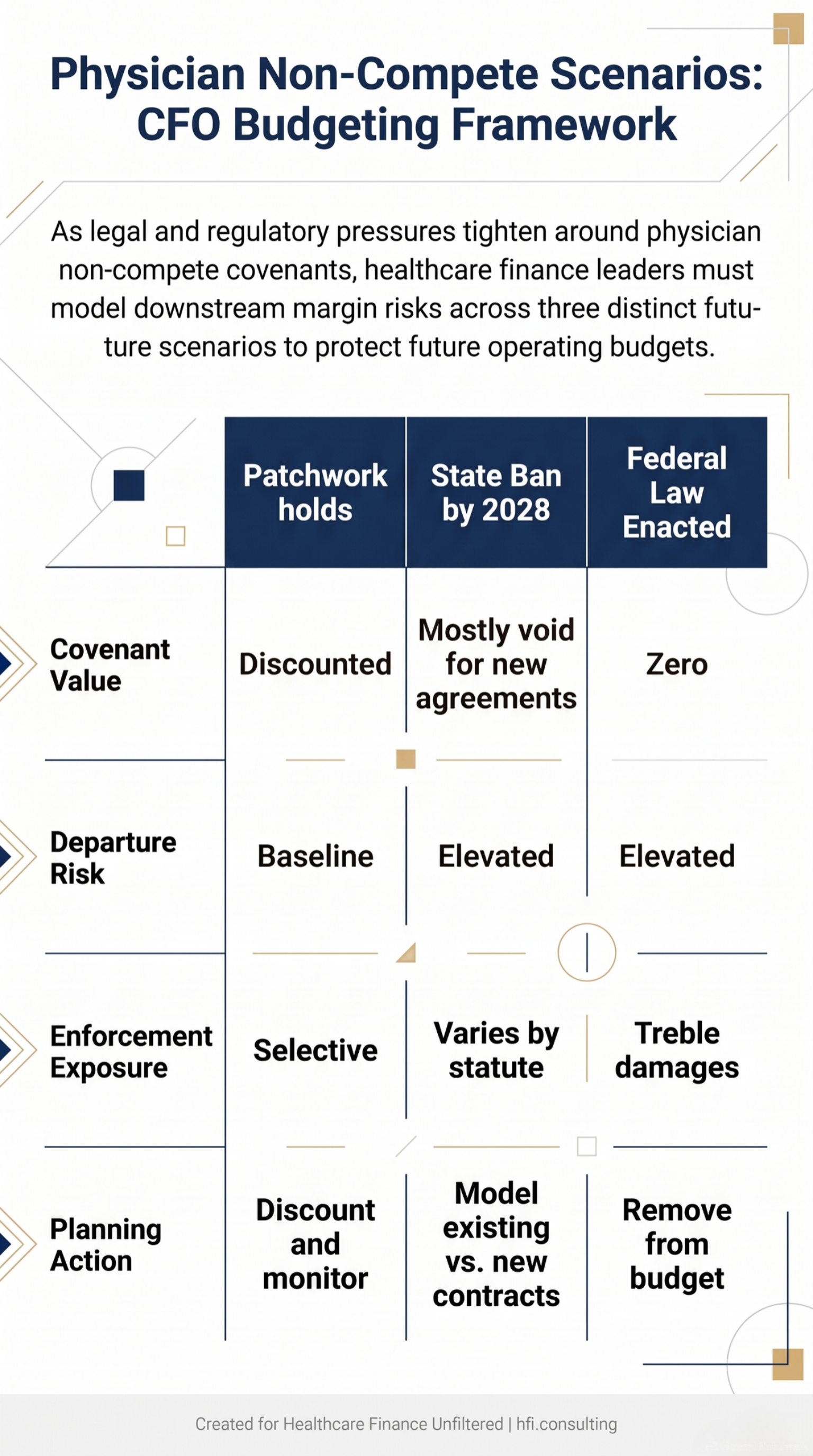
Build three scenarios. Do not pick one.
The patchwork holds. Covenants keep value where state law allows. Enforcement is selective, and the FTC acts case by case. Model covenant value at a discount, not at face.
Your state bans them by 2028. New and renewed agreements go void. Older covenants may survive or not, depending on how your statute treats existing contracts. Model higher departure risk for specialists with large downstream volume.
Federal law passes and takes effect a year later. Every covenant is void, including existing ones. Set covenant value to zero and treat continued enforcement as treble-damages exposure.
Even the fastest federal path puts the effective date in 2028 at the earliest. The state path can arrive sooner. In Washington, it arrives June 30, 2027.
Hypothetical CFO perspective: "If this covenant is void in 2028, what does my 2029 budget look like?"
Notice what the three scenarios share. In every case, the covenant is worth less in 2028 than it is in your 2026 assumptions. The work is deciding by how much, specialist by specialist.
Comparison table of three non-compete scenarios showing covenant value, departure risk, enforcement exposure, and the planning action for each.
Build your own version before someone asks you for it. The Physician Non-Compete Exposure Model is a free Excel workbook that estimates downstream margin by specialist and runs it through all three scenarios. Get it at hfi.consulting.
The Headline Says Independence. The Consolidation Risk Says Otherwise.
Here is the headline. The bill loosens employer lock-in and protects physician independence. Here is what finance leaders actually face.
Law firm analysis cited by HFMA warns that blocking private equity ownership could leave practices with "few practical alternatives to hospital acquisition or physician employment." That would accelerate consolidation in markets that are already concentrated. Baker Donelson also flags that it is unclear whether a health system's physician enterprise subsidiary is exempt.
The bill would also require management fees from hospital-owned management services organizations to be negotiated at arm's length and set at fair market value. That is a cost allocation question. If you charge shared services to physician practices by a formula nobody has documented, start documenting it.
I covered the strategic side of this in my earlier piece on physician enterprise finance and the consolidation wave.
Retention Is the Durable Protection
A covenant buys time. It does not buy loyalty. When the covenant disappears, the only protection left is a reason to stay.
Finance owns more of that reason than most systems admit. Compensation design, call burden, administrative support, access to infusion and lab capacity, and the speed of capital decisions all shape whether a specialist stays. Several of these can be priced.
Any structure that ties a physician's economics to referrals or downstream services must clear Stark and Anti-Kickback review. Build the financial case first. Then have compliance and counsel tell you what is allowed.
The goal is to spend less on retention than a departure would cost. The model answers that in dollars.
If You Are the Physician's CFO, the Radius Is a Financial Plan
Independent practice and ASC CFOs sit on the other side of this contract. Here is what to do before a lease is signed.
Read how the covenant measures distance. Straight line or road miles. The contract language decides, and counsel should confirm it.
Have counsel measure the proposed site against the covenant before you commit. Make the lease contingent where you can.
Model startup cash before volume arrives: lease, staffing, malpractice tail coverage, EHR setup, and a legal reserve.
Assume patients follow slowly. Build a conservative ramp.
Price any buyout against the downstream volume you expect to build, not first-year visits.
The cash timing problem is covered in why profitable practices run out of cash.
What to Do Before the Next Budget Cycle
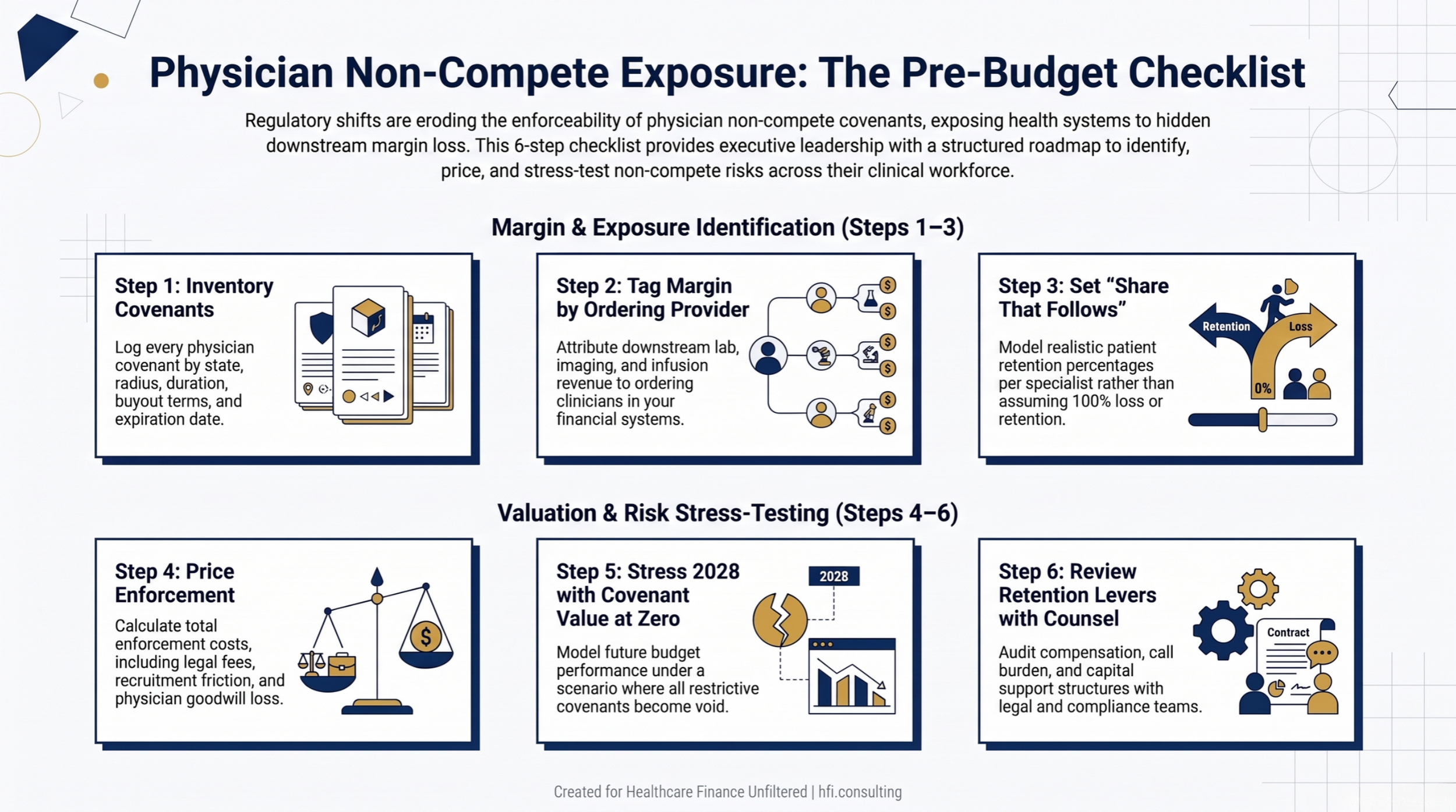
For health system and larger group CFOs, six steps.
Inventory every covenant: physician, state, radius, duration, buyout, and expiration date.
Tag downstream margin by ordering provider.
Set a share-that-follows assumption for each specialist.
Price the cost of enforcing: legal time, recruiting goodwill, and what the story does to the next candidate.
Stress your 2028 budget with covenant value at zero.
Review retention levers with compliance and counsel. Compensation, call coverage, and co-management structures all need Stark and Anti-Kickback review.
Six-step CFO process flow: inventory covenants, tag margin by ordering provider, set share that follows, price enforcement, stress 2028, review.
The Covenant Is a Bet on the Law
A non-compete is a bet that the law will keep working in your favor. The law is moving. The finance question is whether you priced the bet before it changed.
If you want a second set of eyes on your covenant inventory, your chart of accounts, or your 2028 scenarios, start a conversation at hfi.consulting. I work with finance leaders on both sides of this contract: health systems and independent practices.
P.S. If your top-referring specialist gave notice tomorrow, could your team tell you within a day how much downstream margin follows them out? Reply and tell me your honest answer. I read every one.
This article is a financial planning discussion, not legal advice. Have counsel review any covenant, lease, or contract decision.
