
Healthcare Chart of Accounts Errors: The Hidden Accounting Problems Draining Independent Medical Practice Revenue
Five COA mistakes that make your financials unreliable — and how to diagnose them before they damage your valuation or your partnerships.
If your monthly revenue swings by $400,000 and nobody can explain why, the problem is rarely your billing team. It is almost always your chart of accounts.
Most independent medical practices are running on accounting infrastructure that was built for a retail shop or a law firm. The person who set up QuickBooks entered the standard small-business template, created an account called "Practice Income," and called it a day. Nobody flagged it because the books technically balanced.
The problem is that healthcare revenue does not work like other industries. A charge leaves your practice one day and comes back weeks later as a different number, from a different payer, with contractual adjustments, recoupments, and patient balance splits that all need to land in different places. When your chart of accounts cannot capture that complexity, your financial statements are not wrong in an obvious way. They are wrong in a quiet way that compounds over months and surfaces at the worst possible moment.
I have seen it surface during a practice sale, a physician buy-in negotiation, a line-of-credit renewal, and a partner compensation dispute. It never surfaces at a convenient time. And it is almost always preventable.
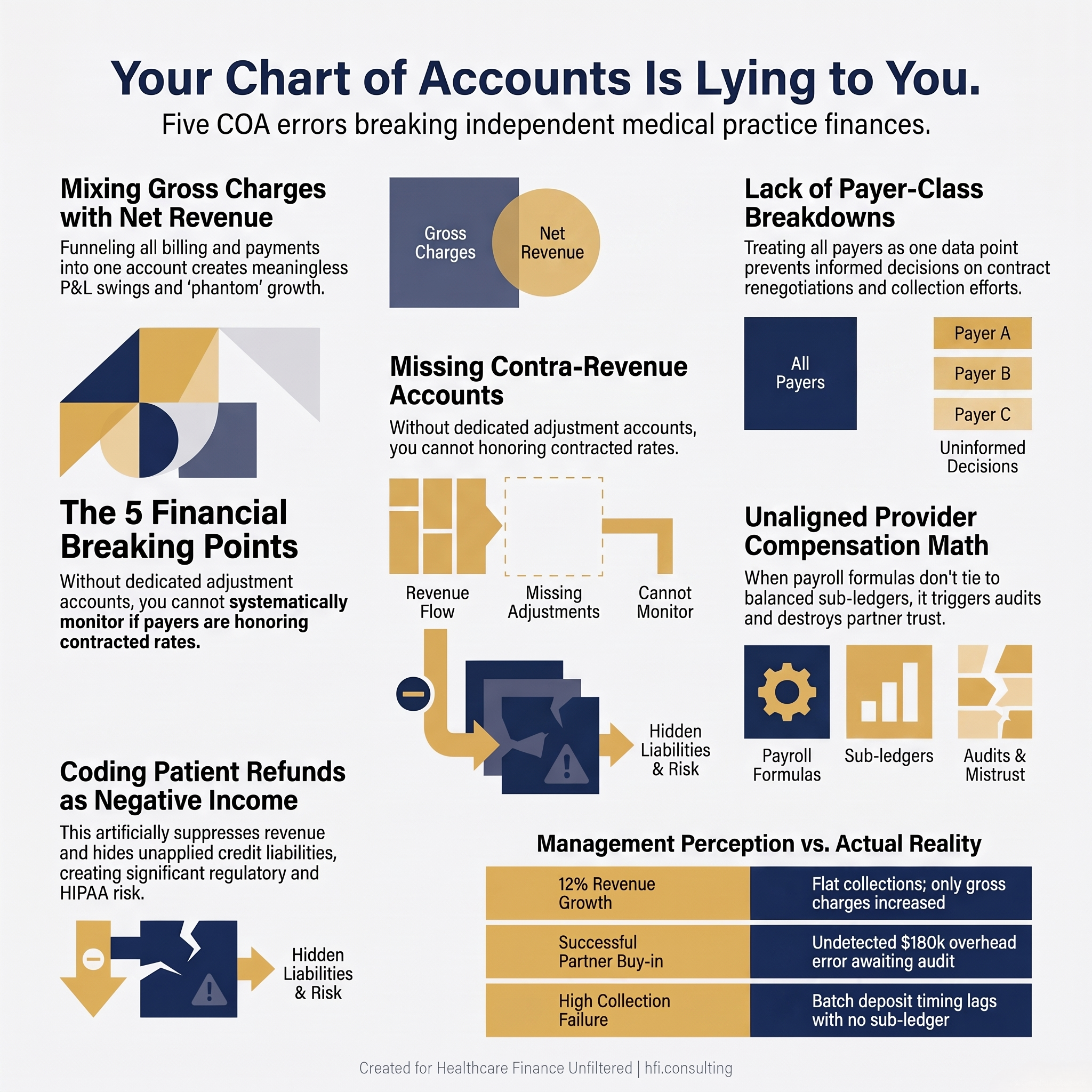
Graphic with headline: Your Chart of Accounts Is Lying to You. Five COA errors breaking independent medical practice finances.
What a Healthcare Chart of Accounts Actually Needs to Do
Before getting to the mistakes, it helps to understand what the architecture should look like.
A properly built healthcare COA captures revenue in layers. Gross charges go in first, representing what you billed at full fee schedule rates. Then contra-revenue accounts reduce that number to reflect contractual allowances and adjustments. What remains is your net realizable revenue, which is the number your operations should actually be managed against.
Below net revenue, bad debt write-offs and administrative adjustments sit in their own accounts. Patient refunds flow through a liability clearing account, not back through income. And revenue is broken out by payer class, so you can see what Medicare, commercial insurance, Medicaid, and self-pay are each contributing and costing to collect.
Most small practices have none of this. And the consequences are not abstract.
The Five Chart of Accounts Errors That Break Practice Finance
Error 1: Gross charges mixed with net revenue
This is the most common and the most disorienting. When everything from charge entry to payer remittance to patient payments gets funneled into a single revenue account, the number on your P&L becomes meaningless.
A surgical group I worked with believed they had a catastrophic collection problem. Revenue was swinging from $320,000 one month to $780,000 the next. The administrator thought her billing team was failing. What was actually happening was that payer electronic funds transfers were landing in batch cycles with no consistent timing, and they were all hitting one account called "Practice Income" with no sub-ledger structure underneath it.
When I asked for the contractual adjustment rate by payer, the billing software showed a 58% contractual write-off rate. The general ledger showed zero contra-revenue accounts. Nobody had ever connected those two systems.
The swings were not collection failures. They were batch deposit timing lags with no accounting structure to separate them from actual performance.
What management thinks they see: Revenue grew 12% quarter over quarter. Production is up.
What is actually happening: The practice updated its charge master, but contracted allowable rates stayed flat. The gross charge number grew. The cash collected did not.
The downstream damage from this misread is real. Leadership hires additional staff or extends facility hours based on a top-line number that will never convert to cash. Billing teams get blamed for performance gaps that are actually contractual timing issues. And when a lender or acquirer requests audited financials, your accounts receivable gets restated downward by 50 to 65 percent. I have seen that restatement trigger covenant violations on an existing line of credit.
Error 2: No contra accounts for contractual adjustments
Contractual allowances are not losses. They are the difference between what you billed and what you agreed to accept when you signed your payer contracts. They belong in a contra-revenue account that sits directly below gross charges on your income statement.
When there are no contra accounts, two things happen. Your gross revenue looks healthier than it is. And you have no mechanism to monitor whether payers are actually paying you at contracted rates.
Payer underpayments are a real and undertracked problem in independent practices. Commercial payers occasionally pay below their contracted schedule, and the only way to catch it systematically is to track what you expected at the contractual rate versus what arrived. Without a properly structured COA, that comparison is impossible to make from your financial statements alone. You would need to run it manually, payer by payer, claim by claim, which most practices simply do not do.
If you cannot answer "What was our contractual adjustment rate by payer class last month, directly from my P&L?", your chart of accounts is not built for healthcare. That question should have a two-second answer.
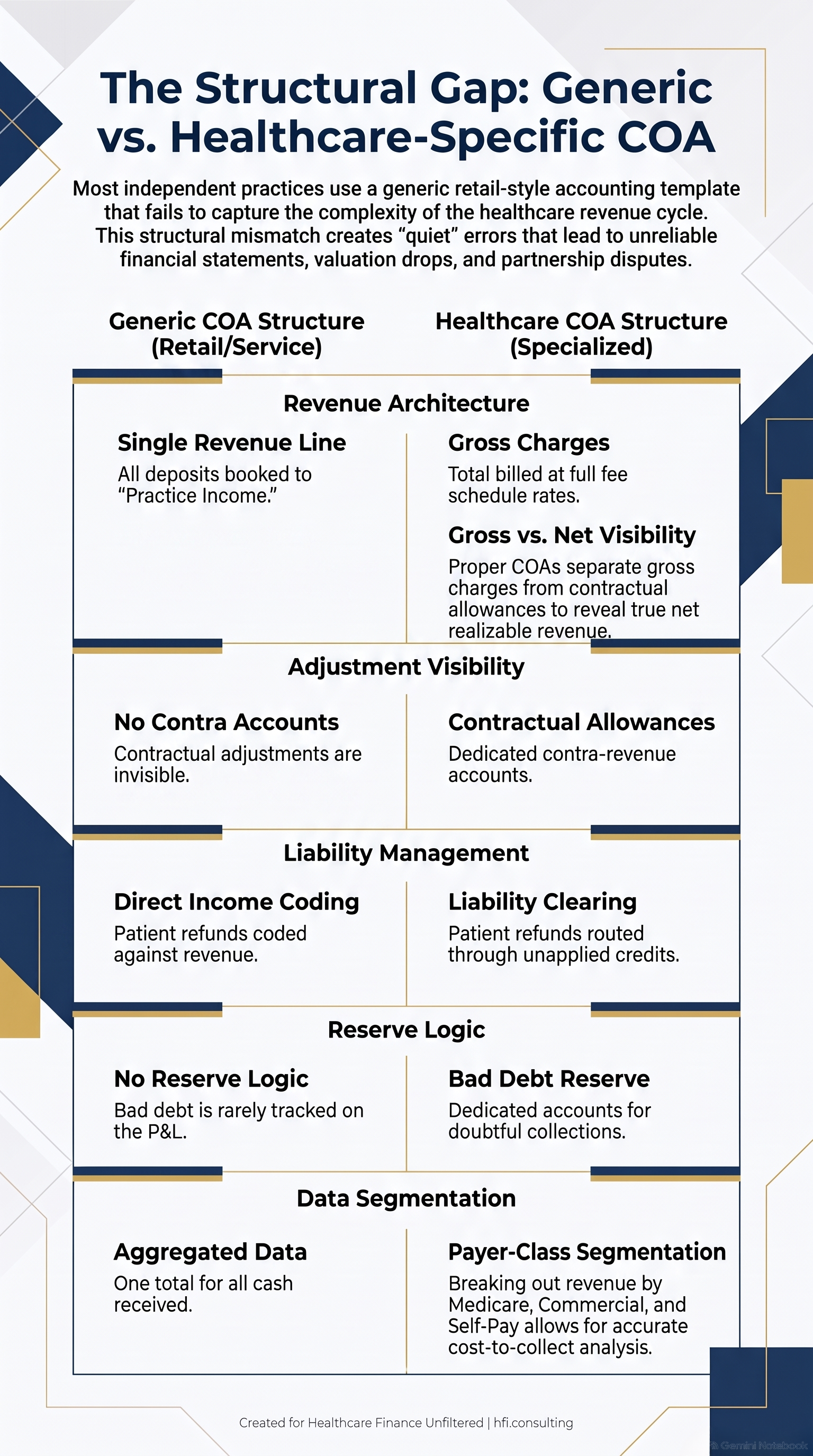
Side-by-side comparison of generic small-business chart of accounts versus properly structured healthcare chart of accounts.
Error 3: Patient refunds sitting in income
This one is small in isolation and catastrophic in aggregate. When a patient overpays at check-in and the practice issues a refund, that cash outflow needs to go through an unapplied patient credits liability account before being cleared. It does not belong coded against revenue.
When refunds are entered as negative deposits against income, you are artificially suppressing your revenue in the period the refund is issued. If you process a high volume of check-in copay collections and have a moderate refund rate, your P&L in any given month may be understated by thousands of dollars. More importantly, you lose the ability to track unapplied patient credits as a balance sheet item.
Unapplied patient credits have regulatory implications. HIPAA and state regulations in many jurisdictions require timely resolution of patient credit balances. If they are not tracked as liabilities, you cannot report on them accurately, and you cannot demonstrate compliance.
This is one of those errors that seems minor when the bookkeeper sets it up and snowballs quietly for years.
Error 4: No payer-class revenue breakdown
If your income statement shows a single "Revenue" line, you are managing the financial performance of a multi-payer business with a single data point. That is the equivalent of running a restaurant where all food and beverage sales go into one number and nobody tracks table turns, check averages, or kitchen costs separately.
Revenue from Medicare, Medicaid, commercial insurers, and self-pay patients each has a different collection timeline, a different contractual adjustment rate, a different denial pattern, and a different cost to collect. A practice with a high Medicaid volume looks very different from a practice with a high commercial mix, even at the same gross charge level. If you cannot see that breakdown in your financials, you cannot make informed decisions about which panels to join, which payer contracts to renegotiate, or where your billing team should be focusing its effort.
From my work in multi-facility financial operations, I can tell you that payer mix visibility is one of the most underdeveloped capabilities in independent practice finance. Health systems invest heavily in it. Independent practices often do not have it at all, even when the data exists in their practice management system and simply has not been bridged to the general ledger.
I covered the payer mix and contribution margin dynamics in more detail in my earlier piece on what the Q2 payer mix crisis means for every level of healthcare provider, which you can read at www.hfi.consulting/articles/contribution-margin-is-lying-to-you-what-the-q2-payer-mix-crisis-means-for-every-level-of-healthcare-provider.
Error 5: Compensation math that does not tie to collections
This is the one that ends partnerships.
A multi-specialty group I observed had a compensation model that tied associate pay to individual net collections after direct expense allocation. The partnership agreement was well-drafted. The problem was that the bookkeeping system could not produce the number the agreement required.
Lump-sum payer recoupments, prior-period adjustments, and patient payment plan defaults were being dumped into a generic overhead account with no provider attribution. When an associate went through a buy-in audit, the forensic review revealed that another provider's billing errors had been absorbed into general overhead, indirectly reducing this associate's net margin calculation for two years. The clawback and restatement cost the group over $180,000 and paused all partnership activity while independent counsel got involved.
When provider compensation formulas do not cleanly tie to balanced, reconciled sub-ledgers, physicians do not assume it was an accounting layout oversight. They assume someone is manipulating the numbers. That assumption is almost impossible to walk back once it takes hold.
The COA architecture required to support production-based compensation is not complicated. But it has to be built intentionally, by someone who understands how healthcare reimbursement actually works. A general bookkeeper working in a standard QuickBooks template is not in a position to build it without healthcare-specific guidance.
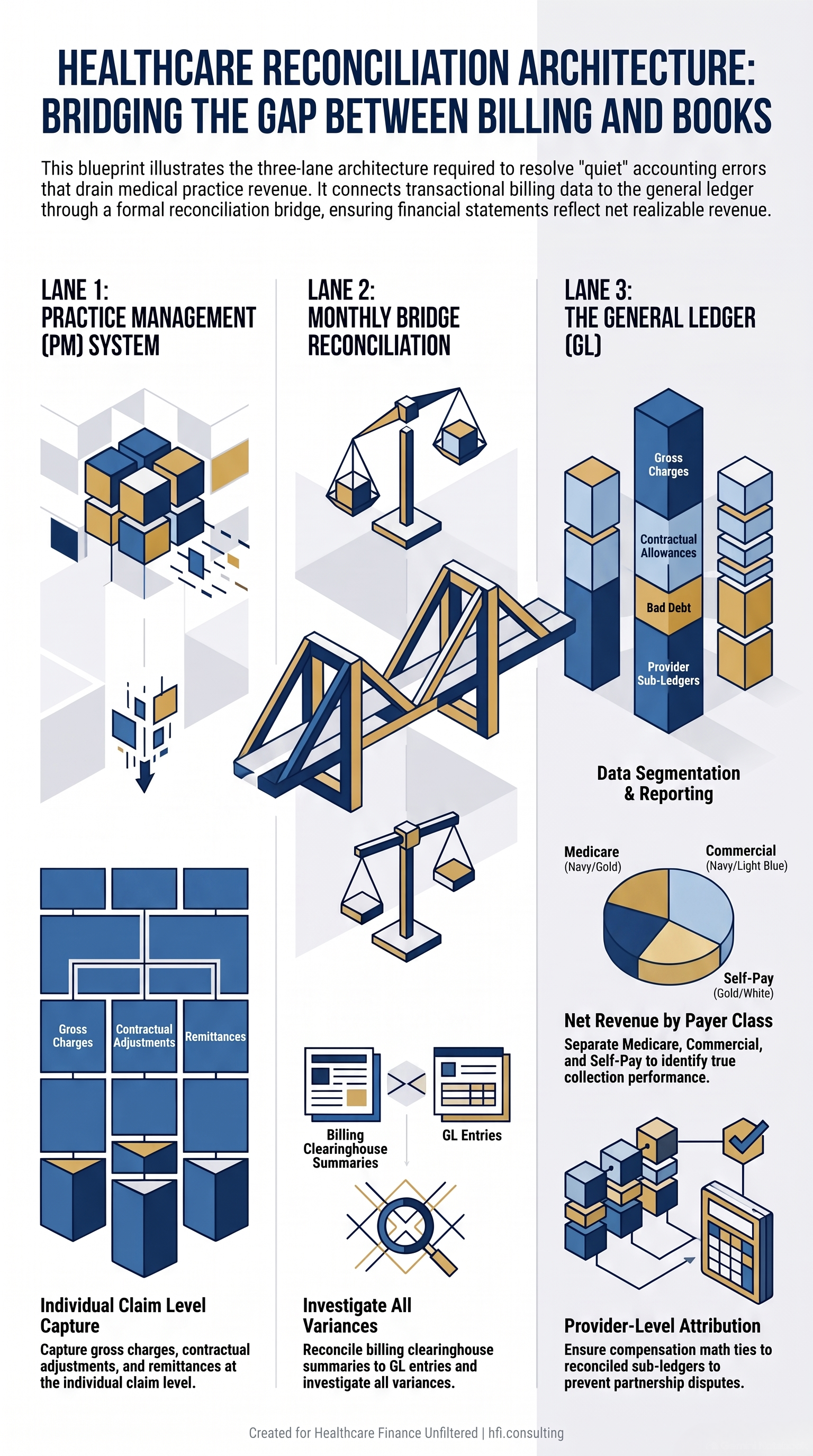
Three-lane diagram showing proper integration between practice management system, monthly bridge reconciliation, and general ledger for medical practices.
Who Actually Owns This Problem
The blame usually circles. Physicians blame the bookkeeper. The bookkeeper blames the billing software. The practice manager points at physicians who keep renegotiating how they want production calculated.
Here is where responsibility actually sits.
The core architectural failure accounts for most of what goes wrong. Generalist bookkeepers who do excellent work for law firms or retailers are not equipped to build a healthcare chart of accounts. Third-party payer reimbursement is a specialized function. Setting up healthcare revenue accounting requires understanding contra-revenue, allowance reserves, provider-level attribution, and the structural bridge between a billing clearinghouse and a general ledger. Most small-business accounting templates do not include any of it.
The second failure is the silo between the practice management system and the general ledger. Billing teams live in Athena, eClinicalWorks, or Epic. Finance lives in QuickBooks or Sage Intacct. When nobody establishes a formal end-of-month reconciliation that ties the billing clearinghouse summary to GL entries, the two systems drift apart permanently. Nobody meant for it to happen. There was just never a protocol.
The third failure, and the smallest in frequency, is at the physician ownership level. Physicians sign compensation agreements drafted by healthcare attorneys without asking whether their current accounting system can mathematically produce the numbers those agreements require. Often it cannot. Often nobody finds out until it becomes a dispute, see this piece for more information www.hfi.consulting/articles/bookkeeping-for-medical-practices-what-your-cpa-wishes-you-knew-before-you-walked-in-the-door
If your practice is approaching a sale, a private equity letter of intent, or a physician buy-in negotiation, these gaps will surface in quality-of-earnings diligence. The only question is whether you find them first.
For a broader look at what independent practice cash flow problems look like from the inside, see my piece on why profitable practices run out of cash at www.hfi.consulting/articles/profitable-on-paper-broke-in-reality-the-cash-flow-crisis-hiding-inside-independent-physician-practices.
The Diagnostic Checklist: Can Your COA Answer These Questions?
Your chart of accounts is broken if you cannot answer these questions directly from your financial statements, without exporting data from your PM system or running a manual spreadsheet calculation:
What was our contractual adjustment rate by payer class last month?
What is our current allowance for doubtful accounts as a percentage of gross A/R?
What is each provider's net collections contribution after direct expense allocation?
How much in unapplied patient credits sits on our balance sheet right now?
What percentage of our revenue comes from commercial insurance versus government programs versus self-pay?
If any of these require a call to the billing department or a custom report pull, the answer is not in your general ledger. It should be.
If you are working through a COA rebuild, a PM-to-GL reconciliation project, or a provider compensation tie-out and want an outside set of eyes before it becomes a governance issue, that is exactly the kind of project HFI Consulting is built for. You can reach us at hfi.consulting.
The Fix Does Not Have to Be a Reinvention
Rebuilding a chart of accounts sounds like a six-month IT project. It is not.
For most independent practices and ASCs, a COA rebuild is a two-to-four week engagement that restructures revenue accounts, maps contra-revenue and bad debt properly, establishes payer-class sub-accounts, and creates a monthly bridge reconciliation protocol between the billing system and the GL. The bookkeeper keeps doing what they are doing. The structure they are working within changes.
The practices that resist fixing this are usually the ones that have been telling themselves the revenue volatility is a billing problem for years. It is almost never purely a billing problem. Billing teams can clean up coding errors and reduce denial rates, and they should. But until the chart of accounts captures net realizable revenue correctly, those gains are invisible on the P&L.
The practices that invest in getting this right are the ones that negotiate payer contracts from a position of actual data, not from a report they had to pull from three different systems. They are the ones whose buy-in negotiations close on schedule because the books can support the compensation calculation. They are the ones whose valuation holds up in a sale.
This is infrastructure work. It pays dividends every month after it is done, and it tends to cost far less than the governance problem it prevents.
If this is on your list and you are not sure where to start, reach out at hfi.consulting. We help practices build accounting infrastructure that actually reflects how healthcare revenue works.
P.S. If you had to pick the single biggest gap in your practice's financial reporting right now, what would it be? Reply and let me know. I read every response, and it directly shapes what I write next.
