
Finance and Strategy Alignment: A Health System CFO Guide to Margin-Based Planning
Strategy plans on volume. Margin lives in unit cost and fixed-cost absorption. Here is how CFOs close that gap.
Hospital margins slipped again this year. Kaufman Hall's national index put calendar year-to-date operating margin at 2.5% through June, a 6% decline from the first half of 2025.
FY2027 plans are moving toward approval right now. If those plans are built on volume and gross revenue, the margin math arrives after the money is committed.
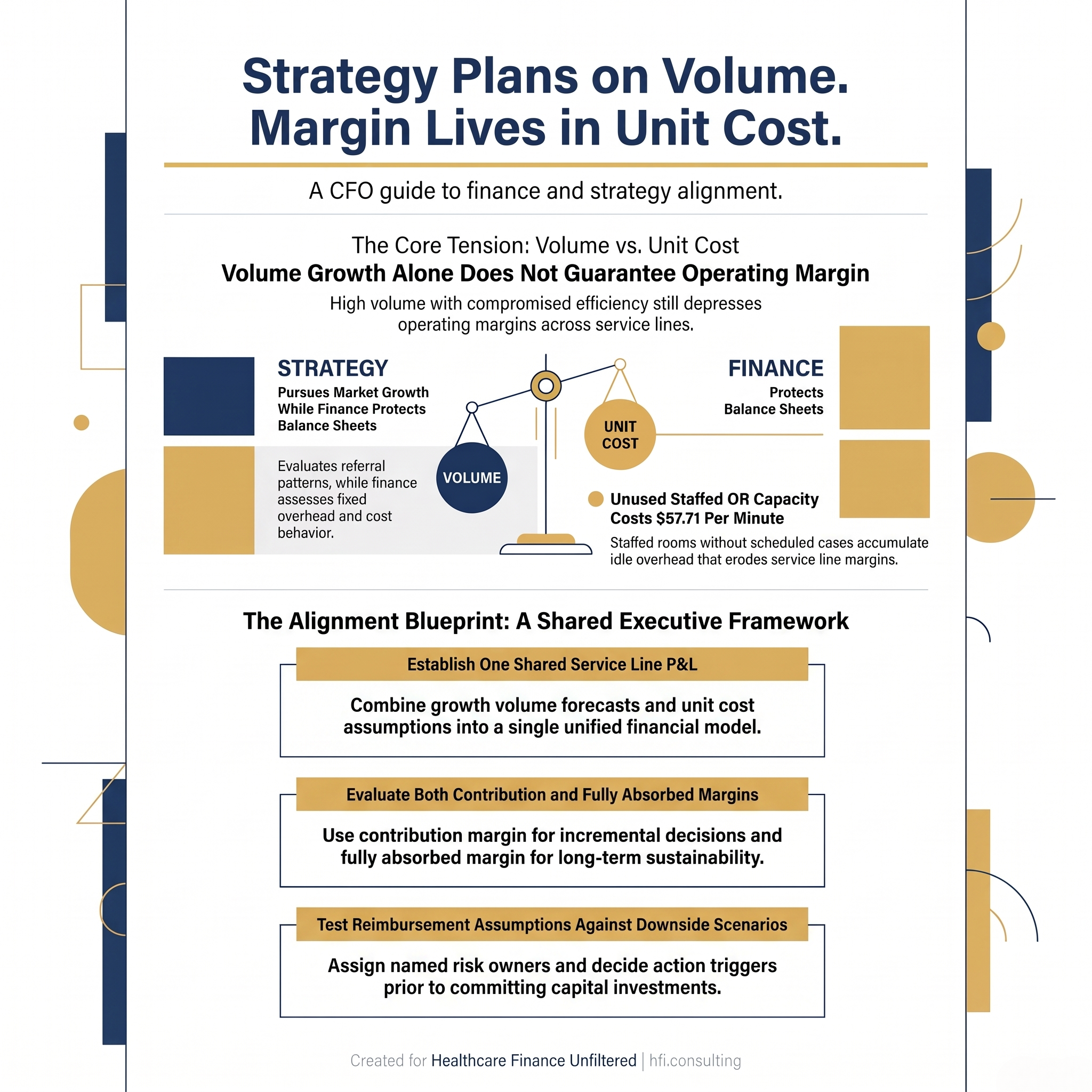
Title graphic reading Strategy Plans on Volume, Margin Lives in Unit Cost, a CFO guide to finance and strategy alignment in health systems.
Strategy Plans on Volume. Margin Lives Somewhere Else.
Strategy teams are paid to find growth. They look at market share, referral patterns, and projected cases. That is the right place to start.
Finance sees the same service line through a different lens. It looks at unit cost and the split between direct and indirect cost. It asks what happens to fixed overhead when the mix shifts.
Both views are true. The trouble starts when each one is presented alone.
"Volume cures all woes." A CFO colleague, quoted by Lee Ann Odom of PYA in Chief Healthcare Executive, May 2026
Odom's point is that how a system manages patient flow and placement matters as much as how many patients it sees. High volume with compromised efficiency is still compromised. Most of us have heard that CFO line in budget season, and it is half right.
The fixed-cost side of the ledger explains why. A Governance Institute analysis of 4,188 acute care hospitals, using 2017 to 2019 data, found voluntary hospitals averaged a 3% loss from patient care operations. Fixed overhead ran about 25% of net revenue.
That data is older, but the structure has not changed. Fixed costs do not shrink when volume softens. Volume only helps if each case contributes enough to cover them.
Finance Is Conservative. Strategy Takes Risks. Both Are Doing Their Jobs.
Here is the headline version. Finance says no, strategy says yes, and the CEO breaks the tie.
Here is what finance leaders actually face. Finance is naturally conservative because it carries the downside. Strategy is built to take risks because growth does not happen without them.
That is not a flaw in either team. It is a design that only works when both sides use the same numbers.
Strategy hands me a volume forecast. I hand back a margin question. Neither of us is wrong.
Each side has a habit worth naming. Finance tends to reply with a number and no path forward. Strategy tends to present a growth case with the cost line left thin.
Neither habit comes from bad intent. Finance is protecting the balance sheet, and strategy is protecting market position. The work is getting both to put a cost assumption and a growth assumption on the same page before the debate starts.
Deloitte's 2024 survey of 63 health care finance leaders shows the gap. Strategic growth had the highest expected effect on margin goals, at 3.9 on a five-point scale. Yet only 27% of health system CFOs treated optimizing service mix as a priority.
I read that as a sign that growth and service line margin are still being discussed in separate rooms. Advisory Board's Sebastian Beckmann made a related point this summer. Volumes and margins no longer move together, so systems need to find the services where they can win in their own market.
The Bariatric Program That Had to Be Priced One Piece at a Time
Years before GLP-1 drugs reshaped the conversation, bariatric programs were a popular strategic bet. At Ascension, I worked on one with the strategy team and the program leader. The margins were thin.
The reason was the program design. Surgery was only one piece. There were step programs, nutritionists, and education sessions, some in groups and some one on one.
Strategy owned the volume case. Finance owned the cost of every piece. Our job together was to show that local volume was real and that reimbursement across the components supported the cost of delivering them.
That is a different question from asking whether bariatric surgery pays. A program is a bundle of services with different reimbursement and different cost behavior. If you price only the surgery, you miss most of what makes or breaks the margin.
It also changes what strategy can promise. A volume forecast for a program is really a forecast for each component, and each component needs its own capacity and staffing.
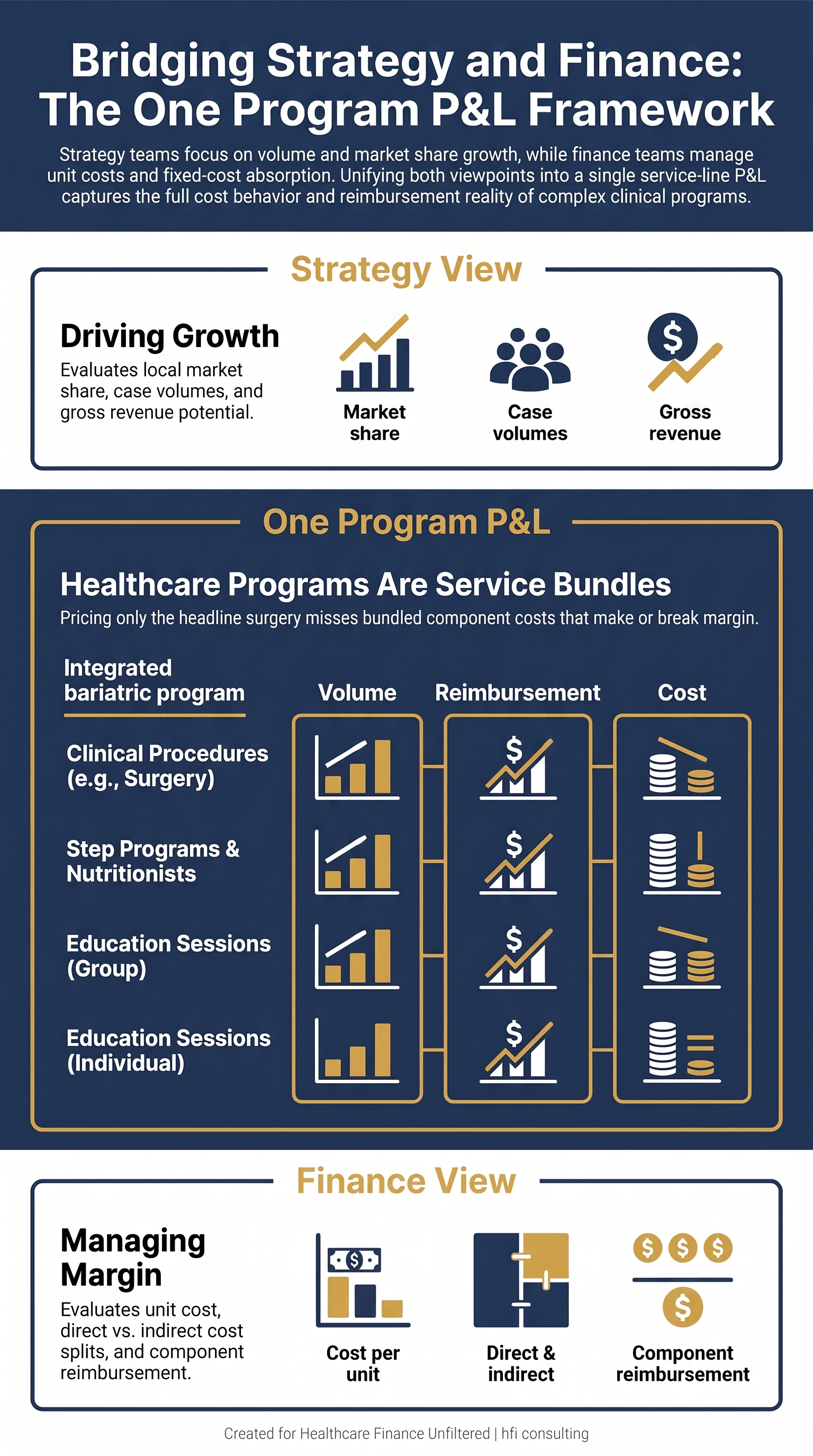
Framework diagram showing a bariatric program priced by component, with strategy volume and finance unit cost meeting in one program P&L.
I use the same logic in my service line financial assessment framework, which is where I start for capital decisions that need to hold up. It begins with the whole program, not the headline procedure.
Staffed Rooms With No Cases Are an Absorption Problem
Walk through almost any OR and you will find staffed rooms with no cases on the schedule. In my experience the cause is usually scheduling, not demand.
A 2026 JAMA Surgery study of 278 California hospitals put the mean cost of one minute of OR time at $57.71 in fiscal 2022. That was a 54% increase from fiscal 2014. At that rate one idle staffed hour costs about $3,460.
Ten idle hours a week across an OR suite is roughly $34,600 a week, or about $1.8 million a year. That is illustrative arithmetic, not your number. Your number sits in your own scheduling and payroll data.
Three questions surface the problem quickly. How many staffed minutes went unused last quarter, who owns the release of unused block time, and what did those minutes cost in payroll whether or not a case ran?
Physician leaders at Surgical Directions and Ventra Health described a 23-room OR in a 2026 Becker's article. Unused anesthesia capacity added an estimated $4 million a year in fixed overhead, measured against a practical 75% adjusted utilization target. Ventra sells revenue cycle services, so read that as an illustration, not a benchmark.
This is where strategy and finance talk past each other. Strategy sees an under-filled OR as a growth opportunity. Finance sees idle fixed cost already sitting in the base.
Both can be right, but only if the growth plan fills the staffed time instead of adding to it. Which cost view you use decides which conclusion you reach.
Here is the rule that keeps the debate honest. Contribution margin answers whether an added case or a service line improves your position, because fixed costs stay whether you do the work or not. Fully absorbed margin answers whether the service line can sustain itself and what it must be priced at.
The Governance Institute authors make the same distinction. Pricing on incremental cost helps you compete for volume, but fixed costs still have to be covered at full cost.
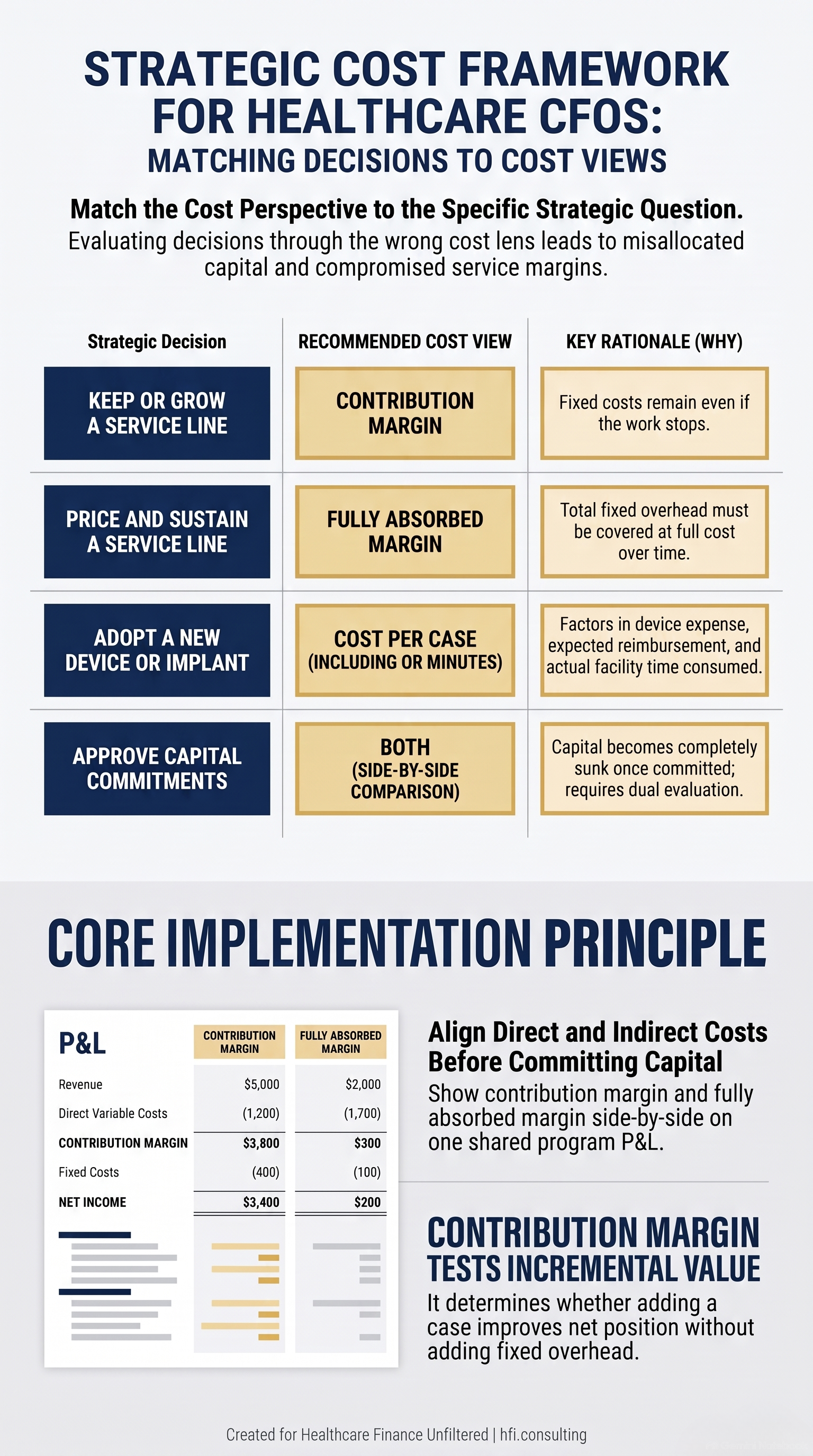
Comparison table matching four health system decisions to contribution margin or fully absorbed margin and explaining why each view fits.
If your dashboard shows only one of those views, my piece on contribution margin integrity covers what it is likely missing.
The Implant Decision Is Where Alignment Gets Tested
In my experience the clearest test of whether finance and strategy work well together is the high-cost implant analysis. The question is which new devices to start using, and what they cost against what they bring.
Physician preference items, mainly implants and devices, are commonly estimated at 40% to 60% of hospital supply spend. Industry sources such as ECRI and Definitive Healthcare put them at the high end of that range in orthopedics, cardiology, and spine. Those are often the service lines strategy is trying to grow.
The failure runs in both directions. If strategy brings the device case without the cost analysis, you adopt first and learn the margin later. If finance runs the analysis alone and says no, you can block the technology your surgeons need to compete.
The fix is sequencing. Put the device's full cost per case next to its reimbursement and the OR minutes it uses, before the commitment. Then decide together.
I covered the cost side in more detail in implant costs as a contribution margin problem. It shows why this is a finance and strategy conversation, not a billing cleanup.
A note for CFOs who want a second set of eyes. If you want to compare notes on how service line numbers move from your ledger into the strategy conversation, send me a message through hfi.consulting. I am glad to talk through what is working for finance and strategy teams right now.
The Payer Side Asks the Same Question
From the payer side, strategy and network conversations start and end with reimbursement and what regulatory changes are coming. That is the question underneath every growth plan.
The provider-side lesson is practical. The reimbursement assumption is the most fragile input in any service line plan. Strategy tends to model it as a rate, and finance should test it as a range.
Treat regulatory change as a planning input, not a prediction. Build a base case and a downside case for each growth program, and decide in advance what each one would change.
Two questions keep that honest. What reimbursement change would turn this program's margin negative? And if that happened, what would we do, and who decides?
If nobody can answer the second question, the plan is not finished. A growth case without a downside owner is a forecast, not a decision.
Put One Set of Numbers in One Room
In my experience this work happens at the very top. The CEO, the CFO, and the strategy leaders are in the room together. That matters more than any template.
Here is a working structure for that room:
Agree on one service line P&L that shows direct and indirect cost separately.
Show contribution margin and fully absorbed margin side by side, and label the decision each one answers.
Put capacity in the model. Staffed minutes, not just cases.
Test the reimbursement assumption against a downside case before approval.
Decide in advance what result would change the decision.
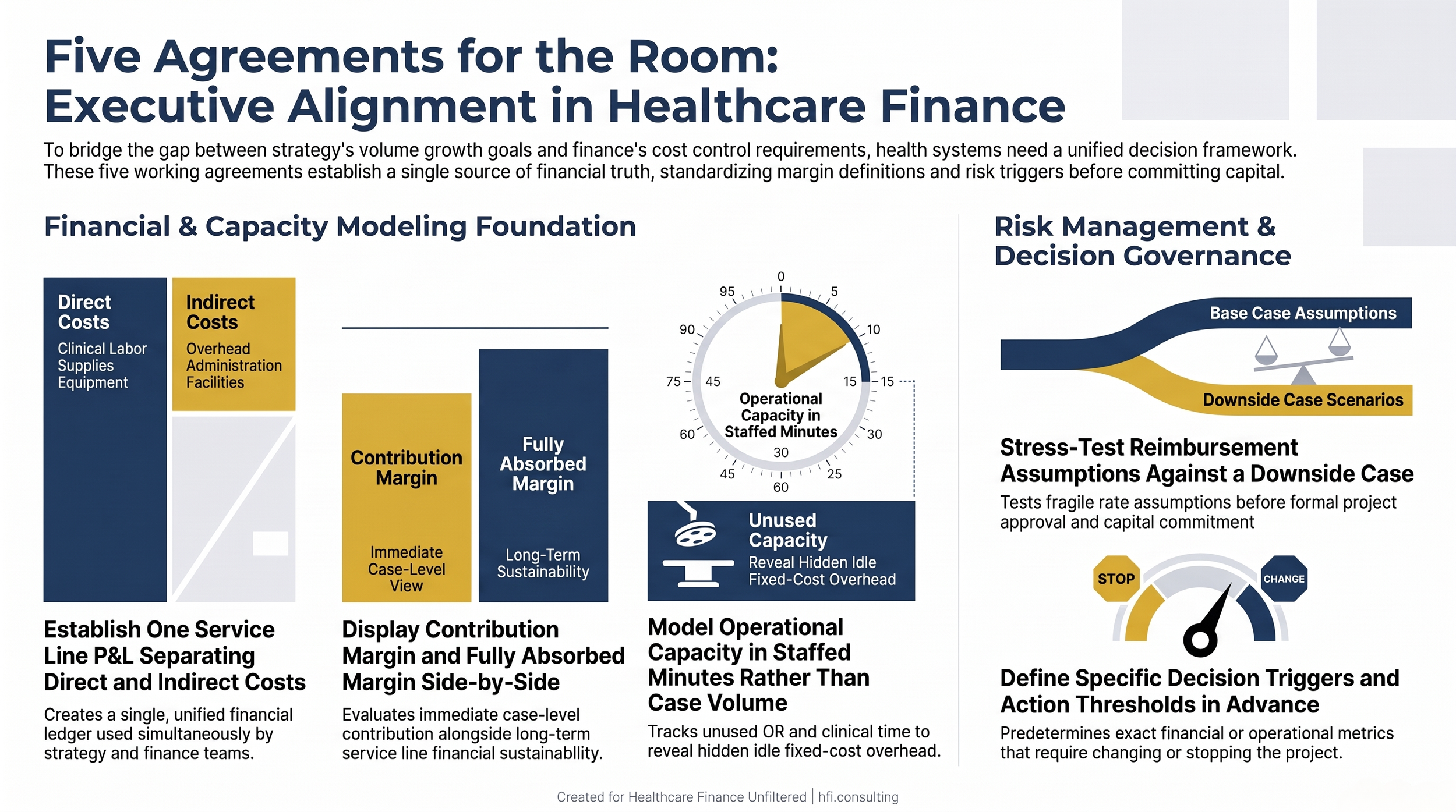
Checklist of five agreements for finance and strategy leaders: one service line P&L, two margin views, capacity, a downside case, and triggers
Finance owns the cost build. That means the direct and indirect split, the allocation method, and the capacity view. Strategy owns the growth assumptions: volume, market share, and timing.
The shared work is the overlap. Every assumption needs one named owner and one source. When a number changes, both teams hear it the same day.
The first item on the list is a chart of accounts question. If your ledger cannot separate direct from allocated cost by service line, the strategy debate never reaches the margin. Whether you run Oracle, NetSuite, or Sage Intacct, the structure of the accounts decides what the room can see.
At HFI Consulting, this is the foundation we build with finance teams before any service line analysis. Clean accounts make the strategy conversation faster.
I also looked at how portfolio decisions change when the margin view is in front of the room, in health system portfolio rationalization.
Finance, brings a yes with conditions. Strategy, bring the cost of capacity next to the volume case. Neither side should hand the other a surprise at the capital committee.
Volume still matters. It just does not settle the question on its own.
Run this once on a single program before you scale it. Pick a service line already on the strategy agenda, build the shared P&L, run the downside case, and see what the room decides differently. That is not a cost-cutting exercise; it is how you protect the growth you approve.
If your strategy and finance teams review service line numbers separately today, start with one service line and one shared P&L this quarter. If you want help building it, visit hfi.consulting and tell me where you are stuck. I can also send you a worksheet that shows contribution margin and fully absorbed margin side by side for a service line.
P.S. When strategy brings a growth case to your executive team, who owns the unit cost number: finance, strategy, or whoever asks first? Hit reply and tell me. I read every response.
