
Fiscal Year Selection for ASCs and Medical Practices: How to Choose, Change, and Conform After a Merger
Why hospitals pick October, July, or January, and what an acquisition can do to your books, budget, and chart of accounts.
October 1 just opened a new fiscal year for the federal government and for many hospitals. If you run a practice or an ASC, that date matters less than the one a buyer or JV partner could assign to your books. A year-end change reaches your budget, your close calendar, and your chart of accounts all at once.
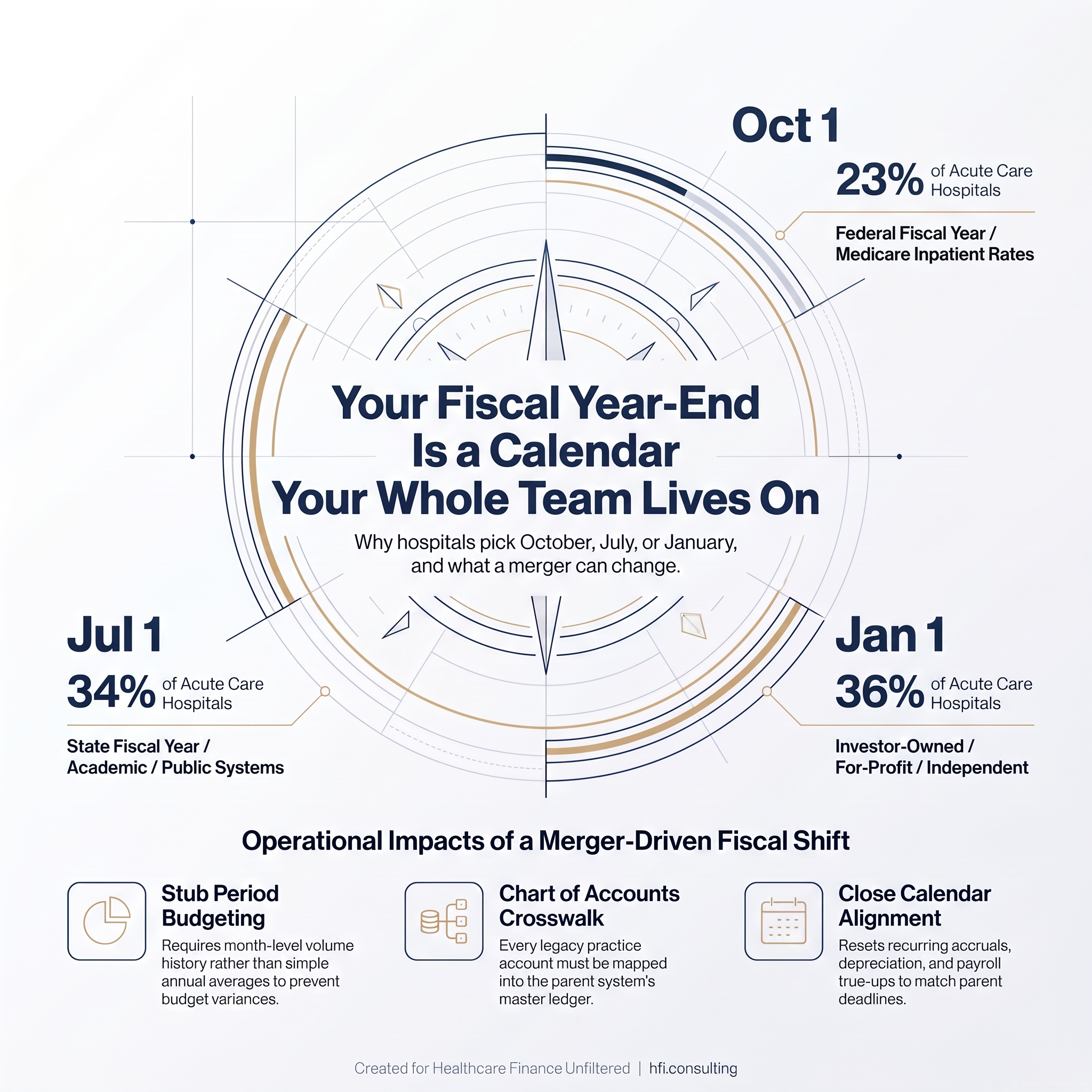
Title graphic reading Your Fiscal Year-End Is a Calendar Your Whole Team Lives On, with Oct 1, Jul 1, and Jan 1 fiscal year start dates at the edges.
Hospitals Cluster Around Three Fiscal Year Dates
Hospitals do not share one fiscal year. The pattern follows ownership, not a federal mandate. Three start dates show up again and again: October 1, July 1, and January 1.
Fitch Ratings' acute care portfolio gives the clearest published split. About 36% run on the calendar year, 34% end June 30, 23% end September 30, and 7% use other dates.
The Bond Buyer reported those figures in 2023. Fitch rates bond issuers, so read this as a pattern and not a census.
The October 1 start tracks the federal fiscal year. Medicare inpatient payment rates also reset on October 1, and many government and district hospitals match that calendar. A Massachusetts finance executive on an HFMA expert panel described a September 30 year-end as the norm for the not-for-profit hospitals in his state.
The July 1 start tracks the state. Forty-six states begin their fiscal year on July 1, according to the National Conference of State Legislatures.
Public, academic, and state-sponsored hospitals often follow. Some large multi-state systems close on June 30 as well, and CommonSpirit is one example.
The January 1 start is the default for investor-owned hospitals and most independent not-for-profits. HCA reports on the calendar year. The same HFMA panel agreed that most for-profit and not-for-profit hospitals use calendar years, while state, local, and district hospitals lean toward June or September.
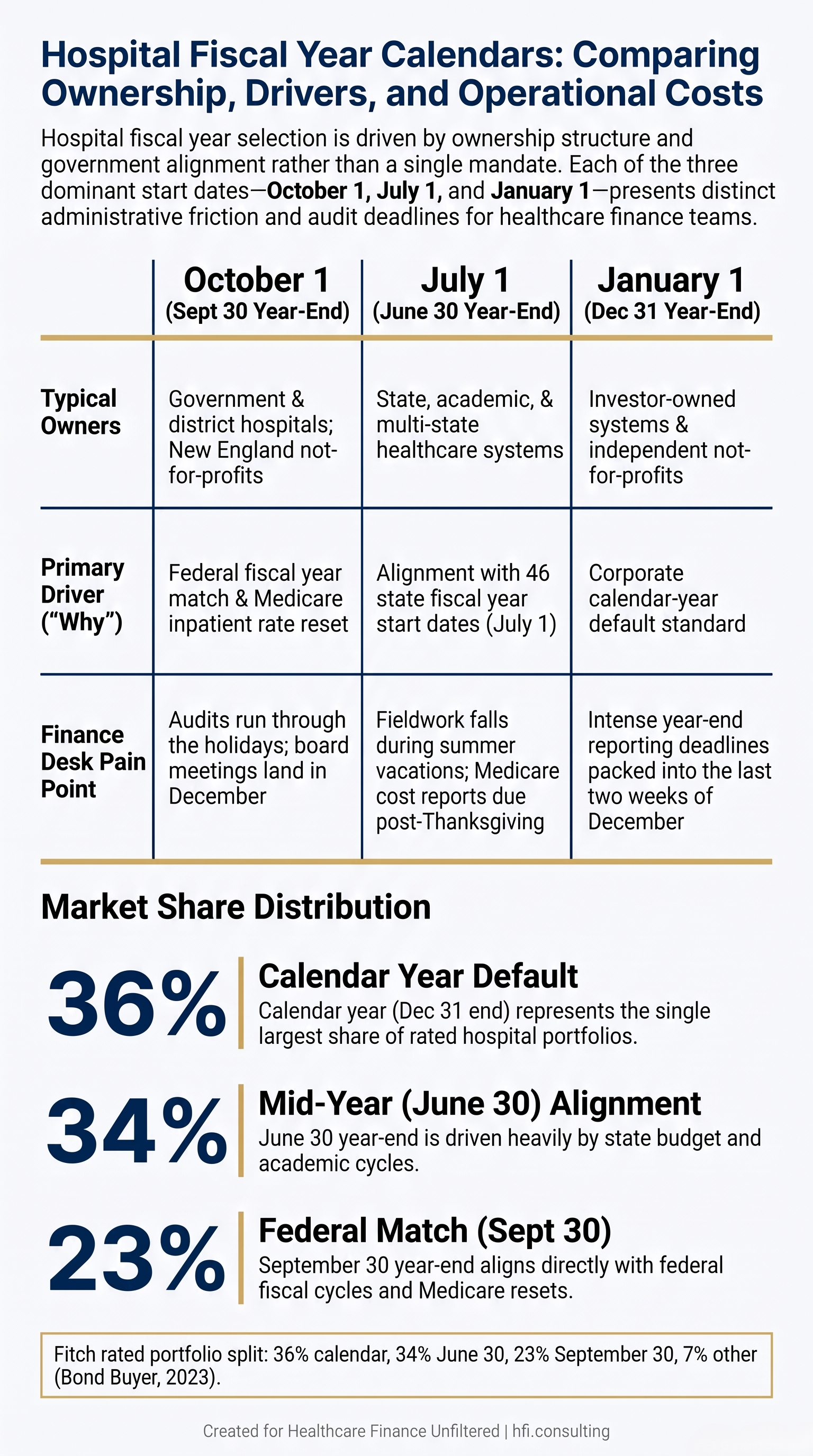
Table comparing hospital fiscal year starts of October 1, July 1, and January 1 by typical owner, reason for the date, and finance team pain point.
Every Year-End Has a Cost
No date is clean for the finance team. HFMA's panelists named the tradeoffs.
June 30: audit work lands in the summer, when key people take vacation, and the Medicare cost report comes due right after Thanksgiving.
September 30: audit work runs into the holidays, and finance committee and board meetings land in December.
December 31: the year-end deadline work lands in the last two weeks of December.
Where the Large-System Rules Come From
Hospitals file a Medicare cost report. It is due five months after the fiscal year-end, so a June 30 hospital files by November 30. ASCs and physician practices are paid on fee schedules and do not file one.
Hospitals also cannot change year-ends on a whim. Under CMS manual rules, as summarized by Noridian, the MAC must receive the written request at least 120 days before the close of the proposed period. The MAC must also find good cause.
One of CMS's own examples of good cause is a chain moving a newly acquired facility onto the same year-end as its other providers. A change meant to maximize reimbursement does not qualify. An approved change can produce a cost reporting period of one to thirteen months.
That rule explains why systems standardize. One calendar makes consolidated reporting simpler. The preference for a single year-end then travels downstream to every practice and ASC a system buys or partners with.
What Your Fiscal Year Controls in a Small Practice or ASC
None of the cost report rules apply to you. Your year-end is set by your entity structure, your owners, and your lenders.
Tax year rules can narrow your options, so confirm any change with your CPA. The operating side is large. Your fiscal year sets your budget cycle and your monthly close calendar. It also sets when accruals, payroll true-ups, and owner distributions get reconciled.
What Each Year-End Feels Like at the Finance Desk
I have worked on both sides of this calendar. At UF Health Jacksonville and at Ascension, the fiscal year started July 1. A July start means February and March are long nights and a stack of budget meetings.
Baptist ran on an October start. That moves the budget crunch into the summer, so there was no summer vacation. Audit results arrived right before Christmas, and that is no time to relax.
I also worked with a short fiscal year that started in March and ran only nine months. Nothing broke. It was a buildup year, so projections were hard to defend in budget planning.
A short period has no clean run rate. You budget it with less history and more judgment. Keep that in mind for what comes next.
"We closed the deal in August. In October we learned our books had a new year-end and a six-month short fiscal year nobody had budgeted." (Illustrative practice administrator perspective)
When an Acquisition or JV Moves Your Year-End
Here is the common path. A hospital system buys your practice, or a JV partner takes a stake in your ASC. The new parent wants one reporting calendar, so your books get conformed to theirs.
Say your practice runs on the calendar year and the parent closes June 30. You run a six-month short fiscal year from January 1 to June 30. That short year needs its own budget, its own close, and its own comparatives.
Six months is not half of a year. Volume and cash collections are rarely flat across the calendar. Budget the short year from month-level history, not half of the annual number.
Here is an illustrative example. Your ASC budgets $6.0 million in annual net revenue, and half of that is $3.0 million.
Now suppose your last three years show January through June delivering 46% of annual revenue. The budget for the short year is $2.76 million, which is $240,000 lower than the shortcut. That gap lands in your first variance report.
I covered the finance side of surgical volume shifts in my ASC financial operations playbook. Month-level volume data matters just as much when you budget a short fiscal year.
The bigger risk is not the short year. It is the data.
I have seen a radiology center brought onto a new set of books where the accounting systems could not talk to each other. The new books stayed incomplete, so the team kept the older data outside the system in Excel files for historical review.
That choice can work. It works better when someone makes it on purpose. An Excel archive has no controls, no version history, and often no named owner.
A practice on QuickBooks or Xero joining a parent on Sage Intacct, NetSuite, or Oracle faces a crosswalk problem. It is not an import problem. Every practice account needs a home in the parent's chart of accounts.
Chart of accounts mapping is where errors tend to hide, a pattern I described in healthcare chart of accounts errors in medical practices. If the conversion forces a platform decision, my healthcare accounting software selection framework covers how to avoid being sold the wrong system.
Clean monthly bookkeeping also makes any short-period close easier. I made that case in bookkeeping for medical practices.
I built a Fiscal Year Transition Calendar workbook for exactly this moment. It calculates your short fiscal year, lays your current close and budget calendar beside the new one, and includes a chart of accounts crosswalk template and a data retention log. Download it at hfi.consulting.
The Five-Step Conforming Framework
When I work through this with practices at HFI Consulting, the crosswalk comes first. The full sequence looks like this.
Step 1: Confirm the year-end and effective date. Get the new year-end, the effective date, and the length of the short year into the deal documents. If the documents are silent, ask who decides and by when.
Step 2: Budget the short year on its own. Use month-level run rates and flag the months where your history is thin. Keep that budget separate from the first full-year budget so each gets judged on its own terms.
Step 3: Build the chart of accounts crosswalk before the first close. Map every account. Give each unmapped line a named owner and a due date.
Step 4: Decide where history lives. Convert it into the new system or archive it on purpose. Lock the trial balances and name an owner for the archive.
Step 5: Rebuild the close calendar. Reset recurring entries, accruals, depreciation, and payroll true-ups to the new year. Confirm the parent's close deadline in writing.
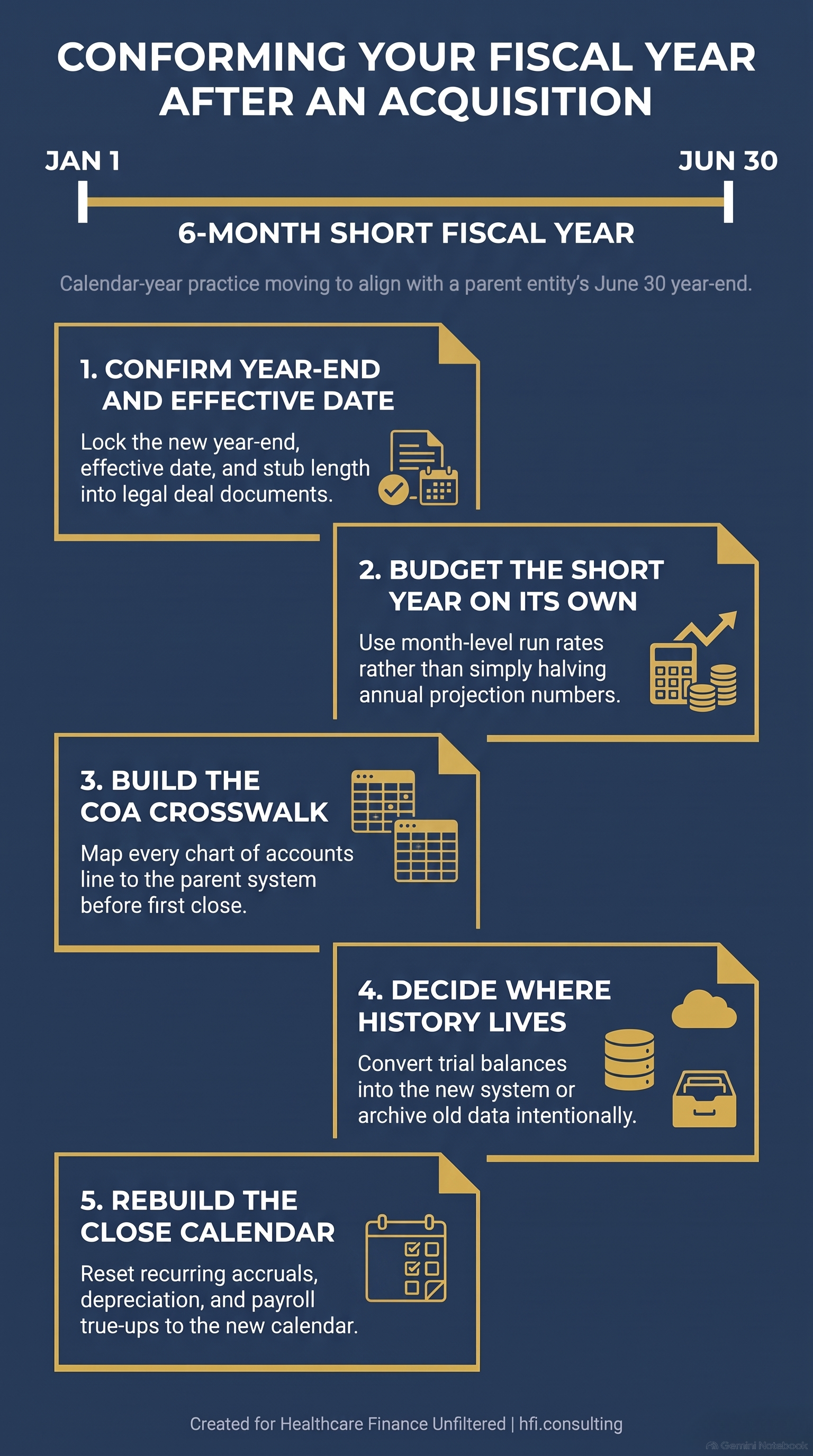
Five-step conforming framework flow with a six-month stub period bar from January 1 to June 30 for a practice moving to a June 30 year-end.
What Changes at the Close Desk
Expect the parent to set a close deadline. Consolidated reporting needs your numbers on a schedule you did not choose. Ask for that date in writing before the short year starts.
The first few closes after the move are where small gaps surface. Prepaid expenses, accrued time off, and depreciation schedules often carry assumptions from the old calendar. Walk each recurring entry and confirm it still fits the new year.
Then tie the short year's ending balances to the opening balances of the first full year. That tie-out is your proof that nothing fell between the two sets of books.
Questions to Ask the Buyer
Put these on the table before you sign.
Who sets the new year-end, and can the effective date move?
Will your accounting platform be retired, and when?
Does your chart of accounts get replaced or mapped?
Who owns the pre-deal ledger after closing?
What is the parent's close deadline, and who signs off on the short year?
How to Choose When You Get to Choose
Sometimes the choice is yours. A new ASC, a new practice, or a restructuring can open the door. A few questions help.
Which year-end do your owners and lenders already report against?
Does the year-end avoid your busiest procedure months and your heaviest holiday staffing gaps?
Will your budget cycle fall in months when your data is clean?
Does a likely acquirer or JV partner run a different year? Matching it early can save you a short year later.
If two dates look close, run both through the same calendar. The workbook's side-by-side view shows where each one collides with your budget and close. Confirm the answer with your CPA before you commit.
A Note From the Payer Side
From the payer side, a provider's fiscal year never created real friction for me. After a deal, the work was renegotiating new contracts. Put that timeline on your deal calendar next to the year-end.
Pick the Calendar on Purpose
Your fiscal year is the calendar your whole finance function lives on. Pick it on purpose, or inherit it with a plan. The worst version is learning in October that your year-end moved in August.
A year-end change is cheap to plan and expensive to discover. If a deal is on your horizon, HFI Consulting helps practices and ASCs with chart of accounts design, bookkeeping, and budget planning before the books move. Start at hfi.consulting.
P.S. Has a merger or ownership change ever moved your fiscal year-end? Reply and tell me what broke first. I read every response.
