
Healthcare Accounting Software Selection: The CFO Framework for Choosing the Right System Without Getting Sold the Wrong One
Your entity count, payer mix, and regulatory burden should drive your ERP decision. Marketing materials won't tell you that.
Medicare cost report season is the fastest stress test of whether your accounting system was designed for healthcare or just adapted to tolerate it. If your team is rebuilding the trial balance mapping from scratch every year, or maintaining a parallel spreadsheet model to calculate net patient service revenue, your general ledger is working against you. That friction has a dollar cost attached to it.
The accounting software conversation has gotten louder in 2026 as health systems replace aging Lawson and legacy on-premise deployments, as multi-location physician groups scale past what QuickBooks can carry, and as behavioral health and post-acute providers face growing grant and fund accounting obligations. The vendors will tell you their platform is built for healthcare. The harder question is whether it is built for your healthcare.
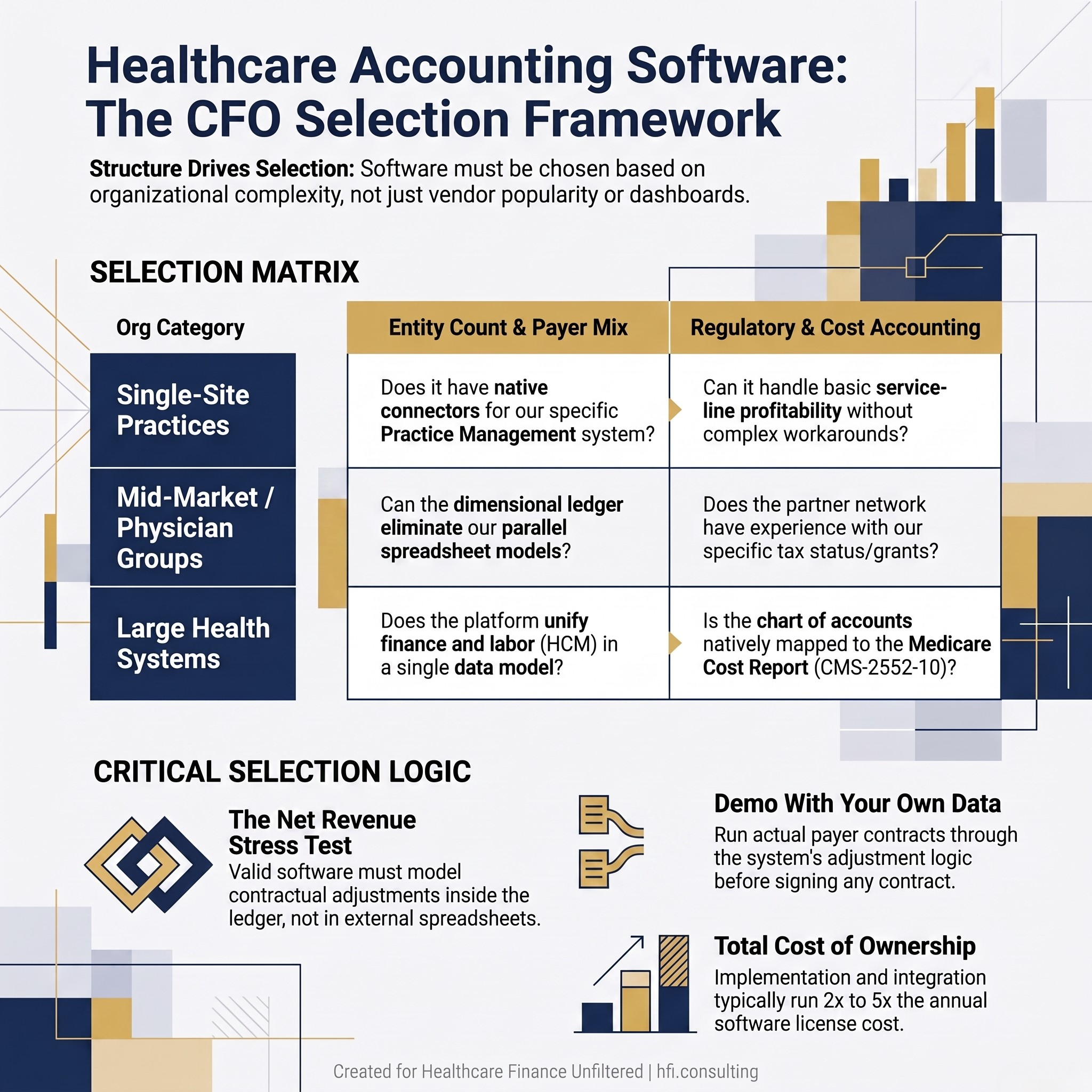
Healthcare accounting software selection framework showing three organization tiers mapped to four decision criteria including entity count, payer mix, regulatory burden, and cost accounting requirements.
Why Healthcare Accounting Is Different From Every Other Industry
Healthcare finance teams face a structural problem that no standard general ledger was designed to handle. The price on the invoice is almost never the price that gets paid.
A hospital records a gross charge, reduces it by a contractual allowance negotiated with each payer, then reduces it again by an implicit price concession for amounts it does not expect to collect. What remains is net patient service revenue. Under ASC 606, that figure is what belongs on the income statement. Not the gross charge.
Software that cannot model those adjustments inside the ledger pushes the reconciliation into spreadsheets. That is where audit preparation turns into a weeks-long reconstruction project, and where the margin for error expands every year.
Layer on top of that the fixed asset complexity of imaging equipment and construction in progress, a workforce that is typically the single largest expense category, multiple legal entities spanning a hospital campus and foundation and management services organization, and the annual obligation of Form CMS-2552-10 for Medicare participating facilities. General-purpose accounting platforms were not designed for this operating environment. The question is which healthcare-specific platforms are designed for yours.
The Four Variables That Should Drive Your Decision
Before you request a demo from any vendor, four organizational characteristics should determine your shortlist.
Entity count. A single-site practice with one tax entity has different needs than a hospital system with a hospital, physician group, foundation, and joint venture on the same balance sheet. Multi-entity consolidation, intercompany eliminations, and the ability to produce auditable separate financials for each entity are features that matter only when you have multiple entities, and become critical when you do.
Payer mix complexity. The more diverse your payer mix, the more your ledger needs to carry payer-specific contractual adjustment logic. A practice with two major payers and a simple fee schedule can manage with tracking categories. A health system with forty payer contracts, risk-based arrangements, capitation, Medicare Advantage, and Medicaid managed care cannot.
Regulatory reporting burden. Tax-exempt hospitals file IRS Form 990 with Schedule H community benefit reporting. Hospitals participating in Medicare file an annual cost report. Public hospitals report under GASB standards. These are not add-ons to a general ledger. They require the chart of accounts and cost-center hierarchy to be designed with those mappings in mind from day one.
Cost accounting depth. Service-line contribution margin decisions require a ledger with enough dimensionality to allocate direct and indirect cost to clinical service lines. If cardiology, orthopedics, and imaging need separate margin visibility, the system has to support that level of allocation. Some organizations run cost accounting in a separate decision-support platform like Strata Decision; others need it inside the ERP. Know which you are before you shortlist.
During my work at Ascension across seven hospitals, the organizations that struggled most with system selection were the ones that shortlisted based on what the vendor presented rather than what the operational structure required. The chart of accounts question, the payer adjustment logic, and the Medicare Cost Report mapping conversation should happen before anyone shows you a dashboard.
The Market, Honestly Mapped
The current accounting software landscape for healthcare providers falls into four tiers, and the differences between them are structural, not cosmetic.
Large health systems most commonly evaluate Workday, Oracle Fusion Cloud ERP, Infor CloudSuite Healthcare, and SAP S/4HANA. Workday's integration of finance and human capital management is a structural advantage for organizations where labor is the largest cost category, which is every hospital. Oracle Fusion positions well when Oracle Health (Cerner) is the clinical system, because the back-office integration is tighter. Infor CloudSuite carries a large installed base rooted in the legacy Lawson footprint. Annual software costs at this tier typically run from $150,000 to over $1 million, before implementation.
Mid-market and multi-entity providers (physician groups, behavioral health organizations, ambulatory chains) have converged on Oracle NetSuite and Sage Intacct as the dominant options. Both consolidate multiple entities and carry a dimensional ledger. Both outgrow the need for parallel spreadsheet models. Sage Intacct is widely used by tax-exempt and multi-location providers. NetSuite is stronger for organizations with more complex intercompany transaction volume. Annual software costs at this tier typically run from $20,000 to $200,000 depending on module selection and entity count.
SMB and mid-market organizations aligned to Microsoft often evaluate Dynamics 365 Business Central and Acumatica. Both integrate well with the Microsoft ecosystem. Acumatica's consumption-based licensing model is attractive for organizations where user counts fluctuate. These platforms require more healthcare-specific configuration work, but they are workable for organizations that do not require deep Medicare Cost Report support.
Single-site practices are the natural home for QuickBooks Online and Xero. The distinction between them matters more than most people acknowledge. QuickBooks Online is the default for U.S. outpatient clinics because the practice management integration library is built around it. Systems like athenahealth, eClinicalWorks, Kareo, Open Dental, and Dentrix all have native or supported connectors. Xero is cleaner and wins on multi-entity and multi-currency workflows, but carries a smaller U.S. healthcare integration footprint and a thinner domestic CPA pool.
The limitation of both appears at the same point: when you add a second legal entity, receive your first grant, or need reliable service-line profitability with any rigor. At that point, the workarounds start to cost more in staff time than a dimensional ledger would cost in license fees. The bookkeeping decisions that look simple at the single-site level have a way of becoming structural constraints the moment the practice adds complexity.
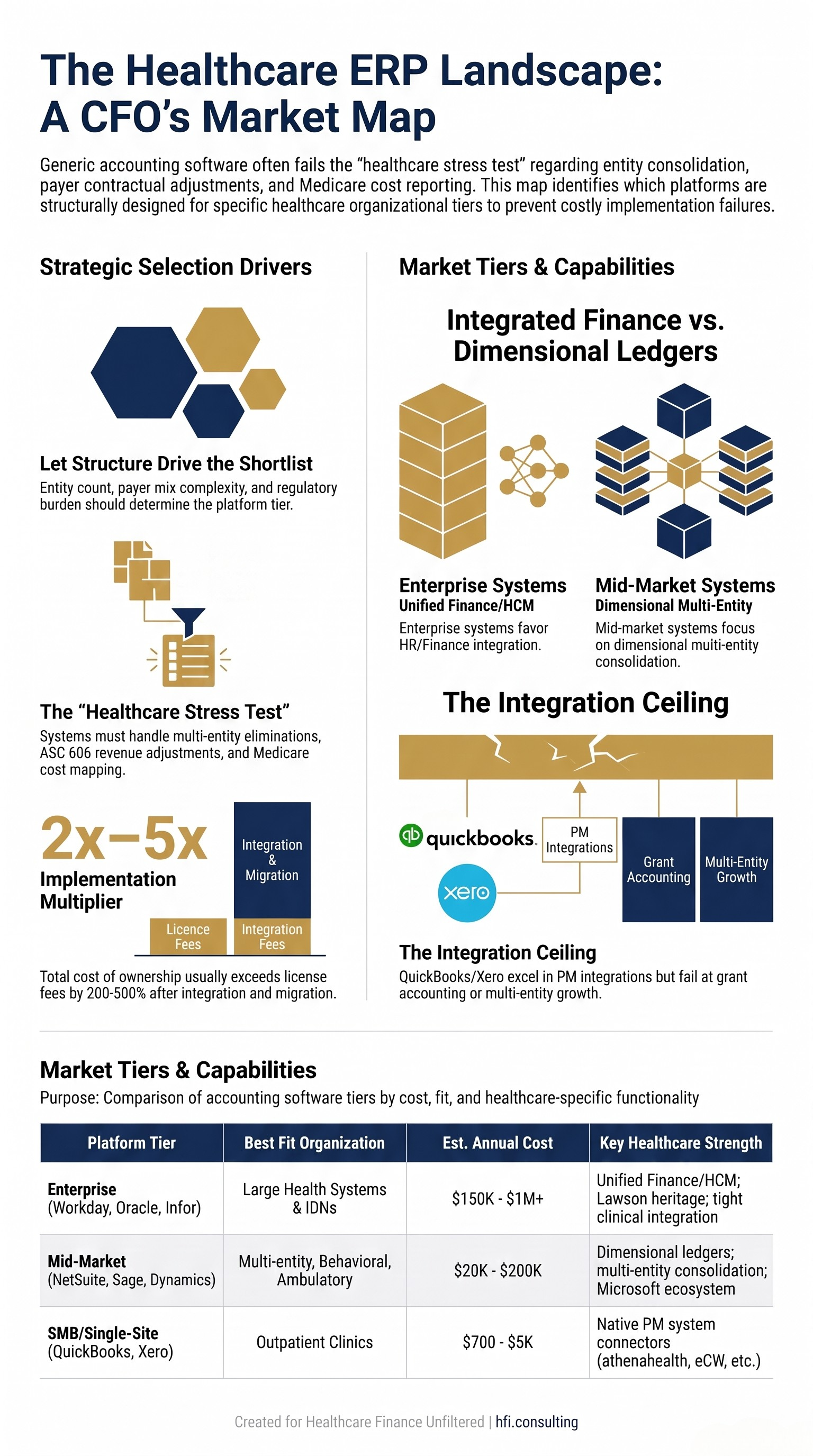
Healthcare accounting software comparison table showing platform tiers, organization fit, cost range, and key healthcare strengths for systems from Workday to QuickBooks.
Two Systems Finance Leaders Frequently Confuse
Two categories of software are often conflated with accounting systems, and the confusion is expensive.
Revenue cycle platforms (Epic Resolute, Oracle Health, and the clearinghouse and denial management tools your team uses daily) manage patient registration, coding, claims submission, and collections. They determine what gets billed and what gets collected. They are not the general ledger.
Decision-support and cost accounting platforms like Strata Decision (which now includes the Syntellis Axiom product line) sit alongside the ledger to model per-case cost and support budget-to-actual analysis at the service-line level. They are not the general ledger either.
Both categories feed the general ledger. Neither replaces it. The revenue cycle system determines what gets recognized; the accounting system determines how it is recognized, reported, and audited.
If your ERP vendor is pitching you on revenue cycle functionality, or your revenue cycle vendor is pitching you on replacing your general ledger, those are the conversations worth slowing down.
What matters at the ledger interface is a supported, reconcilable connection: agreed ownership of charges and cash, a documented posting summary, and the ability to tie the sub-ledger back to the general ledger every month. Get that documented before signing anything.
This connects directly to the payment reconciliation challenge that hits independent practices particularly hard. The sub-ledger-to-ledger reconciliation is where most small and mid-size practice accounting breaks down. Not because of bad software, but because the interface between the practice management system and the accounting platform was never designed for high-volume, multi-payer environments.
The Medicare Cost Report Question Should Come First
Hospitals participating in Medicare file Form CMS-2552-10 annually with their Medicare Administrative Contractor. Preparation requires mapping the trial balance to the report's defined cost centers.
If your chart of accounts was designed with that mapping in mind, the cost report is an extract. If it was not, cost report season is a reconstruction project that can consume weeks of finance team capacity.
This question should come before any vendor demo: show me how the chart of accounts maps to cost report requirements, and show me a client of similar size that has gone through the CMS audit process on this platform.
The same logic applies to Form 990 Schedule H for tax-exempt providers. Community benefit reporting, Section 501(r) compliance, and the financial assistance policy documentation all require data that has to live somewhere in your financial system. If the system cannot produce Schedule H-ready data without a manual rebuild, that is a real operational cost.
From my time at UF Health Jacksonville managing a Level 1 Trauma and Level 3 NICU safety-net facility, the Medicare Cost Report and DSH calculation were never background noise. They were active cash flow determinants. The finance team that could run cost report scenarios without waiting for IT had a material advantage in managing that calendar.
HIPAA Scope: A Vendor Question That Belongs in Procurement
A general ledger typically stores summarized financial data, not protected health information. That distinction matters for HIPAA.
Where a system does create, receive, maintain, or transmit PHI on behalf of a covered entity (patient-level accounts receivable detail being the common case), HIPAA requires a Business Associate Agreement with that vendor.
Most CFOs assume this is the legal team's problem. It is also a vendor contract risk question. During procurement, confirm whether your intended configuration places PHI in the accounting system, and whether the vendor will execute a BAA. If the vendor will not sign a BAA, and your configuration puts PHI in the system, you have a compliance gap that no dashboard integration can fix.
This is one of the areas where the EHR vendor risk conversation and the ERP selection conversation intersect. As I covered in the broader analysis of IT governance as a finance problem, the financial exposure from a vendor BAA gap is not theoretical. It is a penalty calculation that starts with the number of records affected.
If your organization is navigating an ERP selection or outgrowing your current accounting platform, the framework questions above are a starting point, not a vendor scorecard. HFI Consulting works with healthcare finance teams on system selection, implementation governance, and vendor contract review. Start at hfi.consulting
The Selection Process That Actually Works
Vendor demos are marketing exercises. The selection process that produces a defensible recommendation starts before any vendor is invited in.
Step 1: Document your requirements before you talk to anyone. Map your legal entities, payer mix, service lines, cost centers, and the specific reports your board, external auditors, and regulators require. Include the Medicare Cost Report mapping, Schedule H requirements, and any GASB obligations. This document becomes your evaluation rubric.
Step 2: Establish your tax status first. A tax-exempt hospital needs fund accounting, Form 990 and Schedule H support, and 501(r) evidence. A public hospital reports under GASB. A physician group taxed as a partnership needs none of that. These requirements diverge sharply. Settle this before you shortlist.
Step 3: Decide how much cost accounting depth you actually need. If service-line margin analysis drives strategic decisions at your organization, insist on a dimensional ledger and ask explicitly whether per-case costing lives in the ERP or in a separate decision-support platform you will also have to purchase and integrate.
Step 4: Map the revenue cycle interface in writing. Confirm how charges, contractual adjustments, and cash post from your revenue cycle system into the ledger. Confirm who owns each figure and how the sub-ledger reconciles to the general ledger monthly. Get this in writing before signing.
Step 5: Evaluate total cost of ownership, not license fees. Implementation, data migration, integration build, training, and ongoing support typically run two to five times the annual license cost for enterprise deployments. For large health systems, a Workday or Oracle implementation project can run $5 million to $30 million or more before the system is live. The hidden cost framework for digital health investments applies directly here: what gets capitalized, what gets expensed, and how the vendor's implementation timeline maps to your fiscal year all have budget implications that do not appear in the license quote.
Step 6: Demo with your own data. Narrow to three to five vendors and run your actual payer contract through the contractual adjustment logic. Run your actual service-line allocation. Close a simulated month end. Then check references with providers of similar size, similar tax status, and the same clinical system.
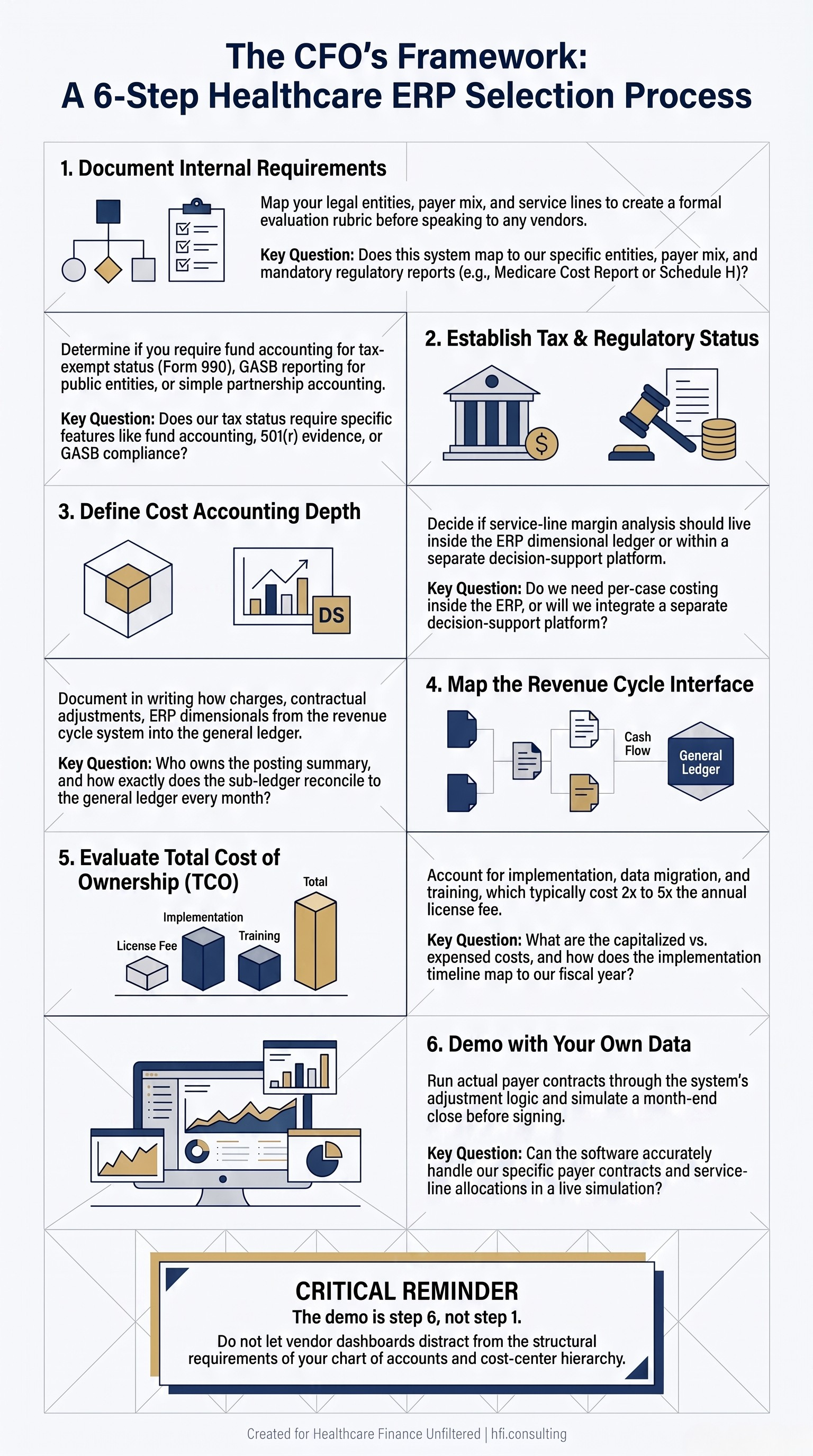
Six-step healthcare accounting software selection process flow showing requirements documentation through reference checks, with key questions at each stage.
Special Considerations by Organization Type
Independent practices and single clinics. QuickBooks Online is the default for U.S. outpatient clinics for a concrete reason: the U.S. healthcare integration stack is built around it. Most major practice management systems, payroll platforms, and billing tools have native or supported QBO connectors. The limitation appears when you add a second legal entity, receive a grant, or need provider-level profitability. At that point, the spreadsheet workarounds cost more in staff time than a dimensional ledger would cost in subscription fees.
Xero is the better choice for multi-entity groups, practices expanding internationally, or organizations starting with no legacy integration debt to inherit. The reconciliation workflow is cleaner, and the unlimited-user pricing model is more predictable as the organization grows.
Physician groups, ambulatory, and behavioral health. Sage Intacct and Oracle NetSuite are the common choice at the point where a second legal entity is added or the first value-based contract is signed. Both carry a dimensional ledger and consolidate multiple entities. The deciding factor is usually the accountant relationship. Most U.S. CPAs work primarily in QBO, and Sage Intacct has a larger healthcare-specific implementation partner network than NetSuite in most markets.
Hospitals, IDNs, and large health systems. Labor is the largest expense category and the most complex to model. Systems that unify finance and workforce management (Workday being the clearest example) have a structural advantage in this segment because the people cost and the finance cost live in the same data model. Oracle Fusion Cloud ERP and Infor CloudSuite both have deep healthcare install bases and strong Medicare Cost Report support. SAP S/4HANA is the choice for large multinational providers with statutory reporting breadth requirements.
What’s Next?
The accounting system question is not a technology decision. It is a structural finance decision about where your organization needs to produce reliable data and how much manual work you are willing to fund to compensate for a system that was not designed for your entity structure.
The systems that work in healthcare are the ones that can carry a payer contractual adjustment from gross charge to net patient service revenue, allocate cost to the service line, consolidate a dozen legal entities into one set of statements, and still produce a clean Medicare Cost Report without a month of manual reconstruction.
That is the standard. Most of the platforms marketed to healthcare meet some portion of it. Your job as the finance leader is to know which portions your organization actually requires, and to hold the vendor to that standard in writing before the contract is signed.
HFI Consulting provides fractional CFO support and vendor evaluation services for healthcare organizations navigating system selection and implementation governance. If your current platform is limiting your team's ability to produce accurate, audit-ready financials, that is a solvable problem. Start at hfi.consulting
P.S. What accounting or ERP platform is your organization currently running, and what is the one thing you wish it handled better? Hit reply and tell me. The most common answers will shape a follow-up piece on implementation gaps that vendors do not disclose in demos.
