
ACCESS Model Strategy: Health System CFO Guide to Partner vs. Build Decisions
A step-by-step framework for health system CFOs weighing an ACCESS partnership against building an internal program.
CMS just added heart failure, COPD, substance use disorder, and tobacco cessation to the ACCESS Model, effective April 1, 2027. HFMA reports that roughly three quarters of fee-for-service Medicare beneficiaries are expected to qualify once those tracks launch.
More than 160 organizations are already participating, and CMS says most have never served Medicare patients. They are enrolling your Original Medicare patients with hypertension, diabetes, chronic pain, and depression under their own Part B billing numbers.
That puts a decision on your desk. Partner with one of them, build your own program, or watch the chronic care relationship move outside your walls.
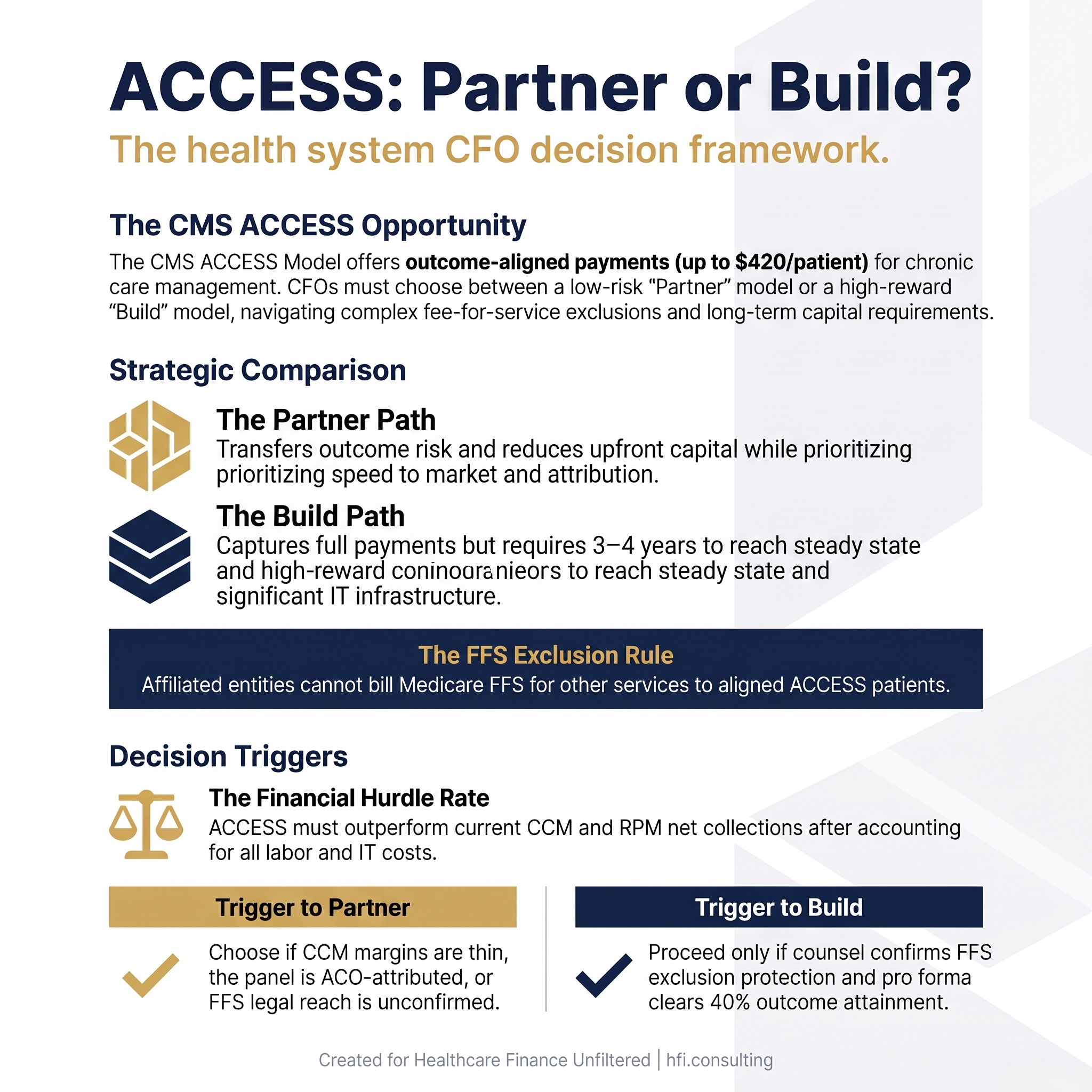
Title graphic reading ACCESS: Partner or Build? The health system CFO decision framework, in navy and gold on a white background.
ACCESS Pays for Outcomes, and Your Patients Are the Panel
ACCESS is a 10-year CMS Innovation Center model that began July 5, 2026. It pays participants a recurring outcome-aligned payment to manage patients in four tracks: early cardio-kidney-metabolic, cardio-kidney-metabolic, musculoskeletal, and behavioral health.
HFMA reports payments of roughly $180 per patient for the musculoskeletal and behavioral health tracks, and up to $420 for cardiometabolic. Half of the annual amount is paid in monthly installments. The other half is withheld and reconciled after the 12-month care period.
The downside is capped, and that matters for your model. In the first 18 months, a participant earns full payment when at least 50% of aligned patients meet their targets. The outcome adjustment cannot cut more than half of the annual payment.
Now look at who is on the roster. As of the September 15 update, it leans toward virtual-first companies, physician groups, nephrology practices, and care management firms. I did not spot a large multi-hospital system on it.
Florida readers should note that the list includes Cadence Health FL PLLC, Isaac Health Florida P.A., and independent nephrology groups in Jacksonville and Georgia.
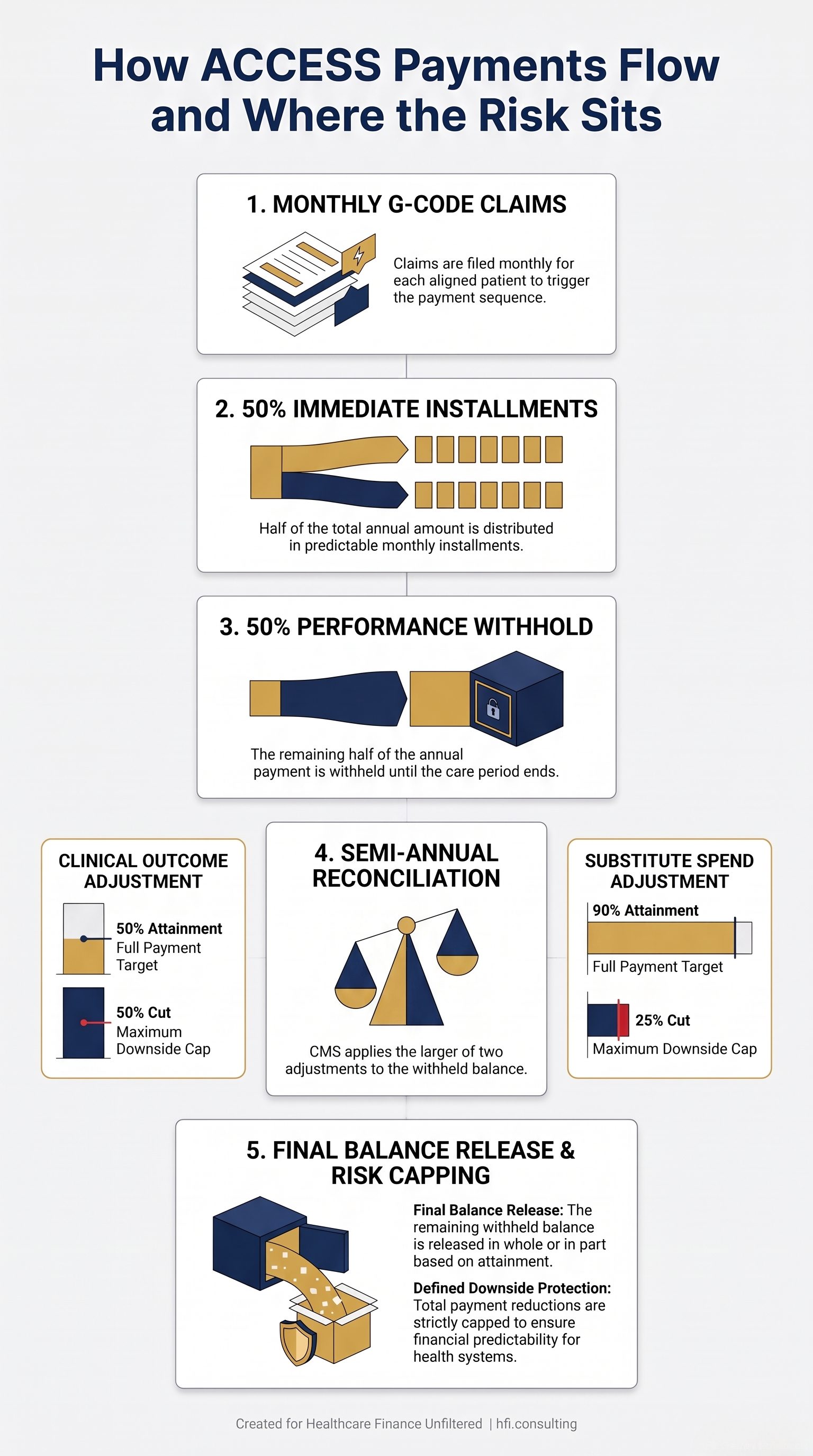
Five-step flow of ACCESS payments showing half paid monthly, half withheld, and two capped adjustments applied at semi-annual reconciliation.
Step 1: Baseline What You Earn Today From CCM and RPM
Start with your own numbers. Pull 12 months of net collections for chronic care management and remote patient monitoring. Then subtract the labor, devices, software, and billing rework behind them.
Most systems cannot do this cleanly. The costs sit across primary care cost centers, IT, and a vendor line in accounts payable.
I covered why cost center design decides whether you can see program margin at all in my piece on healthcare chart of accounts errors. Whether your GL runs on Oracle, NetSuite, or Sage Intacct, give CCM, RPM, and any future ACCESS activity their own cost centers before you build a model.
That baseline is your hurdle rate. Every ACCESS option has to beat it, or you need to explain why it does not have to.
Step 2: Size Your Exposure by Track, Original Medicare Only
ACCESS applies to Original Medicare only. Medicare Advantage members are out of scope, though plans can adopt similar payment terms on their own.
Pull your attributed Original Medicare panel and count patients who meet the qualifying conditions in each track. Then flag who is also aligned to your ACO. That count is your leakage exposure.
Three facts temper the number. Patients enroll voluntarily, and they can switch participants after 90 days.
A small share are also randomly assigned to a control group and cannot enroll for 12 months.
Step 3: Read the FFS Exclusion Before You Model Anything
This is the rule that separates the two paths. An ACCESS participant and its affiliated entities cannot bill Medicare fee-for-service for other services to a patient aligned with them during the care period. Only ACCESS codes are allowed.
CMS defines affiliation as 5% or greater ownership, operational or managerial control, or an organization-level reassignment relationship. The exclusion runs patient by patient, and unaffiliated providers keep billing normally.
For a health system, the question is reach. How far do "affiliated entities" and "other services" extend into your hospital, employed physician, imaging, and lab entities? I would not finalize a build model until counsel and your Medicare enrollment team answer that in writing.
The rule also cuts toward partners. An equity stake of 5% or more in a vendor, or day-to-day control of one, could make it your affiliate. Keep partnerships at arm's length, and have counsel review referral arrangements against the Anti-Kickback Statute and the physician self-referral law, which CMS flags in its ACO guidance.
Step 4: Model the Partner Path Honestly
The partner path is cheaper up front, and mostly it should be. You do not fund the platform, the devices, or the outcome risk. Your primary care physicians refer patients, review the care updates, and bill the co-management payment.
But that payment is small. CMS pays about $30 per review, once every four months per patient per track, plus roughly $10 for onboarding help. The cap is about $100 per patient per year, so 5,000 co-managed patients top out near $500,000.
Partnering is not a revenue play. It is an attribution and total cost of care play. I wrote about why those projections so often miss in why value-based care contracts never pay out as planned.
Two CMS details belong in your model. ACCESS spending stays out of ACO benchmarks in 2026 and 2027, then counts beginning in 2028. And a participant's payment can drop when patients receive listed substitute services elsewhere, so ask whether your own care management billing on the same patient counts against your partner.
Then test viability. A cardiologist with participant Story Health told HFMA that some companies may drop out because the payment rates are low. A participant that leaves must give CMS at least 180 days' notice, so your contract has to say what happens in those 180 days.
"A forcing function in remote management." Patrick Sheehan, Withings, on ACCESS payment rates, as quoted by HFMA
From the payer side, I start with one question for any chronic care vendor. How many members stayed engaged past 90 days, and what happened to the rest? Ask for completed care period counts, not just the outcomes of engaged patients.
Step 5: Model the Build Path Like a Multi-Year Capital Project
Building looks better on paper. You keep the full outcome-aligned payment, and the patient stays inside your brand. Then the pro forma meets reality.
In my years on the provider side, including multi-hospital finance work at Ascension Florida, population health and analytics pro formas were the hardest models I worked on. Attribution shifted every quarter. Claims data lagged.
Staffing ratios depended on a volume nobody could pin down.
The administrative leader and the finance analyst had to work as one team, or the model fell apart. My planning assumption for a large system standing up an enterprise care management capability is three to four years to steady state. An ACCESS-only scope may run faster if you keep it narrow, but do not build the pro forma on that hope.
What ACCESS requires of a participant is concrete:
A Medicare Part B enrolled TIN and a physician medical director.
FHIR-based reporting to CMS.
Validated connected blood pressure cuffs, because manual entry is not allowed.
Health information exchange connectivity.
180 days' notice to leave.
Scale the payoff against that list. At the top of HFMA's range, 5,000 enrolled cardiometabolic patients generate at most $2.1 million a year before adjustments, and half is at risk until reconciliation. I laid out the hidden cost categories that sink these cases in my digital health investment justification framework.
If you want a second set of eyes on your partner versus build model, HFI Consulting works with finance teams on exactly this kind of scenario analysis. Visit hfi.consulting or reply to this email, and I will send the ACCESS partner versus build workbook.
Two timing facts take pressure off. Cohorts start January 1, 2027 and quarterly through mid-2033, and current participants do not need to reapply for the new tracks. Confirm the current application deadline on the CMS portal, but you do not need to decide this quarter to keep the option open.
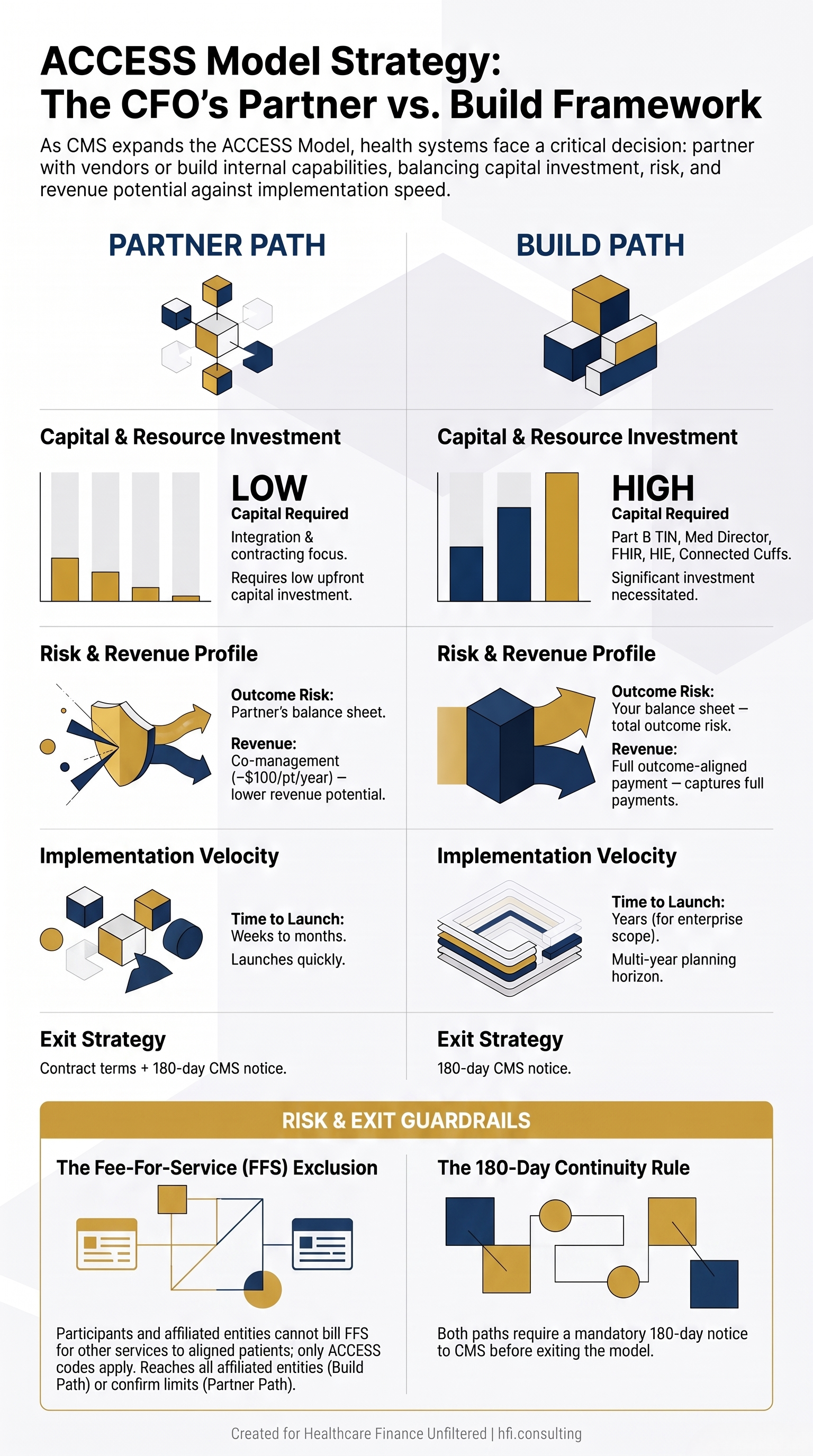
Table comparing ACCESS partner and build paths across capital, outcome risk, FFS exclusion exposure, revenue, time to launch, and exit terms.
Step 6: Choose With Triggers, Not Instinct
My default for most large systems is partner first, with build as an option you earn. Partnering buys speed, transfers outcome risk, and shows you how your patients actually behave. You then decide the build question with your own data.
Use these triggers to test that default:
Partner first when your CCM and RPM margin is unmeasured or thin, most of your panel is ACO-attributed, or counsel cannot yet confirm which of your entities the FFS exclusion reaches.
Build when you already run a technology-enabled program with measured outcomes, counsel confirms a structure that keeps your core entities outside the exclusion, and your projected build margin still clears the hurdle rate when only 40% of patients meet their outcome targets. CMS's own example pays 80% of the full amount at that level.
Wait when your highest-volume condition sits in an April 2027 track and you cannot yet model its payment terms.
Step 7: Put Guardrails in the Partner Contract
If you partner, the contract does the work. Ask for these terms:
Care updates delivered into your EHR workflow, not only a vendor portal. CMS says a portal alone does not meet the requirement unless it is integrated.
Outcome, retention, and completed care period data by track, quarterly.
Referral routing back to your system for needs outside ACCESS scope, with documented patient choice.
A written definition of which services your clinics will and will not bill for aligned patients.
A 180-day exit and continuity plan.
No equity, management, or reassignment ties without counsel review.
Beginning Winter 2028, CMS will publish risk-adjusted outcomes for each participant. Get your partner's numbers before the public directory does.
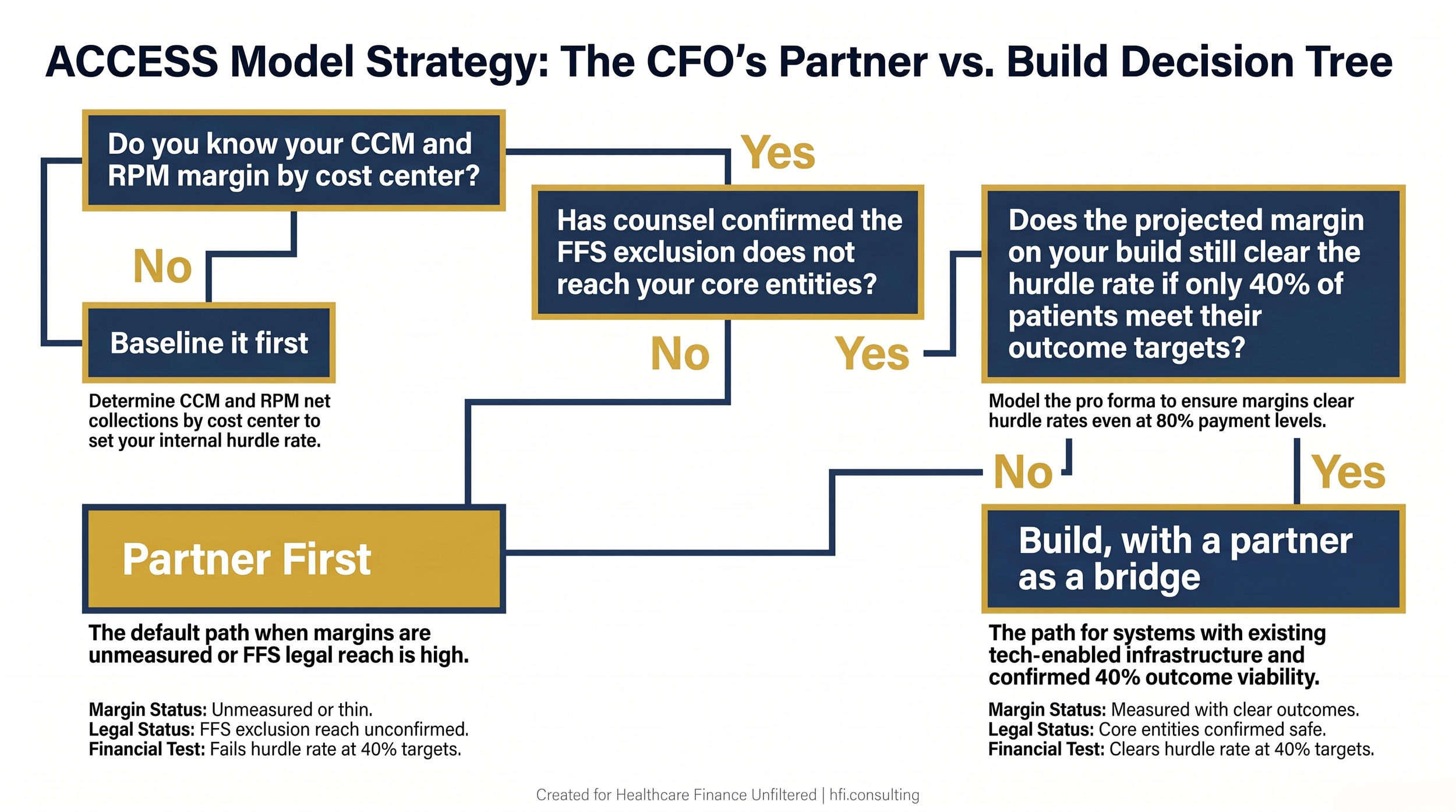
Decision tree for ACCESS strategy asking about margin baseline, FFS exclusion counsel review, and 40 percent outcome attainment to choose partner or build.
A Note for Payer CFOs
Private payers representing 165 million members have committed to align with ACCESS payment terms, and many begin this year. ACCESS excludes Medicare Advantage, so your exposure is indirect. Your contracted providers and vendors may ask for the same terms.
Three questions come first:
Will you pay outcome-aligned rates inside your own chronic care programs?
How will you prevent double payment when a member is in both your program and a vendor's?
Will a vendor's Stars gap-closure numbers match your own data?
CMS says outcome-based payments generally count as medical expenses in the MLR numerator when they meet existing rules. That removes one objection before it starts.
The Decision Is a Finance Decision
The CFOs who handle ACCESS well will not choose a side on principle. They will baseline the margin, get the exclusion question answered, and choose the path their own numbers support.
If you want to pressure test your partner versus build model, visit hfi.consulting or reply to this email. I would rather see your real numbers than a generic scenario.
P.S. Does your system know its CCM and RPM contribution margin today? Reply with yes, partly, or no. I am collecting how finance teams are measuring it.
