
When Your Vendor Gets Breached: What the CareCloud Incident Means for Healthcare CFOs and Who Actually Pays
A 3.7M-patient breach just exposed the real financial anatomy of healthcare vendor risk. Here is what CFOs need to understand before the next one.
A health IT vendor serving more than 40,000 providers just disclosed that an unauthorized third party accessed one of its cloud environments for six straight days before anyone noticed. By the time CareCloud Health detected the intrusion, 3.76 million patient records had potentially been exfiltrated. The breach happened in March. Individual notification letters went out months later. Class action lawsuits are already consolidated in federal court. If your organization uses a vendor like this, your BAA is your first line of defense. Most of them are not written well enough to hold.
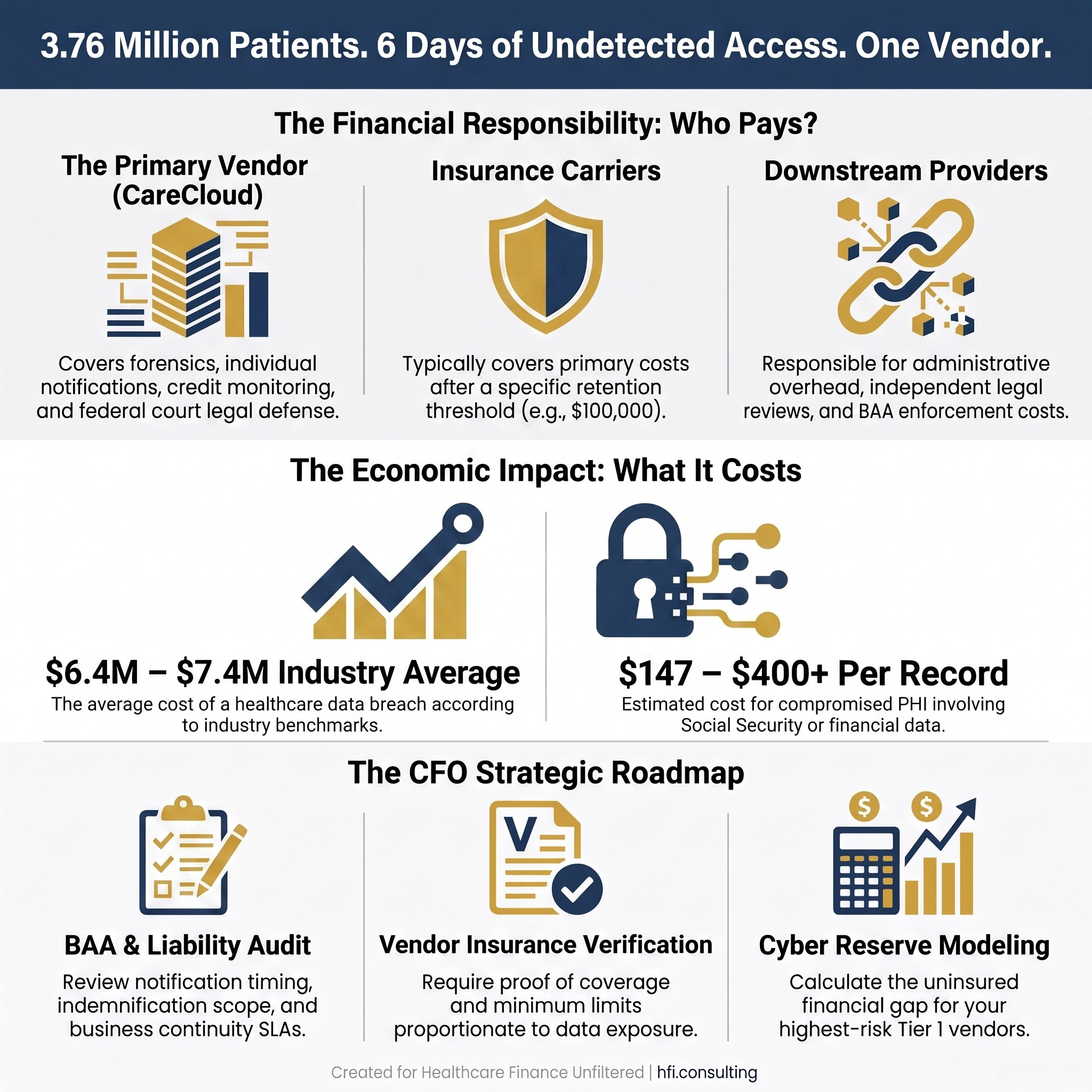
Infographic showing the financial breakdown of the CareCloud data breach affecting 3.76 million patients, including who pays the costs and CFO action steps.
What Actually Happened at CareCloud
CareCloud, Inc. (Nasdaq: CCLD) is a cloud-based health IT company serving more than 40,000 providers across 50 states. Its CareCloud Health division provides EHR platforms, practice management software, revenue cycle management, and clinical documentation services to hospitals, physician practices, and medical groups.
In March 2026, an unauthorized third party accessed one of CareCloud's six AWS-hosted EHR environments. The access window ran from approximately March 10 through March 16. CareCloud discovered it on March 16, when the intrusion caused a temporary network disruption lasting about eight hours.
The company disclosed the incident to the SEC via a Form 8-K on March 27, after determining on March 24 that the breach was material given the sensitivity of the data involved. By June 24, forensic investigators had confirmed the exposed data included patient full names along with a range of other protected health information. CareCloud reported the incident to HHS's Office for Civil Rights in July, with the agency posting it in August.
The final tally: 3,756,469 individuals affected. Class actions are already consolidated in the Southern District of Florida.
Why this matters to you right now: CareCloud is not an outlier. It is a representative example of the vendor risk that lives in every healthcare organization's third-party portfolio. The question is not whether your vendors will be breached. The question is what happens to your finances when they are.
The AWS Shared Responsibility Question Most CFOs Are Not Asking
Every post-breach analysis of a cloud-hosted healthcare incident eventually surfaces the same question: was this AWS's fault?
For the CareCloud breach, the answer is almost certainly no. Under AWS's shared responsibility model, the cloud provider is responsible for the security of the underlying infrastructure: the physical data centers, hardware, and foundational services. The customer is responsible for security in the cloud: identity and access management, network configuration, encryption, application security, database access controls, and monitoring.
Independent analysis of the CareCloud incident has confirmed there is no indication of an AWS platform-level failure. The unauthorized access was achieved through the customer-managed layer. Whether that involved compromised credentials, misconfigured access controls, or another vector has not been publicly confirmed as of this writing.
This is not a cloud-specific problem. It is the most common pattern in healthcare vendor breaches: the infrastructure is intact. The configuration is not.
What this means for CFOs reviewing their own vendor portfolios: "We're on AWS" or "We're ISO-certified" is not a risk management answer. It is a starting point. The control questions that actually matter are what your vendor is doing with identity and access management, whether they have continuous monitoring enabled, how quickly anomalous activity triggers a response, and whether your BAA gives you any financial recourse when the answer to any of those questions turns out to be inadequate.
I wrote about this pattern in broader terms earlier this year in my piece on healthcare cybersecurity financial risk and budget planning. The CareCloud incident puts a specific face on those numbers.
Who Pays, and How Much
The financial anatomy of a vendor breach like this has three layers. Understanding all three is part of the CFO's job now.
Layer 1: The Vendor's Direct Costs
CareCloud has stated publicly that it engaged a Big Four forensic firm, secured the environment, notified approximately 3.76 million individuals, and is offering identity-theft protection through IDX. The IDX package includes 12 to 24 months of credit monitoring, CyberScan dark web surveillance, a $1 million insurance reimbursement policy, and fully managed identity-theft recovery services. The enrollment deadline for affected individuals is December 17, 2026.
CareCloud has repeatedly indicated that its cybersecurity insurance policy is expected to cover the bulk of these costs beyond a $100,000 retention. The company told investors on its Q2 2026 earnings call that it does not anticipate a material financial impact on operations.
That framing is notable. For a company with approximately $120 million in annual revenue, positioning a 3.76 million-patient breach as a largely insured event is possible only if the policy coverage is robust and the class action settlements stay manageable. Neither of those is guaranteed.
Industry benchmarks provide context. The IBM/Ponemon Institute average healthcare breach cost is approximately $6.4 to $7.4 million across incidents of all sizes. Per-record costs for PHI involving Social Security numbers and financial data often run $147 to $400 or more. Major healthcare vendor breaches have settled in ranges from $10 million to over $100 million, depending on patient class size, breach scope, and regulatory outcomes. CareCloud's exposure sits somewhere in that range before insurance offsets.
Layer 2: The Downstream Provider's Costs
If your organization used CareCloud and your patients are in this breach, your immediate financial exposure is lower than you might expect. When a business associate handles notification, credit monitoring offers, and primary remediation under the terms of a BAA, covered entities generally do not need to re-notify patients themselves.
Your actual costs in this scenario are mostly administrative. Staff time for reviewing the notification and confirming scope. Updating your HIPAA risk analysis. Directing patients who call to CareCloud's identity protection enrollment line. Some organizations may conduct an independent audit or increase vendor scrutiny, which carries its own cost.
For a small practice, those costs may be measured in hundreds to low thousands of dollars. For a large health system with meaningful CareCloud exposure, independent legal review and audit activity could reach six figures. Contractual indemnification under the BAA may shift some of that back to CareCloud, but enforcing indemnification clauses is not free.
The bigger cost is longer-term: higher cyber insurance premiums, potential customer-side exposure if patients name your organization in lawsuits alongside CareCloud, and the time and capital cost of vendor evaluation if your risk tolerance has shifted.
Layer 3: What Everyone Is Underestimating
The cost line that does not appear in press releases or earnings calls is the cost of not having the right contract provisions before an incident occurs.
From my time managing financial operations across seven hospitals at Ascension, the complexity of third-party vendor relationships was staggering. Claims processors. Prior authorization vendors. EHR integrations. Pharmacy benefit interfaces. Each held PHI. Each had signed a BAA. Almost none of our contracts had vendor liability provisions written tightly enough to transfer meaningful financial risk when things went wrong.
That is the gap CareCloud's customers are navigating right now. The BAA exists. Whether it contains specific business continuity SLAs, meaningful indemnification provisions, or requirements that the vendor maintain adequate cyber insurance is another question entirely.
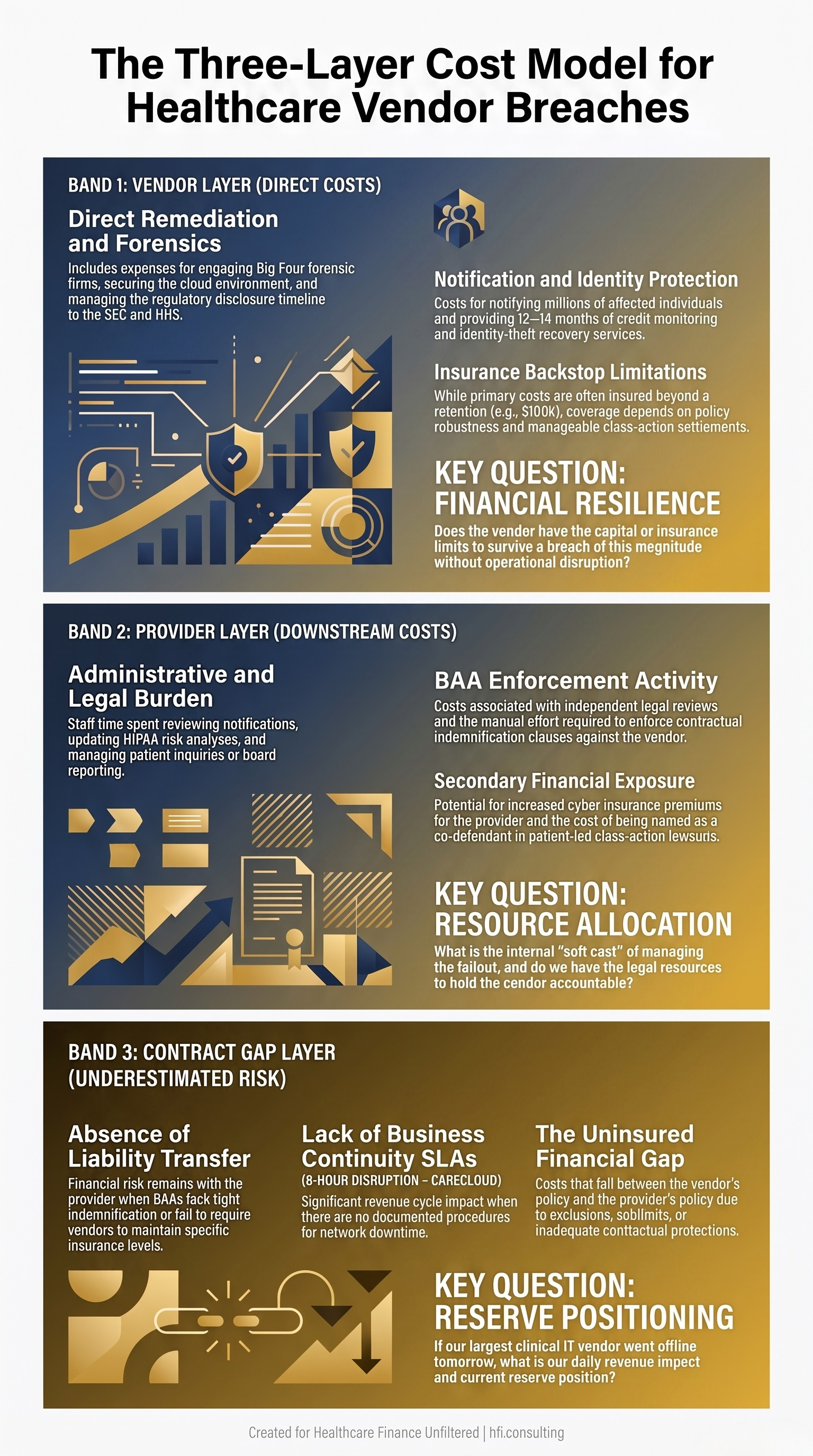
Three-layer framework diagram showing vendor breach costs broken into vendor direct costs, downstream provider administrative costs, and contract gap costs with no liability transfer.
The BAA Audit CFOs Are Not Running
The Business Associate Agreement is a financial document. Most healthcare organizations treat it as a compliance artifact. That distinction costs money when a vendor is breached.
A well-structured BAA should address at minimum:
Breach notification timing. HIPAA requires notification to covered entities without unreasonable delay, and no later than 60 days from discovery. But how quickly does your vendor actually commit to notifying you? CareCloud's gap from March discovery to individual notification letters arriving months later is not atypical, and it affects your own ability to respond to patient inquiries, update your risk register, and advise your board.
Indemnification scope. Does the BAA specify that the vendor will indemnify your organization for losses, regulatory penalties, or legal costs arising from their breach? Many BAAs include indemnification language that sounds protective but carves out so many exceptions it provides little practical coverage.
Cyber insurance requirements. Does your BAA require the vendor to maintain a minimum level of cyber insurance and name your organization as an additional insured? If not, you have no contractual mechanism to ensure the vendor's policy actually covers your downstream exposure.
Business continuity and downtime procedures. What happens to your revenue cycle if a vendor's EHR environment goes offline for eight hours? Thirty-six hours? A week? The CareCloud network disruption lasted eight hours. The Change Healthcare ransomware event lasted weeks and disrupted billing for thousands of providers nationwide.
This is not a compliance conversation. It is a capital planning conversation. If your largest clinical IT vendors were breached tomorrow and your BAAs provided no financial recourse, what is your reserve position?
That question belongs in your next risk register review, not just your CISO's.
What a Defensible Vendor Risk Program Looks Like
The CareCloud incident is a useful benchmark because it describes a realistic scenario, not a catastrophic outlier. Six days of unauthorized access. One compromised environment out of six. A vendor of meaningful scale with cyber insurance. Even in that scenario, 3.76 million people are affected and a multi-front litigation and regulatory process is underway.
For CFOs building or updating a vendor risk framework, the financial controls that matter most are:
Tiered vendor classification by data sensitivity and operational dependency. Not all vendors carry the same risk profile. A vendor that touches your EHR and holds millions of patient records is categorically different from a vendor managing your parking lot software. Your financial reserves, audit frequency, and contract rigor should reflect those tiers.
Documented downtime revenue cycle procedures. If your largest clinical IT vendor went offline tomorrow, how many days of revenue cycle continuity do you have? What is the daily revenue impact of billing disruption? Most organizations cannot answer that question with precision. They should be able to.
Vendor cyber insurance verification. Before renewal or initial contract execution, require proof of coverage, minimum limits that are proportionate to data exposure, and confirmation that their policy covers your notification costs and legal exposure if their breach affects your patients.
Incident reserve modeling. Based on your vendor portfolio's data exposure, what is a reasonable estimate of your organization's uninsured financial exposure in a major vendor breach? That number should inform your own cyber insurance limits, not the other way around.
Contract audit for existing agreements. Identify which active BAAs and vendor contracts lack adequate liability transfer, notification timing requirements, or business continuity provisions. Prioritize renegotiation by risk tier.
You can read more on the framework for evaluating IT vendor risk as a finance problem in my earlier piece on IT governance as a healthcare finance issue, and on how phishing and MFA bypass are adding another attack vector to the same vendor risk equation in the healthcare phishing CFO/CIO playbook.
The Cyber Insurance Conversation Has Changed
CareCloud's position that its cybersecurity insurance will absorb most direct costs is the right outcome in a well-structured program. It is also a reminder that cyber insurance is not a set-and-forget line item.
Three things finance leaders need to understand about the current cyber insurance market in healthcare:
Coverage terms are tightening. Insurers have responded to the explosion of healthcare breaches by adding exclusions, sublimits on specific coverage categories, and stricter security control requirements as conditions of coverage. If your organization cannot demonstrate MFA on privileged accounts, documented risk analysis, and tested incident response procedures, you may find your claim partially or fully denied.
Premium trajectories are not stable. The Change Healthcare breach, the Ascension breach, and now the CareCloud breach are all contributing to insurer loss ratios in the healthcare sector. Renewal pricing and retention levels are moving up, not down. That belongs in your multi-year budget model.
Vendor policy and your policy may both apply, or neither may cover the gap. When a vendor is breached, your organization's cyber policy may respond for your direct costs. The vendor's policy should respond for their costs. The gap is any cost that falls between the two policies because of exclusions, coverage disputes, or indemnification failures. That gap is real and CFOs should be modeling it.
The Your EHR Is Now a Legal Liability piece I published earlier this year addresses how vendor litigation is landing on CFO balance sheets in ways the traditional IT risk framework was not built to handle. The CareCloud case adds a data breach dimension to the same pattern.
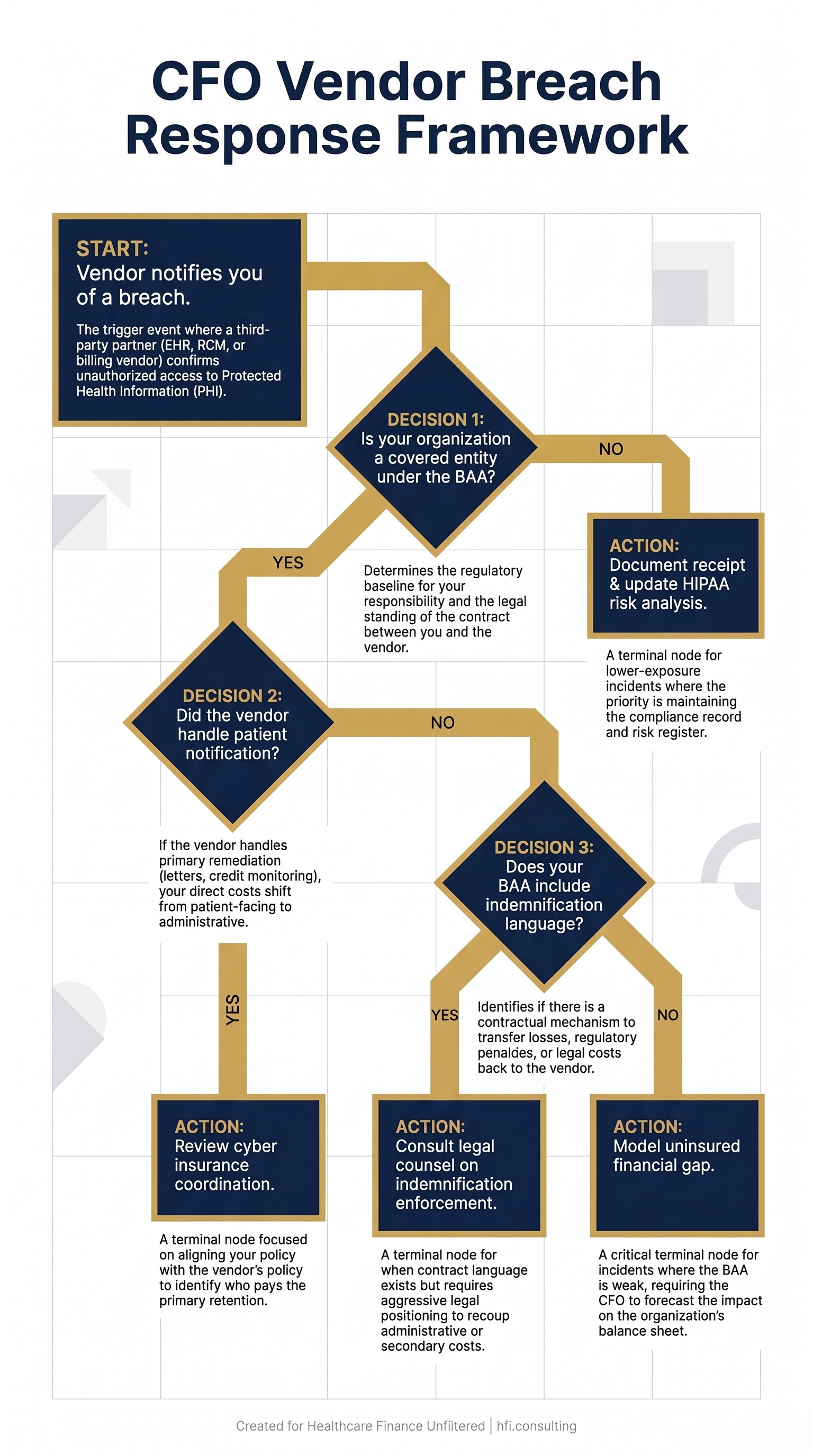
Decision tree flowchart showing CFO response steps after a vendor data breach notification, including BAA review, HIPAA documentation, insurance coordination, and indemnification enforcement.
What To Do in the Next 30 Days
Whether or not your organization uses CareCloud, this incident is a useful forcing function for a vendor risk review that most organizations have been deferring.
Week 1: Identify your highest-risk vendors. Pull a list of every active vendor with a signed BAA. Rank them by data volume, operational dependency, and available information about their security posture. Any vendor holding more than 100,000 patient records or supporting revenue cycle operations belongs in Tier 1.
Week 2: Audit your Tier 1 BAAs. Specifically look for: notification timing commitments, indemnification language, cyber insurance requirements, and business continuity provisions. Flag every agreement that lacks specific provisions in any of these areas.
Week 3: Review your own cyber insurance. Confirm your policy's response to vendor-triggered incidents. Confirm your retention level and that your limits are calibrated to your current data exposure, not your exposure from three years ago when you last renewed.
Week 4: Brief your CFO leadership team and board risk committee. Vendor cyber risk is not an IT briefing item anymore. It is a balance sheet discussion. The framing that works: "Here is our top vendor exposure, here is our contractual protection, and here is our uninsured gap."
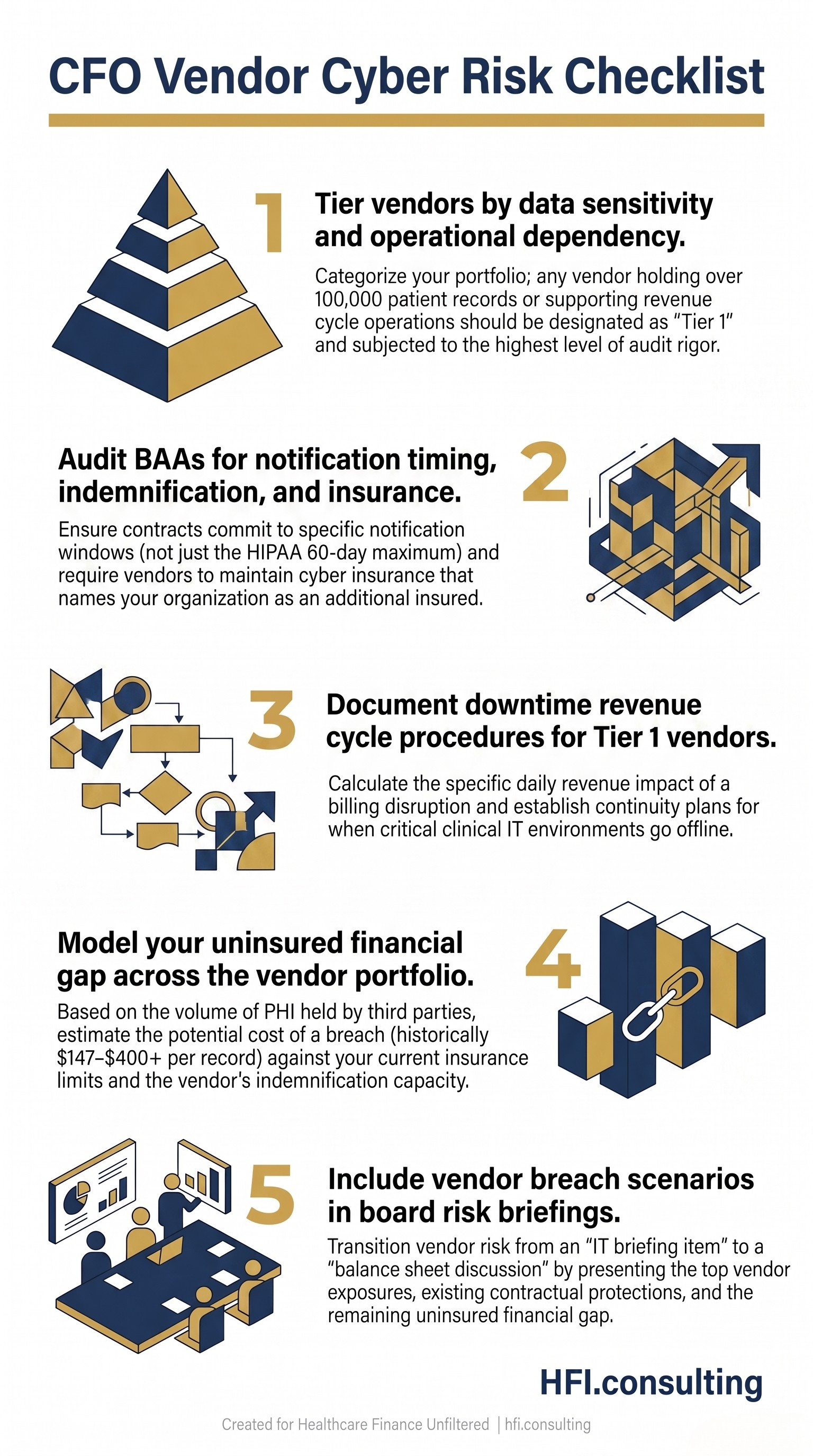
CFO vendor cyber risk checklist with five action steps including BAA audit, downtime revenue procedures, uninsured gap modeling, and board risk briefing.
The Broader Signal
The CareCloud breach is one incident in a consistent pattern. Healthcare is the most targeted critical infrastructure sector in the United States for cybercrime. The financial exposure is no longer limited to organizations that are breached directly. Third-party vendor breaches are now the primary channel through which patient data is compromised at scale.
The Change Healthcare attack showed what happens when a clearinghouse is hit. The CareCloud incident shows what happens when an EHR vendor is breached. Your RCM vendor, your prior authorization platform, your pharmacy benefit interface, your telehealth provider: any of them could be the next entry point.
Finance leaders who treat vendor cyber risk as an IT governance issue are one breach away from discovering it is a balance sheet issue. The organizations building the financial controls now, not after the incident, are the ones that will manage through it without the kind of operational and reputational disruption that cannot be fully transferred to an insurance carrier.
The vendor contract work is not exciting. It does not show up on a dashboard. But it is the financial protection layer that actually holds when everything else fails.
If you are working through this analysis and want a framework for prioritizing the contract audit or building the reserve model, reach out at hfi.consulting. This is exactly the kind of work that belongs in a CFO's portfolio, not just on the CISO's task list.
