
Mark Cuban says employers went soft on brokers and TPAs. Here is what health system CFOs can verify, and why it is harder.
On November 2, the Department of Labor published a final rule that will require PBMs to show self-insured plan sponsors where their money goes. Three days later, Mark Cuban told a room of hospital executives that most employers never look. If your health system self-insures, your employee health plan is also a contract with your own hospitals, and that makes the question harder than it sounds.
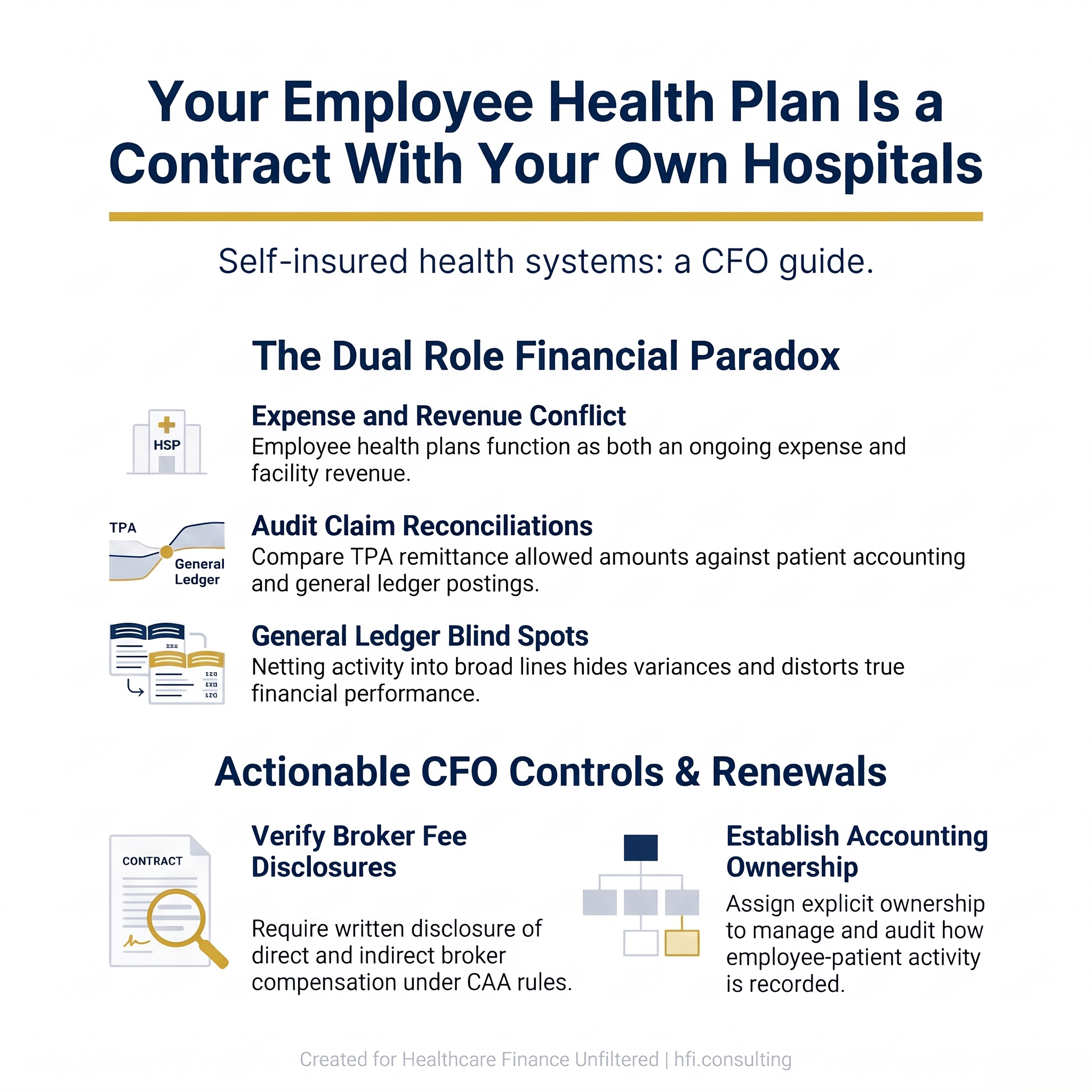
Title graphic reading Your Employee Health Plan Is a Contract With Your Own Hospitals, a CFO guide for self-insured health systems.
Cuban Is Right About the Habit, Even Where the Numbers Are His Own
At Becker's CEO+CFO Roundtable, Mark Cuban told hospital CFOs to stop letting insurers and benefits administrators set the terms. His first instruction was to put every healthcare contract through AI and ask one question.
"Where are they ripping me off?" Mark Cuban, Becker's CEO+CFO Roundtable
Cuban called employee health benefits an employer's second largest ongoing expense after payroll. That is the right frame for a CFO.
Discount the specifics and keep the point. Cuban co-founded Cost Plus Drugs, so his Dallas Mavericks example, $169,000 spent on generics he says would have cost $19,000, comes from someone with a stake in the answer. His claim that almost all hospitals self-insure is his estimate, not a verified figure.
The habit he describes is real. Insurance Business, using Department of Labor Form 5500 data, reports that broker commissions on employer group plans grew from about $4.35 billion in 2015 to $6.49 billion in 2024. Fees rose from 18.5% to 23.3% of broker pay over the same period, so commission still accounts for more than three-quarters of the total.
One veteran brokerage executive framed the conflict simply. When an employer takes a 35% medical increase and the broker's pay rises 35%, the incentive does not point at your savings.
When the Plan Sponsor Is Also the Provider
For a health system, the employee health plan is not only an expense. It is also revenue for your own facilities. That is where controls get thin.
Cuban described a hip replacement for an employee at a self-insured hospital. In his telling, the hospital should be paid about $25,000, and is not. That is one anecdote from one speaker. It is also a test you can run.
Pull a sample of employee claims for care delivered at your own facilities. Compare the allowed amount on the TPA's remittance to what patient accounting posted. Then follow it to the general ledger line: revenue, contractual adjustment, benefits expense, or eliminated in consolidation.
If the three numbers do not tie, you have a finding. If you cannot pull them in a week, that is also a finding.
Do this the right way, because these are employees' health records. Your self-insured plan is a HIPAA covered entity. Your system, as plan sponsor, can use that data only for plan administration, and only through staff named in your plan documents.
The test does not need names on a screen. It needs claim and account numbers, dates of service, codes and dollars. Have designated plan staff or an independent auditor under a business associate agreement pull the sample, limit access to the minimum necessary, and keep the results out of every employment decision. Run the design past your privacy officer and counsel first.
Cuban raised a second question. Why would a self-insured hospital let its TPA steer employees to outside providers when its own facilities could deliver the same care?
I would not assume the answer is carelessness. Network design, capacity, access and employee privacy all play a part. An employee will not always want a colleague reading their oncology or behavioral health chart. But the question is fair, and someone should be able to answer it with data: where do your employees get care today, and what does each site cost the plan and your system?
Here is what I can say from my own seat. In budget and finance roles at UF Health Jacksonville and later at Ascension Florida, employee plan activity lived inside contractual adjustments and the benefits expense line. As a budget owner, I was handed the number. Another team did the accounting.
I have no evidence of a variance. I could not have found one, because I never saw inside those lines. A number that is stable year after year is not the same as a number that is correct.
That is a chart of accounts problem as much as a benefits problem. I wrote about how account structure distorts what leaders see in my earlier piece on healthcare chart of accounts errors. The same logic applies when employee-patient activity is netted into lines that managers cannot drill into.
How that activity should be recorded is a policy question for your controller and your auditors. The answer depends on how the plan is funded and structured. What matters is that someone owns the policy and can show it.
If your system also thinks of itself as a payer, my earlier piece on provider-sponsored health plans covers how the financial playbook changes when you carry the risk.
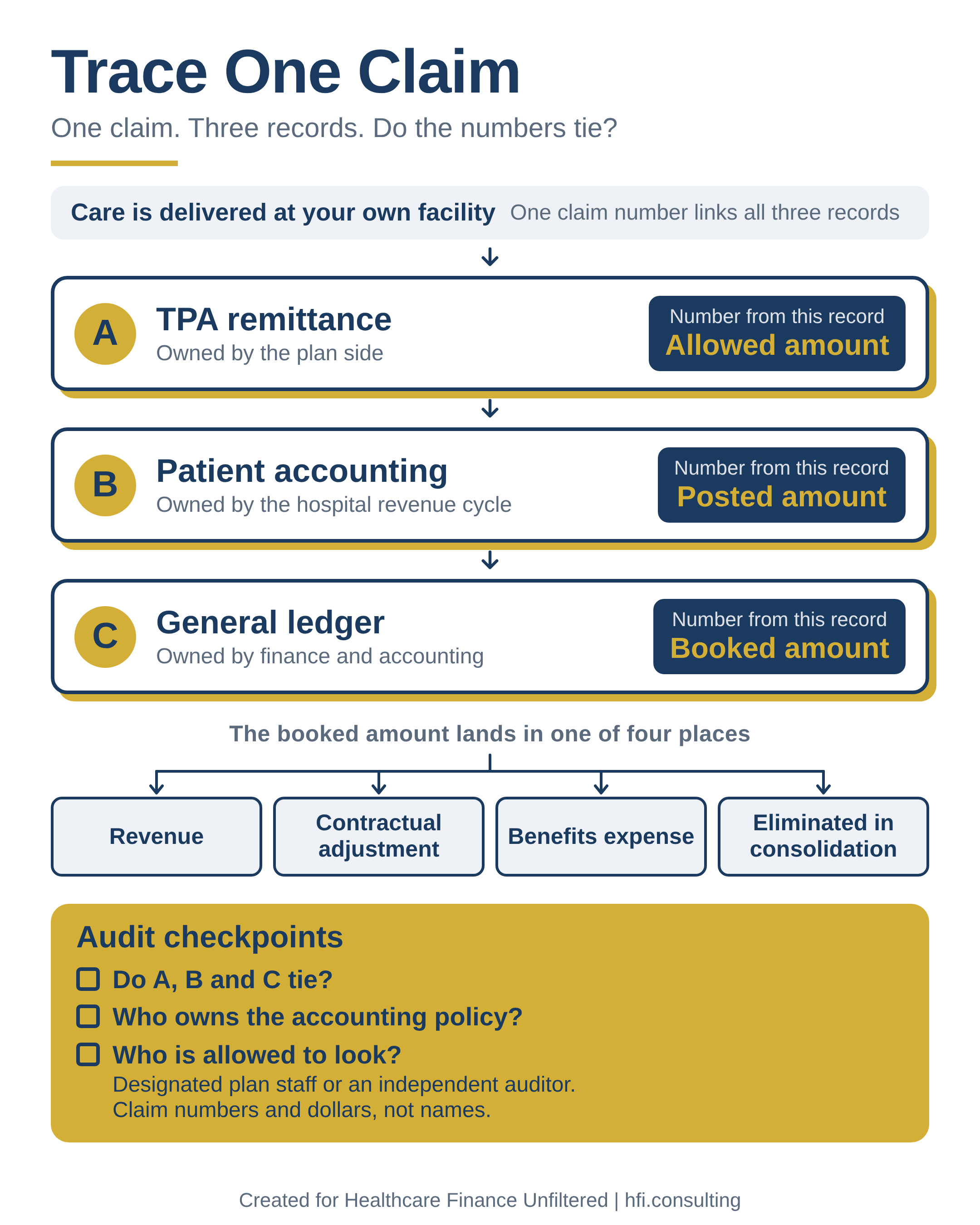
Flow tracing one claim from care at your facility to TPA allowed amount, patient accounting, and four possible general ledger lines, with audit checkpoints including who is permitted to review the data.
Why Cuban Makes It Sound Easier Than It Is
Cuban's asks are sound. Review contracts with better tools, and make sure employees get deductible credit when they find a lower price outside insurance. Neither is a quick negotiation.
Start with leverage. In many markets, the carrier that administers your plan is also a carrier you negotiate commercial rates with. Pressure at one table can echo at the other. I cannot tell you how much leverage any single system has, and neither can Cuban.
Next, disruption. HR Brew reports that most employers stay with the Big 3 PBMs partly out of fear of disruption. The CEO of the Health Transformation Alliance, an employer coalition, put it this way: if saving $7.5 million means a lot of employee unhappiness, many companies will not do it. Intent is high. In a September 2025 National Alliance survey, 61% of 324 employers had switched away from a Big 3 PBM in the past year or were considering it within three years. Action is slower.
Then your workforce. Your employees are your plan members. A Penn LDI study of 2015 to 2018 claims from one national insurer found high-deductible plan spending about 20% lower than low-deductible plans, but spending grew at about the same pace under both. A design that lowers the level once and leaves the growth rate alone is not a cost strategy. It moves cost to the household.
An emergency physician wrote in a STAT opinion essay about a patient who skipped a surgical consult for gallstones because her family had not met their deductible. She later spent two weeks in intensive care. Months afterward, the physician's own hospital moved nearly all of its insurance offerings to high-deductible plans, and she noted that even full-time physicians there carry $3,000 deductibles.
KFF's 2026 survey puts the average worker contribution for family coverage at $7,471, up 9%. Total family premiums rose 5% to $28,303. Wages rose 3.7%.
I see this at my own kitchen table. Our HDHP costs have climbed roughly 6% to 10% a year. This year our coinsurance moves from 10% to 20%.
For 2026, the IRS ceiling on family out-of-pocket costs for an HSA-qualified plan is $17,000. The family HSA contribution limit is $8,750. The gap between those two numbers is money I pay after tax and cannot shelter.
None of this makes Cuban wrong. It makes the work slower and more political than a conference stage allows. Every cost lever you pull lands on someone you employ.
If you want a second set of eyes on how employee plan claims reach your general ledger, that is the kind of chart of accounts and managerial accounting review we do at HFI Consulting. I made the case for bringing in targeted help in why healthcare finance teams are breaking. Reply with your biggest blind spot, or start a conversation at hfi.consulting.
What the DOL Rule Gives You, and When
The rule is a planning input, not a verdict. This summary draws on Mayer Brown and the International Foundation of Employee Benefit Plans, and it is not legal advice.
Issued October 29 and published in the Federal Register November 2, 2026.
Effective January 4, 2027.
Applies to plan years beginning on or after July 1, 2027. For a calendar-year plan, that is the 2028 plan year.
Covers self-insured plans of employers with at least 100 employees.
CAA 2026 rebate pass-through and added reporting follow for plan years beginning on or after August 3, 2028.
PBMs and their affiliated brokers and consultants must disclose direct compensation, manufacturer payments, and spread by drug before you sign or renew. For renewals, 90 days in advance is treated as reasonable. Semiannual reports follow within 30 days of each period, and any category running 5% or more over its estimate needs an explanation.
You also get an annual audit right. You choose and pay the auditor, and the PBM pays to produce the records. If your TPA or carrier contracts for pharmacy services, it becomes the covered provider and must get the information from the PBM.
You carry the review. Plan fiduciaries must obtain the disclosures and decide whether the contract and compensation are reasonable.
Budget for the follow-through. The audit fee and staff time for semiannual reviews belong in your plan. For a calendar-year plan, the 90-day mark before January 1, 2028 falls in early October 2027, which is budget season for many systems.
Legal challenges to the rule remain possible, according to Insurance Business. Plan for it, and watch for changes.
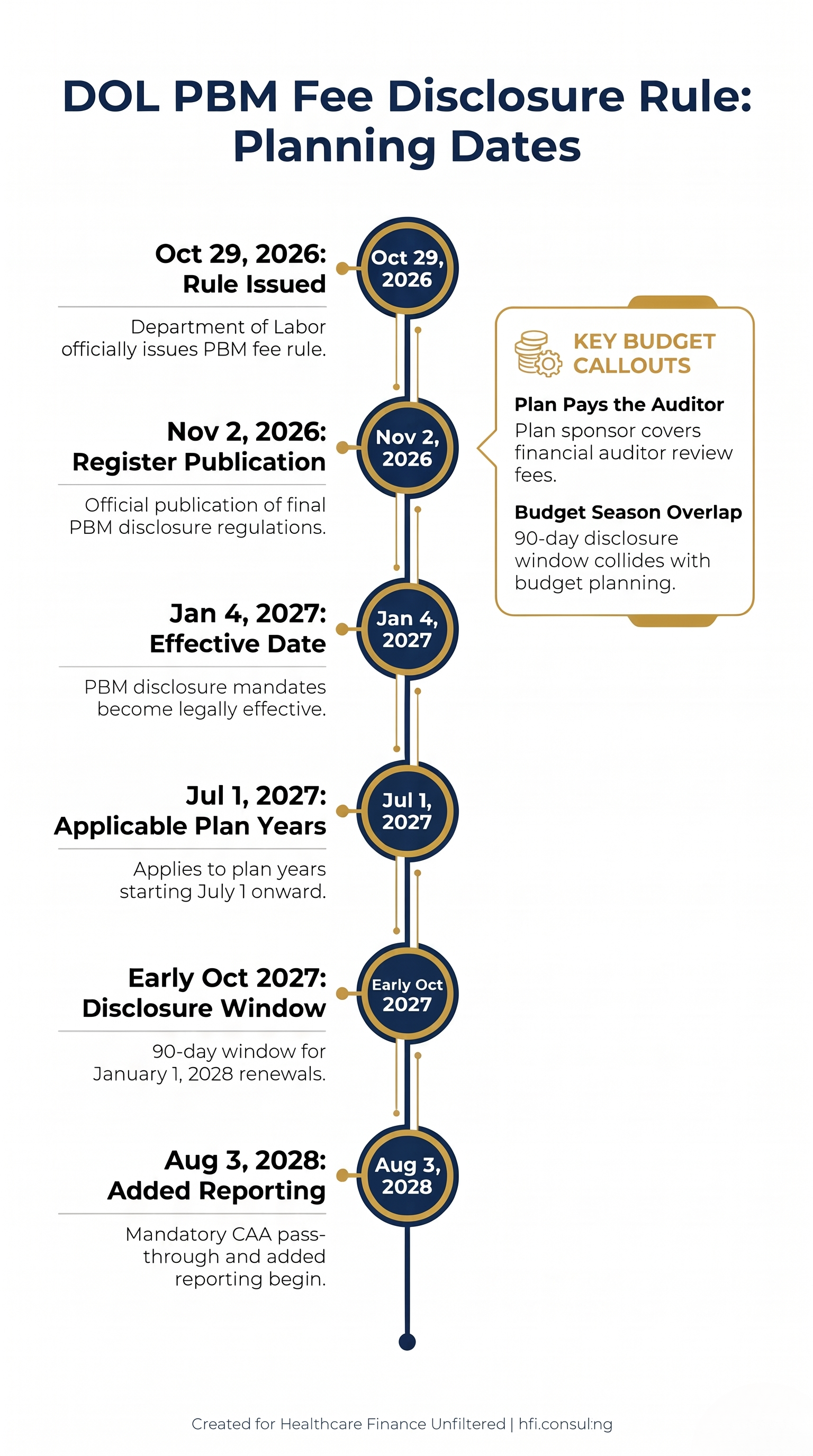
Timeline of DOL PBM fee disclosure rule dates from October 2026 through August 2028, with budget callouts for audit costs and renewal timing.
Five Questions for Your Next Renewal
Who is the covered service provider? Know whether the PBM, the TPA, or the carrier owes you the pharmacy disclosures.
What does your broker already owe you? The 2021 Consolidated Appropriations Act requires written disclosure of direct and indirect compensation. Ask for it.
Can you tie claims to the ledger? Test a sample from TPA remittance to patient accounting to the GL line.
Who owns the accounting policy? Name the person who decides how employee-patient activity is recorded.
What do the contracts say about audit rights, termination notice, and confidentiality? Read them before anyone uploads them to an AI tool.
Cuban's AI approach is useful, but PBM and TPA contracts often carry confidentiality terms. Check them first, and use an enterprise AI tool with data protections.
Two ideas you will hear next: steering employees to an in-house pharmacy, and pricing plan claims below commercial rates for care at your own facilities. Both raise 340B eligibility and ERISA reasonableness questions. Those belong with counsel before they belong in a budget.
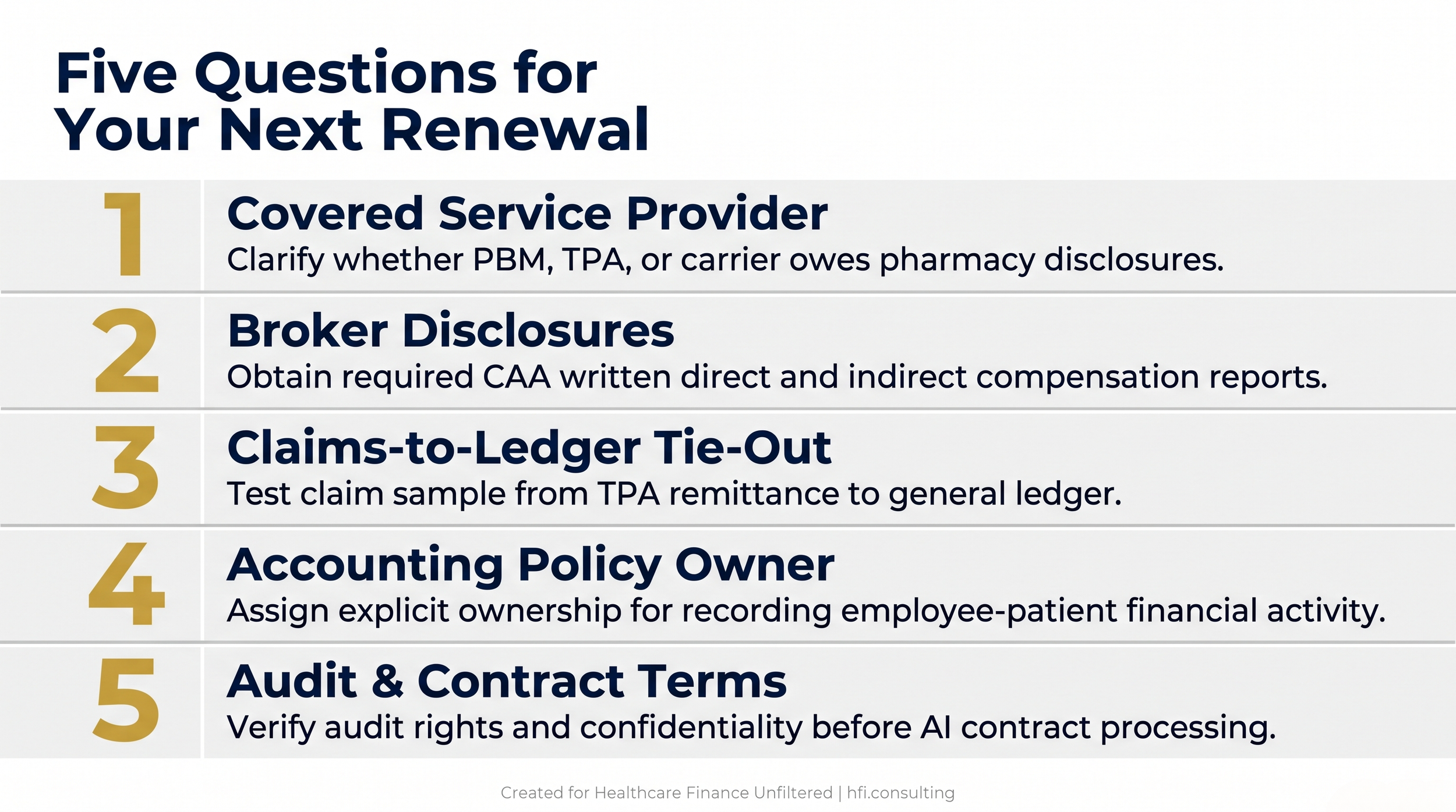
Checklist graphic titled Five Questions for Your Next Renewal covering service provider, broker disclosures, claims tie-out, policy owner, and contract terms
The Takeaway
Cuban's lesson is to look. The harder lesson for a health system is that you may sit on both sides of the table, and your ledger may not show it.
Start with one sample and one reconciliation. Whatever you find, you will know more than you do today.
If you want help designing that review, or want to compare notes on how your system records employee plan activity, reach out at hfi.consulting. I read every reply.
P.S. Where does employee-patient activity at your own facilities land in your P&L: revenue, contractual adjustment, benefits expense, or somewhere else? Hit reply and tell me.
