
Why Healthcare Finance Teams Are Breaking: The Case for Targeted Outside Help
Running lean doesn't mean running without support. Here's what boutique advisory actually looks like for a stretched finance team.
A finance leader at a large West Coast health system recently described her team in a way that has stayed with me. People stay, she said, mainly because they are too busy to look for another job.
That sentence deserves to sit for a moment.
It is not a retention success story. It is a quiet warning that the healthcare finance workforce is being held in place by constraints, not by satisfaction. And when the economy shifts enough to widen the exit door, the people who have been carrying the load for years may be the first ones through it.
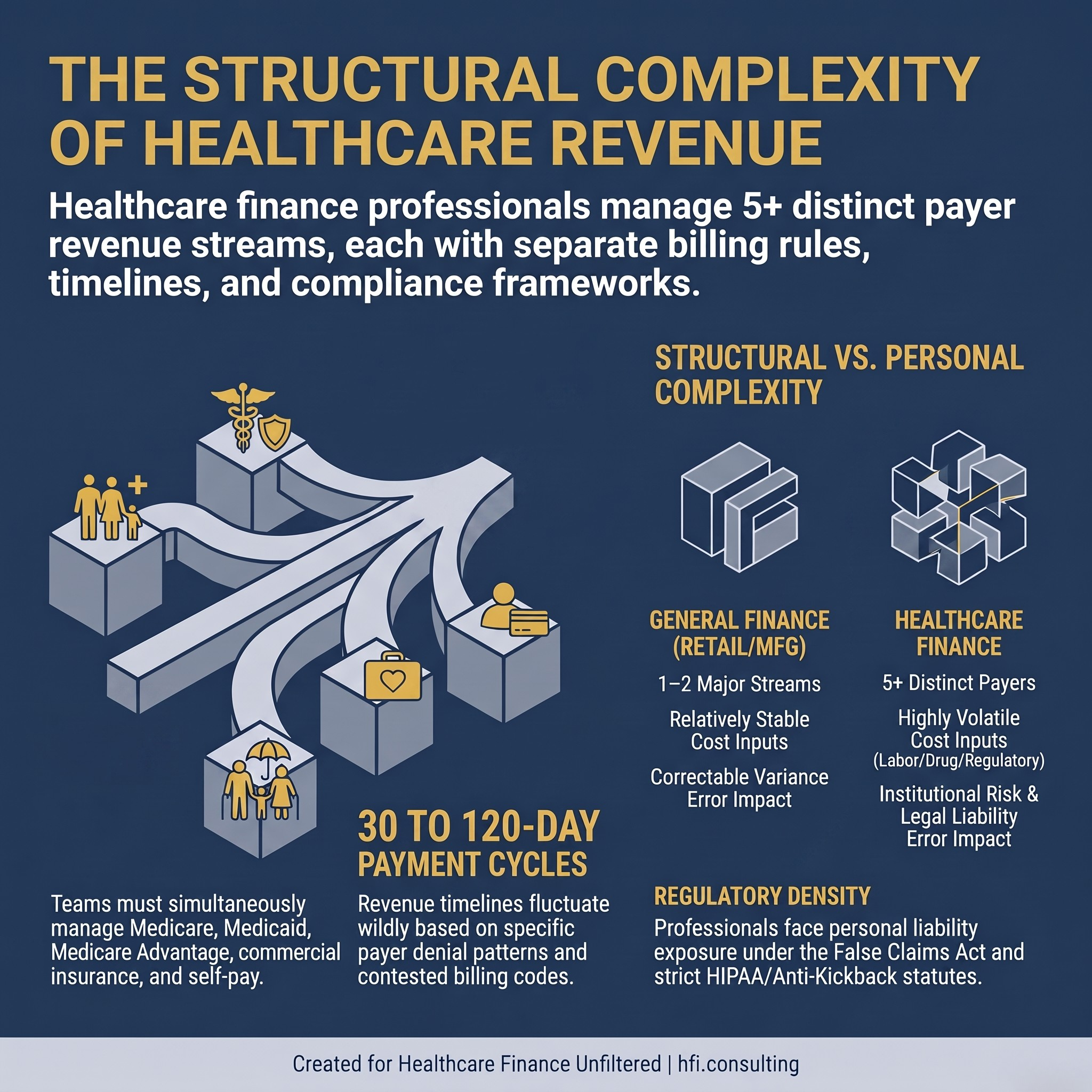
Infographic showing five distinct healthcare payer types that finance teams must manage simultaneously, illustrating the structural complexity of healthcare accounting.
The Forbes analysis published last week captured the balance sheet side of this problem well. Hundreds of hospitals could see deficits grow 50% to 75% under the combined weight of Medicare sequestration, Medicaid cuts, and expiring ACA subsidies. Federal actuaries project national health spending climbing toward $9 trillion by 2034. Every CFO in the room already knows that math.
What the analysis does not capture is what absorbing that math, month after month, does to the finance teams executing the work behind it. And more practically: what CFOs running lean teams are supposed to do when the problems keep arriving faster than the capacity to address them.
The Accumulation Problem
The burnout pattern in healthcare finance is rarely dramatic. It does not look like a crisis moment. It looks like a team that is always one project behind, always catching up, always running the close while simultaneously fielding the next request that could not wait.
In my work at Ascension across seven hospitals, I watched the month-end close cycle consume teams in ways that felt normalized only because everyone around them was experiencing the same thing. The reconciliation work was not the problem. Reconciliation is legitimate and necessary. The problem was that the same people doing the reconciliation were also expected to interpret what the numbers meant, build the narrative for leadership, respond to the questions that came back from that narrative, and start the cycle over.
That is three different jobs with three different cognitive demands, collapsed into one person, on a deadline that resets every 30 days.
The Forbes piece cited a finance leader who described month-end as a cadence problem: a month's worth of drift discovered and explained all at once, under deadline. That framing is right. But the cadence problem is downstream of something more fundamental. The work was never designed around what a sustainable team looks like. It was designed around the reporting structure, and then people were asked to fit inside it.
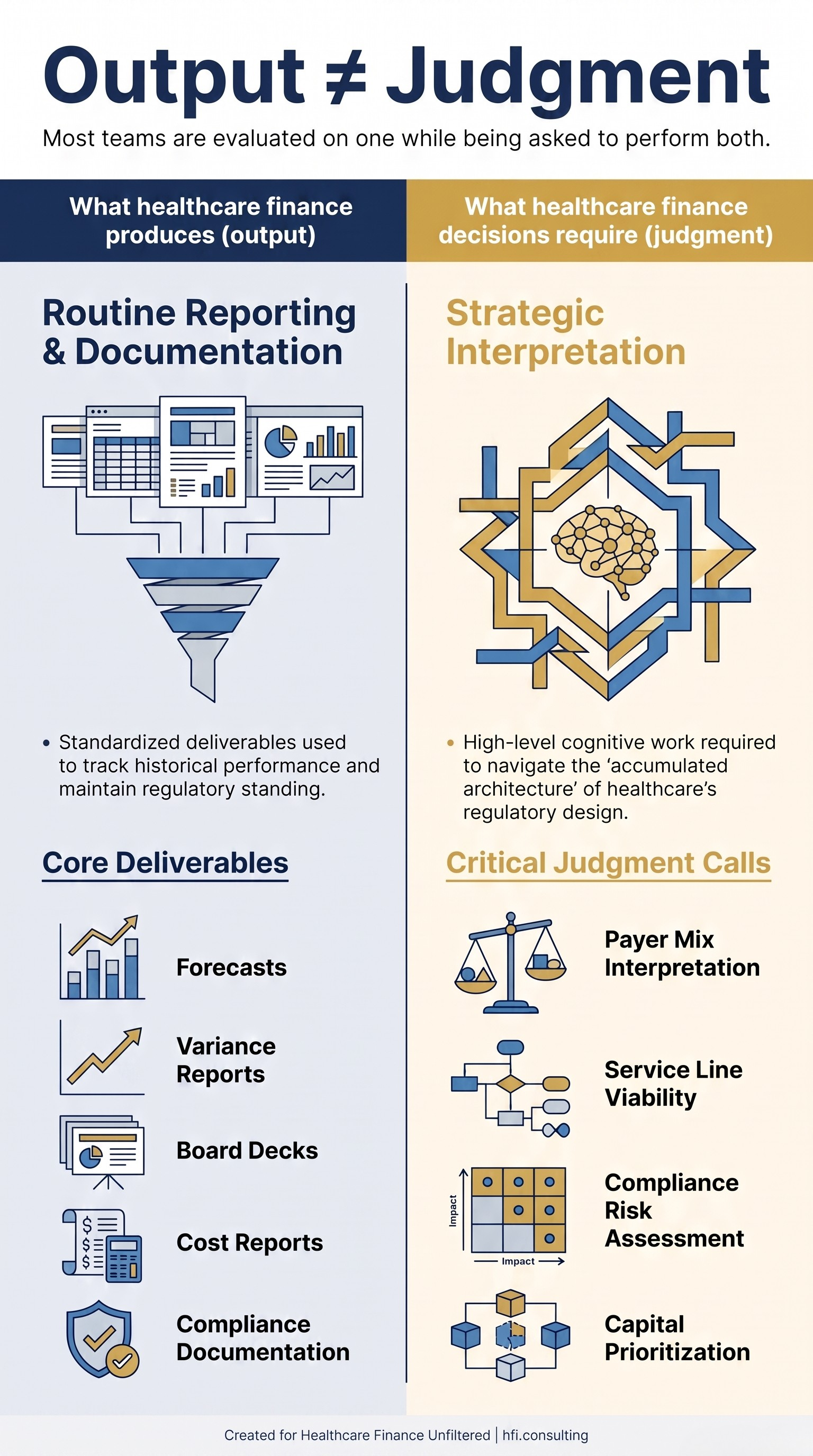
Two-column graphic contrasting healthcare finance output metrics like reports and decks against the judgment work required including payer interpretation and risk assessment.
Finance teams in healthcare are evaluated almost entirely on output: the forecast, the variance analysis, the board deck. What a CFO with one of the largest academic health systems in the Midwest discovered, when asked which of those reports had actually changed a decision in the past quarter, was that he could not name one. At least half, he estimated, were legacy requests nobody remembered originating.
That work kept getting produced because nobody wanted to be the one to stop producing it. And the people who could have had that conversation were too tired to escalate it.
What Balance Looks Like When the Stakes Are High but Not Urgent
Here is an honest framing that does not appear often in healthcare finance content: most of what finance teams do on a Friday afternoon before a long weekend is not saving anyone's life.
That is not a criticism. It is a structural reality that matters for how we think about workload and where outside support actually helps.
Healthcare is unique in that the mission of the enterprise carries genuine stakes. People who work in health systems feel that weight, even in administrative roles. There is a belief, often unspoken, that the urgency of clinical care justifies the urgency of the finance work that supports it. And to some extent that is true.
But the budget model that took 40 hours to run this week is not going to change patient outcomes by Monday. The variance report that gets revised three times because a department director cannot agree on the labor allocation will not affect a single clinical decision in the next 24 hours.
The connection between finance work and patient outcomes is real, but it operates on a longer time horizon than the urgency embedded in daily workflow suggests. Health systems that have learned to communicate that distinction to their finance teams, to make the meaningful work visible while protecting people from the escalated urgency that attaches to everything, retain better. The ones that have not tend to produce the environment that finance leader described: people staying because they are too busy to leave.
Where Accounting Awareness Breaks Down
The accumulation problem is not just a workload problem. It is also an accounting visibility problem that CFOs running lean teams often cannot see clearly from the inside.
When I managed financial operations at UF Health Jacksonville, a Level 1 Trauma and Level 3 NICU safety-net facility, the volume and complexity of what the finance team carried meant that certain accounting functions got deprioritized not because anyone decided they were unimportant, but because the team never had the bandwidth to surface them as a gap. Cost report accuracy. Contribution margin analysis at the service line level. Payer contract reconciliation against actual payment patterns. These are not exotic functions. They are foundational. And at stretched teams, they are exactly the work that gets absorbed into the background until something goes wrong.
The CFO usually finds out about the gap when it shows up as a variance that does not reconcile, a compliance question with a deadline attached, or a service line decision made without the margin data to support it.
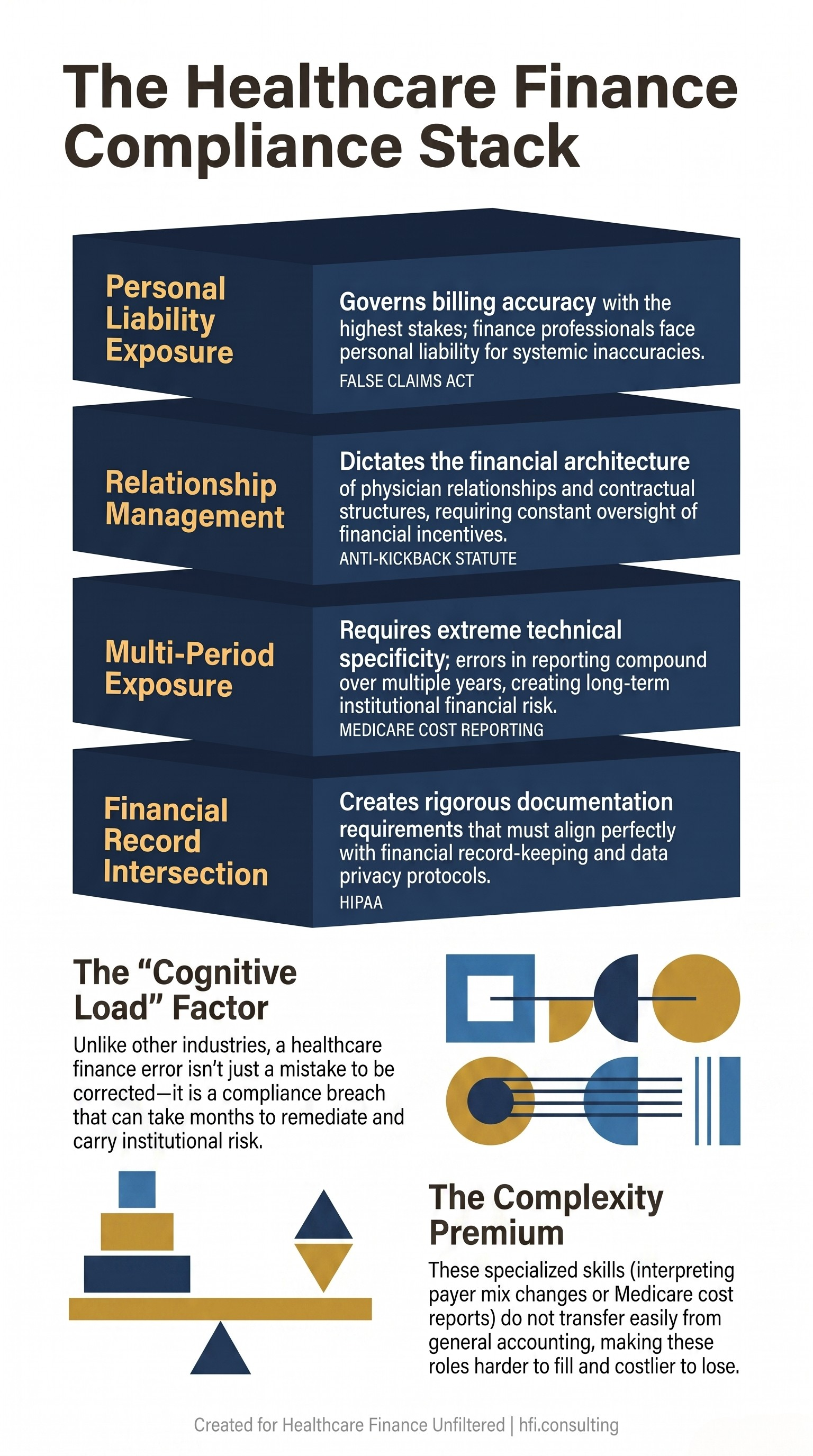
Layered diagram showing four major federal regulatory frameworks that healthcare finance professionals must manage simultaneously, each with distinct compliance and documentation requirements.
Carrying that level of exposure, consistently, across a full work calendar, is exhausting in a way that does not show up in utilization metrics. And it does not resolve itself when the team gets a little less busy. Lean teams stay lean. The accounting gaps stay open. The only thing that changes is which one surfaces first.
The Case for Targeted Outside Support
The default response to a stretched finance team is to look at internal solutions: redistribute the work, hire when budget allows, invest in another system that promises to automate the problem away. These are legitimate options. They are also slow, expensive, and frequently solve the symptom rather than the gap.
Boutique advisory firms work differently. The value is not in adding bodies or deploying a platform. It is in bringing a defined scope of expertise to a specific problem, on a timeline that matches the urgency, without the overhead of a large engagement or the ramp time of a new hire who still needs six months to understand the environment.
The problems that fit this model in healthcare finance are specific. Contribution margin analysis for a service line where the internal team does not have the cost accounting depth to run it cleanly. Implant cost reconciliation where the billing gap has been sitting for two quarters because nobody had bandwidth to investigate. Grant strategy for a rural or safety-net facility where the finance team knows the opportunity exists but cannot build the application alongside the day job. Payer contract review where the team suspects they are being underpaid but cannot substantiate it without someone who knows what to look for.
These are not consulting engagements that require months of discovery. They are targeted interventions that require someone who already understands the healthcare finance environment and can move without a long orientation period.
In my work through HFI Consulting, that is exactly the kind of engagement I take on. Not comprehensive finance department overhauls. Specific problems, defined scope, practical deliverables that the internal team can own after the engagement closes. The compensation frameworks and workforce cost analysis I have covered publicly reflect the same approach: a defined problem, a framework that works in the operational reality of a health system, and output the team can use.
What CFOs Can Do Right Now
If you are a CFO reading this with a team that is stretched, the question worth asking is not whether you need help. You probably already know the answer to that. The more productive question is which specific problem, if addressed, would give your team the most breathing room.
Audit your recurring report volume before budget season. Ask which reports have changed a decision in the past quarter. Cut the ones that have not and use that recovered time on the work that actually requires judgment.
Separate data assembly from interpretation. The skill that catches a number that looks wrong is not the same skill that chases it through five systems. When those two demands fall on the same person in the same afternoon, both suffer.
Name the accounting gap that keeps getting deferred. Every stretched finance team has one. Cost report accuracy, service line contribution margin, payer reconciliation, grant strategy. If it has been on the list for more than two quarters and has not moved, it is probably not going to move without outside help.
The healthcare CFO revolving door compounds this problem at the leadership level. When finance leadership turns over, the institutional knowledge about where the gaps are does not transfer through an org chart. It walks out the door. Outside advisors who work across multiple health systems carry a different kind of continuity: they have seen the same gap at other organizations and know what closing it actually requires.
The Recovery Is Not Automatic
The conditions holding healthcare finance professionals in their current roles will not hold permanently. Economic conditions shift. Consulting pipelines open. Organizations outside of healthcare are increasingly interested in finance professionals who have learned to manage multi-payer revenue, regulatory complexity, and operational volatility simultaneously. That skill set transfers.
When the market reopens, health systems that have treated their finance teams as a resource to be consumed rather than a function to be sustained will face a retention problem that budget season cannot solve. The structural realities of healthcare workforce compensation mean that pay alone will not close that gap. The organizations retaining finance talent are addressing workload design, accounting visibility, and capacity differently. Some of that is internal. Some of it is knowing which problems to route outside.
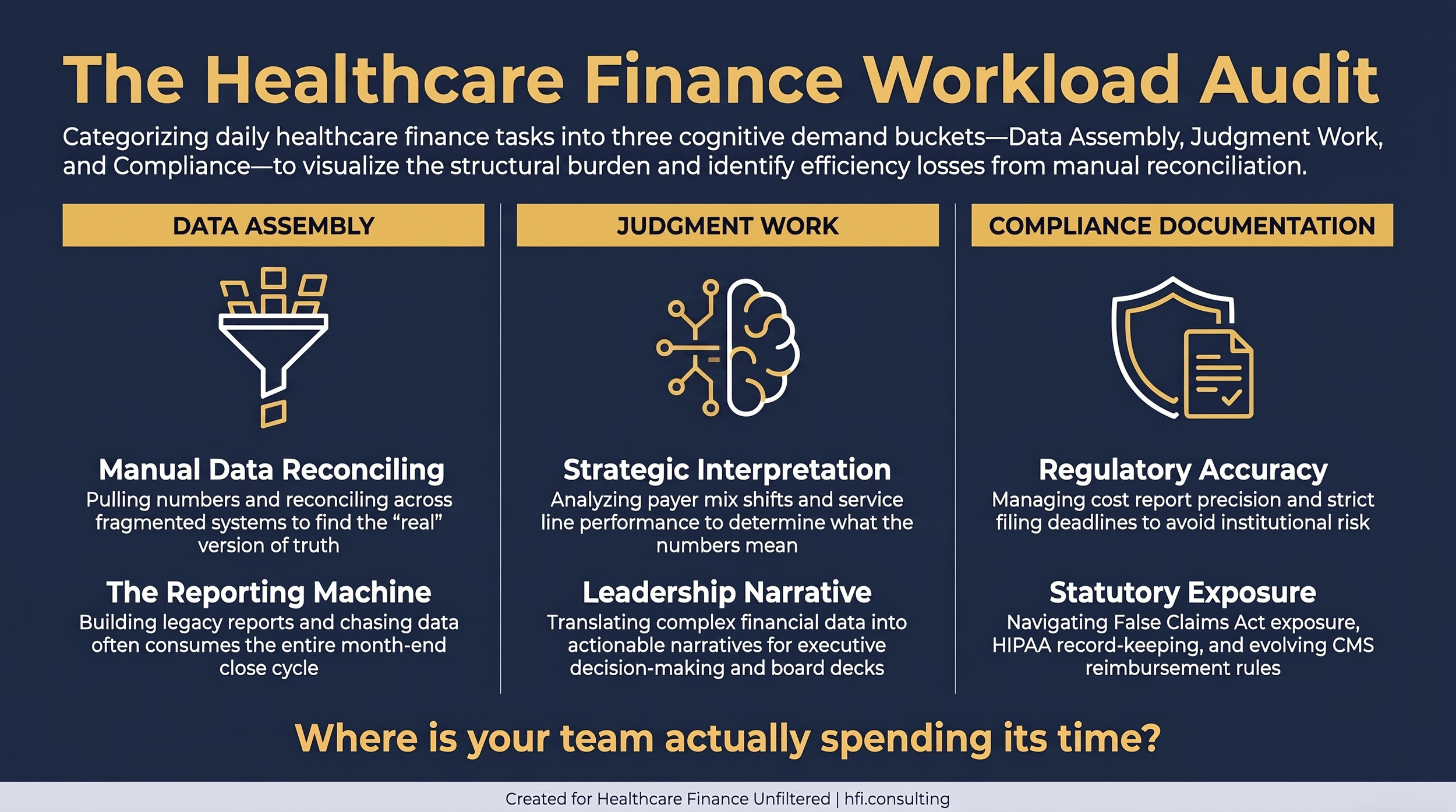
Three-column healthcare finance workload audit framework categorizing team activities into data assembly, judgment work, and compliance documentation, with a prompt asking where teams are actually spending their time.
The CFOs building for the longer term are not waiting for a crisis signal. They are looking at their finance operations right now and asking whether the people inside those operations have a realistic path to a career here, not just a path through the next close cycle. That question has an answer. The harder question is whether there is organizational will to act on it before the accounting gap becomes a compliance gap, and the compliance gap becomes a headline.
If you are carrying a specific finance or accounting problem that your team does not have the bandwidth to close, that is exactly the kind of engagement I take on. Reach out at hfi.consulting.
The healthcare finance workforce is running on institutional knowledge and professional obligation. Those are real assets. They are also finite. The organizations that recognize the difference between loyalty and exhaustion, and that know when to route targeted problems outside, will be better positioned when the labor market shifts.
That shift is coming. The question is whether you will have addressed the accounting gaps before or after the people who knew where they were decide to leave.
For more on what sustainable healthcare finance leadership looks like in practice, visit hfi.consulting.
P.S. What is the accounting or finance function in your organization that keeps getting deferred because the team does not have the bandwidth to close it? Hit reply and tell me. I read every response and it shapes what I write next.
