Epic wins the big switching decisions. Oracle and Meditech mostly keep the customers they have. Plan the capital accordingly.
Epic added 77 hospitals in 2025 while Oracle Health shed a net 56. Only two health systems with more than 10 hospitals made an enterprise-wide EHR decision all year, and both chose Epic.
If you are building a 2027 capital plan, you do not need another headline about market share. You need to know what the decision costs, who owns it, and whether it survives the next leadership change.
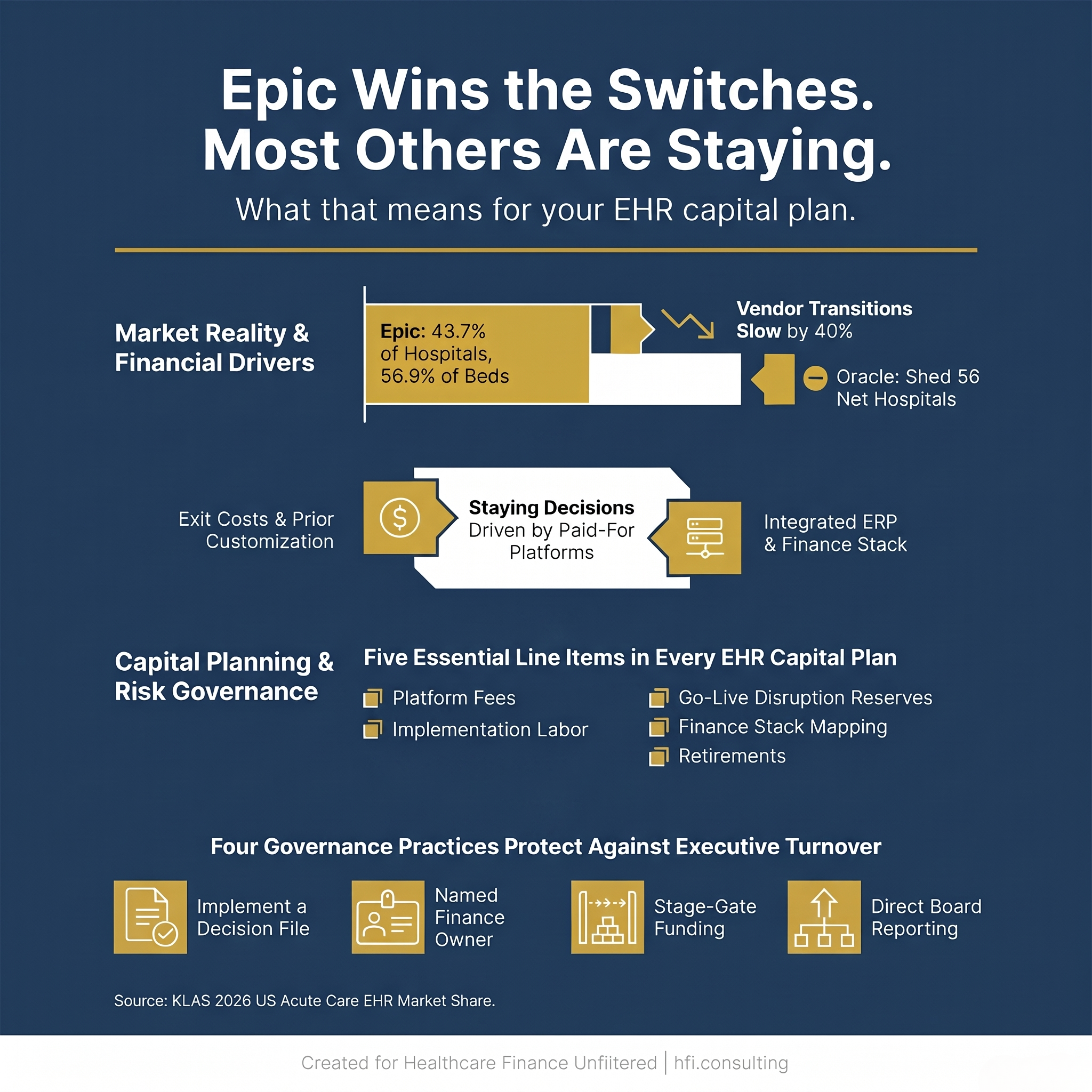
Epic wins the switches, most others are staying. EHR vendor selection and capital planning guide for healthcare CFOs.
The headline says Epic. The contracts say stay.
KLAS counted every acute care EHR contract executed in 2025. Epic now holds 43.7% of acute care hospitals and 56.9% of beds. Oracle Health holds 21.9% of hospitals, and Meditech holds 14.7%.
Buying slowed down. The number of hospitals making EHR decisions fell 40% from 2024, which KLAS tied to policy uncertainty and shifting technology priorities.
Oracle Health posted the largest net share loss for the third year in a row. Nearly all of its departing customers went to Epic. Becker's reports that six of the 11 hospitals and systems Epic added in August are replacing Oracle Health in whole or in part.
That is the consensus view, and the data supports it. Epic wins the switching decisions.
Now look at who is not on Epic. Becker's list of the largest non-Epic systems is led by investor-owned operators: HCA, Tenet, Community Health Systems, Universal Health Services, and Lifepoint. Most of the nonprofit and public systems on that list run Oracle Health.
Almost none of those are switching decisions. They are staying decisions.
HCA is the clearest case. It has 72 hospitals across the U.S. and U.K. live on Meditech Expanse, and Becker's describes the rollout as an expansion of a longstanding partnership, not a vendor switch. Meditech's biggest 2026 go-lives came from existing customers upgrading, not from systems changing vendors.
Universal Health Services tells the same story. It has run Cerner, now Oracle Health, since 2009. Its CIO told Becker's in 2024 that UHS was disappointed by the lack of progress in revenue cycle and consumer experience, yet stayed because of its customization investment and cautious optimism about Oracle's roadmap.
A staying decision still commits capital. It commits it to a roadmap you do not control.
Three financial reasons systems stay off Epic
In the public reporting I reviewed, there is no organized "never Epic" camp. There are three recurring financial reasons.
Reason 1: The platform is already paid for. In my read, HCA and UHS are not weighing Epic against a blank page. They are weighing it against years of customization, trained staff, and a vendor relationship they have already built. The exit cost plus the go-live disruption is what keeps them in place.
Reason 2: Independence and total cost at smaller hospitals. Schneck Medical Center in Indiana ran a four-to-five-month evaluation of Meditech Expanse against Epic Community Connect. Clinician scoring settled a close race slightly in favor of Expanse. The cost case: Epic would have required a separate ERP implementation, while Schneck runs supply chain, HR, and accounting through Meditech's ERP.
Becker's has reported a similar pattern in Idaho. Two critical access hospitals stayed on Meditech after a planned Epic move became unaffordable. The Meditech implementation cost under $500,000 plus a monthly subscription, while Epic's price tag would have been in the millions.
If you run a smaller or rural hospital, I covered how grant funding can reach EHR and ERP projects in my earlier CFO and CIO guide to the Rural Health Transformation Program.
Reason 3: The finance stack is already there. Quorum Health selected Oracle Health in September for its 11 hospitals in nine states. It added the EHR, patient accounting, and a clinical AI agent to the Oracle finance software it already uses. Community Health Systems has deployed Oracle's ERP enterprisewide.
When the ERP and patient accounting systems already sit with one vendor, the EHR decision becomes partly a finance decision. That is where CFOs have the most to add.
Hypothetical CFO perspective: "We did not pick an EHR. We picked a finance stack, and the EHR came with it."
What Epic's pricing policy means for your process. Epic's stated policy is that it does not negotiate price. Becker's reports that some clients found that surprising and welcome. Others will find it limiting.
My read: a competing bid is not leverage against Epic. It is a decision-quality tool, because it forces every vendor to price the full stack, including the EHR, ERP, patient accounting, interfaces, and retirements. I wrote about what leverage looks like with the market leader in my earlier piece on Epic contract strategy when leverage is limited.
Florida shows all three paths in one market. HCA's North Florida division has 16 hospitals live on Meditech Expanse. Sarasota Memorial launched Epic in early October in a roughly $160 million big bang go-live, replacing Altera. BayCare runs Oracle Health.
Moffitt Cancer Center and Nicklaus Children's are leaving Oracle Health for Epic. Baptist Health Care in Pensacola is moving from Altera to Epic with a big bang targeted for early 2028, and Parrish Healthcare in Titusville signed for Expanse in March.
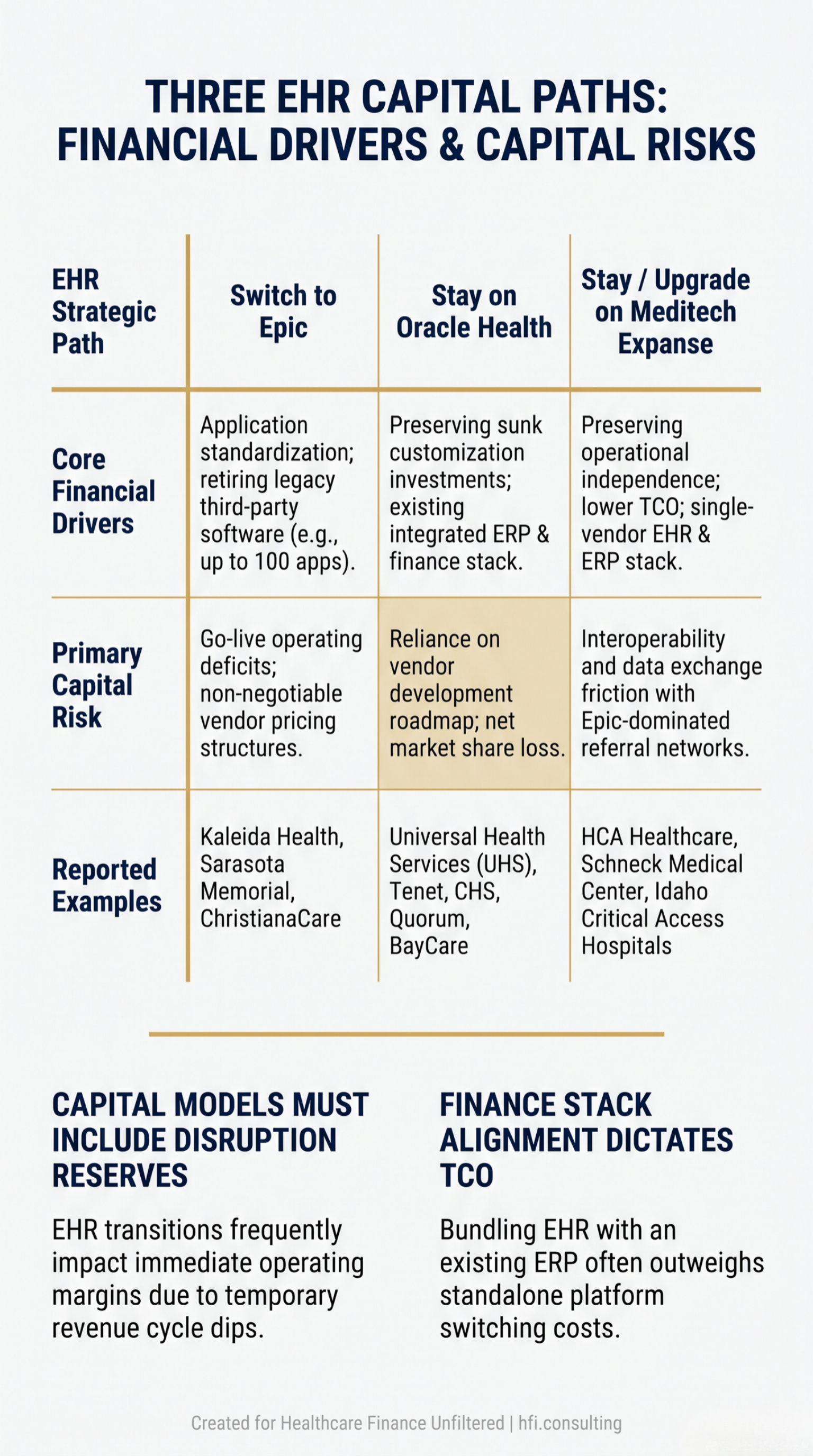
Comparison table of three EHR paths, switch to Epic, stay on Oracle Health, stay on Meditech Expanse, with cost drivers and capital risks.
What belongs in the capital plan, whichever vendor you pick
The reported numbers are large, and they are not comparable. Kaleida Health reports about $170 million for five hospitals, and the transition contributed to a $21.1 million operating deficit in the second quarter. Sarasota Memorial reports about $160 million, and Nicklaus Children's reports $75 million across three campuses.
Inspira Health frames its $120 million as a 10-year commitment that lets it turn off roughly 100 third-party applications. Its COO acknowledged that Epic will cost more each year than its current EHR. Adventist Health funded its project in part with roughly $1 billion in tax-exempt bonds.
Scope, timeline, and what each system counts all differ. Do not benchmark one against another. Use them to see which line items exist.
Read the Inspira framing closely. Its savings case depends on retiring applications, and retirement savings arrive only after the old contracts end. If the plan books the savings in year one and the contract tails in year three, it has a timing gap built in.
From the payer side, these costs do not stay inside the provider. They surface later in rate discussions. My read: a capital model with a stated reserve and written gates is more credible than a budget with one total.
The operating hit is real, and it is not limited to large systems. Memorial Sloan Kettering reported a $113.2 million operating loss for the first half of 2025, citing higher supply and drug costs along with one-time costs tied to its Epic go-live. In an earlier Becker's report, a 25-bed critical access hospital in Iowa posted a $430,135 loss in the month after its $3.88 million Epic go-live.
Every go-live also rewires how charge data reaches your general ledger. That was the center of my work as a cost accountant at UF Health Jacksonville: making charge and cost data tie to the chart of accounts. If the mapping is wrong at go-live, your contribution margin and variance reports can be wrong for months.
That is the kind of chart of accounts and managerial accounting work I do through HFI Consulting. If you are also deciding on accounting platforms, my accounting software selection framework covers how to avoid being sold the wrong system.
Five line items belong in every EHR capital plan, whichever vendor wins:
Platform cost: license or subscription, hosting, and annual increases.
Implementation labor: internal backfill, consultants, certified trainers, and activation support.
Go-live disruption reserve: volume dips, billing backlogs, and delayed cash.
Finance stack: ERP, patient accounting, and chart of accounts mapping.
Retirements and exit: applications and contracts that turn off, and the cost to leave the current vendor.
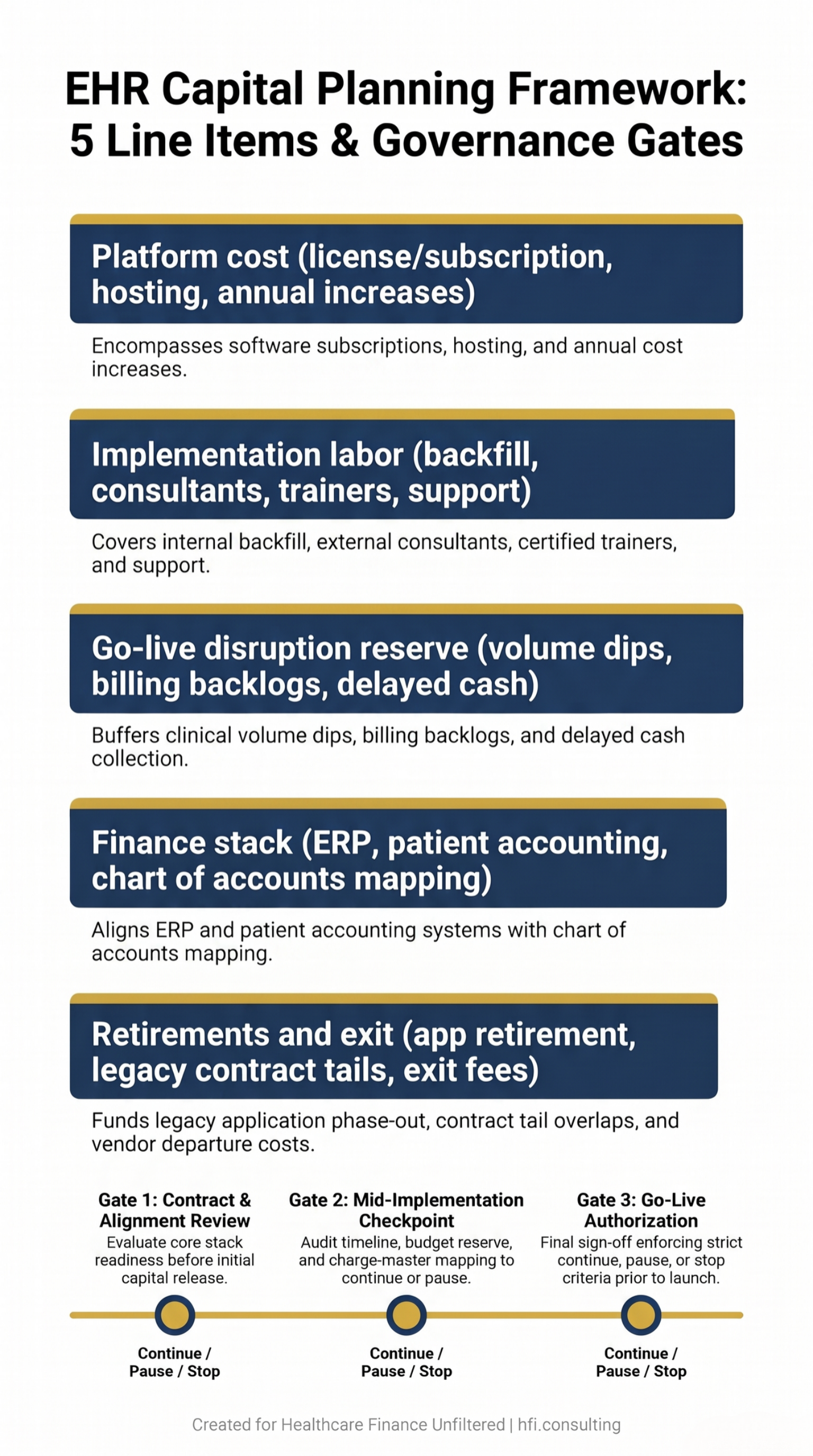
Framework diagram of five EHR capital plan line items: platform, implementation labor, go-live reserve, finance stack, and retirements and exit.
A note before the next section. If you are building an EHR or ERP capital plan and want a second set of eyes on the finance stack, chart of accounts mapping, or go-live reserve, start at hfi.consulting. Or reply to this post with the one line item you are least sure how to size.
The decision has to outlive the people who made it
Go-lives trail contract signatures by years. ChristianaCare decided to switch in 2024 and went live on October 3, 2026. Baptist Health Care in Pensacola is targeting early 2028.
That window is long enough for a CIO, a CFO, and a CEO to turn over.
Hypothetical CFO perspective: "The contract runs ten years. I have been in this seat for four."
The cautionary cases are older, but they show the pattern. Maine Medical Center's CIO was dismissed in 2013 amid trouble with its estimated $160 million Epic project. At Denver Health, a former CIO warned that total cost could reach $300 million, including $70 million to exit an existing contract, while the CEO said the project was under budget at $170 million.
Both views existed inside one executive team. A disagreement about cost is itself a risk the capital plan should price.
Becker's has also tracked health system CIO departures through 2026, as summarized by MarketScale. I would not build a plan on the assumption that leadership stays stable.
Staying does not remove this risk. UHS told Becker's it was disappointed in revenue cycle progress and stayed anyway. A staying decision made without a written exit cost and a roadmap checkpoint is the same blind commitment as a switch, only quieter.
Four practices make a decision survive turnover:
A decision file. Document the scoring, the cost model, and the assumptions, so a new executive inherits the reasoning and not just the contract.
A named finance owner. One person in finance owns the capital model through go-live, independent of who holds the CIO seat.
Stage gates. Release capital in phases with written criteria for continue, pause, or stop.
Board visibility. Report the reserve and the gates to the board, not only the budget total.
A simple test: could your successor rebuild the cost model from the file alone? If not, the file is not finished.
If you are recruiting a CIO, CFO, or CEO while an EHR program is in flight, treat the program as part of the job. Ask candidates how they would inherit it.
Six questions to answer before you sign
These are the short version of the decision file. If a candidate for a finance or IT leadership seat cannot answer them for your program, the program is not yet portable to the next leader.
Is this a switch or a stay, and what does exit cost under each?
What does the finance stack look like under each option, including ERP and patient accounting?
What is the go-live disruption reserve, and who approves drawing on it?
Which applications and contracts retire, and when does that savings reach the budget?
Who owns the decision file if leadership changes in month 14?
What would make us pause or stop at each capital gate?
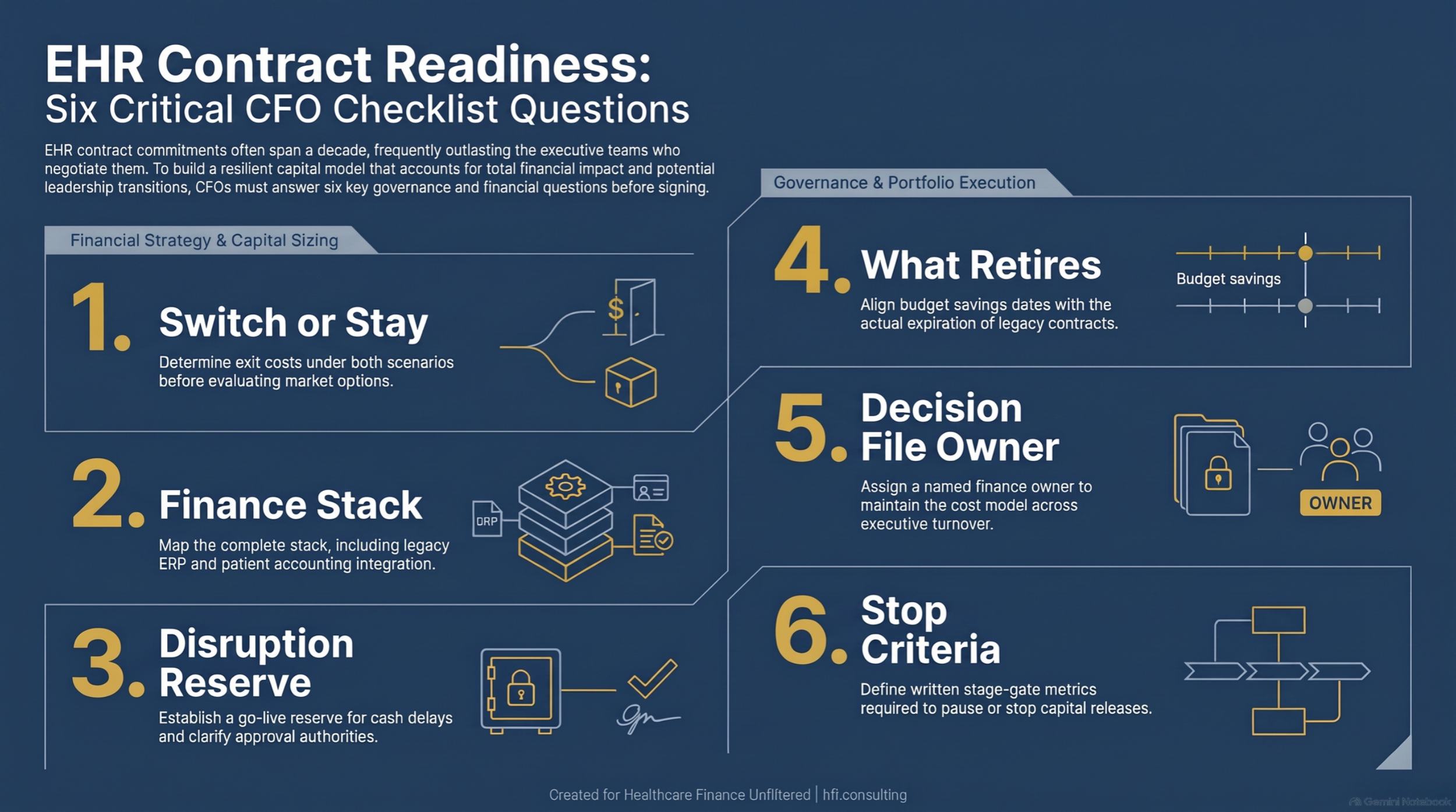
Checklist graphic of six questions CFOs should answer before signing an EHR contract, from switch or stay to who owns the decision file.
Epic will keep winning the switches. That does not make your decision simpler, and it does not make staying free. Either way you are committing a decade of capital to a vendor roadmap and a team that will change.
P.S. When your organization last signed an EHR or ERP contract, did the leaders who approved it still hold their seats at go-live? Hit reply and tell me yes, no, or it depends.
