
Payer Workforce Cuts and AI Claims Processing: The Provider CFO's Cost-to-Collect Playbook
Payers are cutting staff and leaning harder on AI for claims and prior auth. Here is how to make the cost you absorb visible.
At least 16 major payers have cut jobs so far in 2026, and the list keeps growing. Most of them are backfilling that headcount with AI.
For your revenue cycle team, that trade is not neutral. Every automated denial, every lost escalation contact, and every prior authorization stuck in a queue lands on your cost to collect, not theirs.
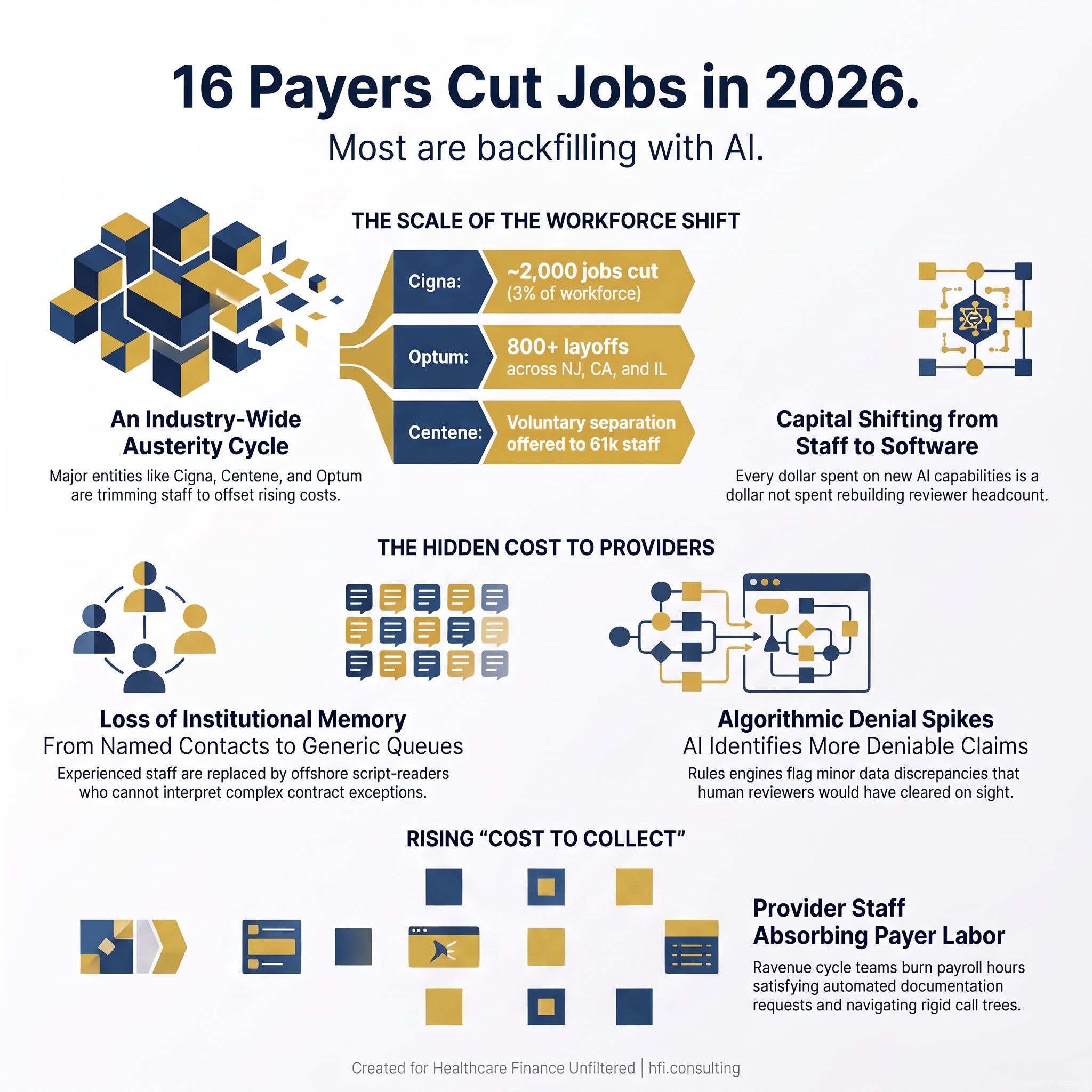
Graphic stating that 16 payers cut jobs in 2026 and most are replacing that headcount with AI, framing the article's core trend.
The Trade Payers Are Making
Becker's tracked at least 16 payers reducing headcount in 2026. Cigna cut about 2,000 jobs, roughly 3% of its workforce. Centene offered a voluntary separation option to most of its 61,000 employees. Optum has laid off more than 800 workers across New Jersey, California, and Illinois this year alone. Elevance Health, Molina, Aetna, and several regional Blues plans are on the same list.
Providers are watching the same austerity play out inside their own walls. Fierce Healthcare's 2026 layoff tracker lists dozens of health systems trimming administrative and revenue cycle staff for the same reasons payers cite: rising costs and thinning margins. This is not a payer problem happening to providers in isolation. It is an industry-wide cost-cutting cycle, and both sides are running close to the same playbook at the same time.
None of that headcount is coming back. What is replacing it is AI, and payers are not shy about saying so. Cigna just announced a collaboration with OpenAI to bring AI-enabled clinical support into oncology case management across its specialty pharmacy and health plan operations, on top of a $100 million investment it made earlier this year in a related medication-adherence AI program. That is a genuine investment in patient support, and it will likely help patients navigating a difficult diagnosis. It is also a signal of where payer capital is going instead of adjudication staff. Every dollar directed at a new AI capability is a dollar not spent rebuilding the reviewer headcount that just left.
The direction of that AI investment cuts both ways, and that nuance matters. Blue Cross Blue Shield Association's own analysis found that AI-enabled coding tools have added nearly $1 billion in healthcare costs since 2023, mostly by identifying secondary diagnoses that shift claims into higher-reimbursement categories. A recent UBS report found the opposite dynamic on the provider side: AI may actually benefit hospitals more than insurers, because health systems are using large language models to summarize records and draft appeal letters, cutting the time it takes to fight a denial.
Read together, those two findings say the same thing from opposite directions. AI is not making the payer-provider relationship more efficient. It is making both sides faster at the same fight.
From the payer side, I am watching this trade happen in real time right now. Many organizations are routing more claims and prior authorization decisions through AI-assisted review, alongside a new round of experience-based voluntary separation offers. That combination is not unique to one company. It is becoming the standard operating model for 2026, and it changes what your provider organization can expect from the other side of every claim.
Mechanism 1: You Lose the Person Who Used to Pick Up the Phone
Long-tenured payer staff carry something a rules engine cannot replicate: institutional memory. They know which contract carve-outs apply, which escalation path actually works, and which exceptions are standard practice even when nothing about them is written down.
Voluntary separation programs are typically built around age and tenure thresholds, which means the employees most likely to leave are exactly the ones who carried that memory. When they go, your billing team loses the direct line that used to resolve a dispute in a single phone call. What used to be a two-line email to a name you recognized becomes a ticket dropped into a generic provider services queue, with no guarantee it lands on a desk that understands your contract at all.
I saw the mirror image of this problem managing FP&A across seven hospitals at a multi-facility health system. Every clean resolution ran through a named contact who understood our contract's specific language. When that person moved on, the same dispute that used to take one email now took three weeks and a formal appeal.
I wrote about this loop in more detail in The Denial Loop Is Breaking Healthcare, where I broke down what both sides are actually paying for it and why neither one is winning.
Mechanism 2: Algorithmic Denials Do Not Ask Politely
To offset the staff they no longer have, payers are substituting rules engines and claim-scrubbing algorithms for human review. These engines are tuned conservatively. They reject or pause claims at the slightest data discrepancy and generate mass requests for medical records and itemized bills.
This is a zero-sum cost shift, and it is a deliberate one. The categories showing the sharpest increase tend to be the ones that require the least clinical judgment to flag: itemized bill requests, missing modifier codes, and duplicate claim triggers. A human reviewer would have cleared most of them without a second look. The payer saves the cost of a human reviewer. Your revenue cycle staff burn payroll hours pulling charts, compiling documentation, and uploading records to satisfy an algorithm that a human reviewer would likely have cleared on sight.
"AI is identifying more billable conditions, not sicker patients." (Luke Chalker, BCBSA)
BCBSA's own research shows how sensitive this dynamic has become on the provider side. That quote was about hospital coding, but the same disconnect runs the other direction. Payer-side AI is identifying more deniable claims, not more accurate ones.
If your denial rate looks flat while your revenue does not, this is usually why. I broke down exactly how that gap hides inside a clean-looking dashboard in Your Denial Rate Looks Great. Your Revenue Doesn't.
Mechanism 3: Prior Authorization Sits Until Someone Is Left to Clear It
Even under CMS interoperability and prior authorization reform guardrails, operational capacity still matters more than the rule written on paper. When payer clinical review teams shrink, complex requests sit longer. Advanced imaging, high-cost biopharmacy, surgical interventions, and post-acute transitions wait until the statutory limit or default into an administrative denial.
Inside Medicare Advantage operations, the math is straightforward. Fewer reviewers means the same volume of complex requests takes longer to clear, every time, regardless of what the regulation requires. That is not a policy failure. It is a staffing reality that policy cannot fully offset, and it will not show up in a payer's public compliance metrics. It shows up in your discharge planning meetings, weeks after the fact, as a case that should have moved faster.
For hospitals, that shows up as discharge delays and unreimbursed observation days piling up in a category nobody budgeted for. For outpatient groups and ASCs, it shows up as canceled procedures, delayed patient care, and lost downstream volume that never makes it back onto the schedule.
Mechanism 4: Offshore Hand-offs Turn Your Follow-up Call Into a Script
Headcount cuts at regional plans routinely lead to offshore outsourcing or vendor hand-offs for claims processing and call center operations. Representatives on the other end operate strictly off rigid call trees. They lack claim re-adjudication authority and often misinterpret non-standard contract carve-outs that a longer-tenured employee would have recognized immediately. A representative reading from a script has no way to know your organization negotiated a bundled-payment exception two contract cycles ago. The call ends in a transfer, or a promise to escalate that quietly never happens.
The result is higher call abandonment, repeated follow-ups on the same claim, and a real risk of hitting timely filing limits while your staff tries to get past a script to someone who can actually answer the question. None of that shows up as a clean line item on a report. It shows up as a slower, more expensive collections process that nobody can point to a single cause for.
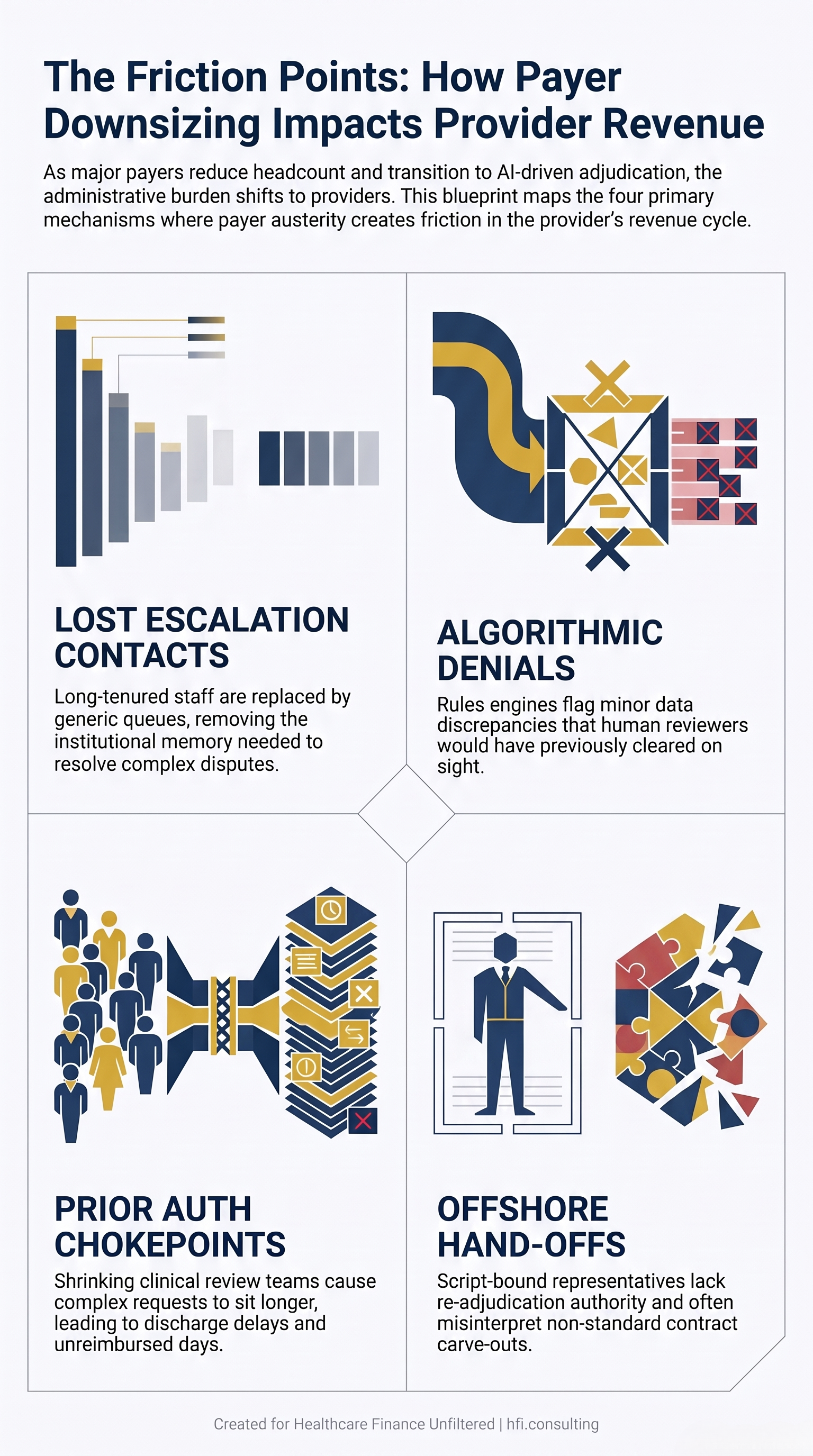
Diagram of four ways payer staff cuts hit provider revenue cycles: lost contacts, algorithmic denials, prior auth delays, and offshore hand-offs.
Ready to put a number on what this is actually costing you? That is exactly the kind of diagnostic work I do at HFI Consulting. Reply to this newsletter or visit the site and tell me where the pressure is hitting hardest inside your organization right now.
The Metric That Is Hardest to Pin on Payers
Every mechanism above rolls up into the same number: cost to collect. And it is the hardest one of all to point back to the payer causing it.
Denial rate has a name attached to it. You can segment it by payer and bring the data into a joint operating committee to make your case. Cost to collect does not work that way. It is the sum of every extra hour your team spends on hold, every chart pulled for an algorithmic documentation request, and every claim that ages past 90 days while a script-bound representative tries to find someone who can actually answer the question. No single payer signs their name to that number. All of them contribute to it.
Part of the problem is structural. Most provider organizations track cost to collect at the department or organization level, not broken out by payer. That makes it nearly impossible to build a clean before-and-after case when one specific plan cuts its claims staff or swaps in a new AI vendor. You feel the change in your own labor hours long before you can prove exactly where it came from.
Providers are not sitting still either, and that is worth acknowledging honestly. Trinity Health outsourced its revenue cycle technology work rather than continue staffing it internally. Novant Health cut 31 revenue cycle roles this year specifically to modernize its own operations. You are not the only side of this relationship automating and trimming headcount.
But your automation is a response to a cost that started on the other side of the table, and that distinction belongs in your next payer contract renegotiation. I laid out the specific AI tools hospitals are using to fight back against payer take-backs in AI in the Revenue Cycle: How Hospitals Are Fighting Back Against Payer Take-Backs. The short version: the providers gaining ground are the ones treating this as a measurable, negotiable problem instead of an invisible cost of doing business.
The Provider CFO Action Plan
You cannot fix what you have not made visible. Three moves turn cost to collect into a metric you actively manage instead of one you quietly absorb.
Payer contracting. Negotiate strict SLA penalties into managed-care agreements for clean-claim turnaround, phone wait times, and prompt payment interest enforcement. Track payer SLA compliance as its own line item, by payer, every quarter, not as a footnote in a broader contract review.
Denial monitoring. Segment denials weekly by root cause. Separate "medical necessity" from "missing records" instead of tracking a single blended denial rate. That split is what reveals an automated audit spike from a specific plan before it becomes a pattern you only notice in the annual numbers.
Cash acceleration. Escalate aggregate unresolved balances directly through joint operating committees instead of letting individual claims cycle through standard appeals one at a time. Aged A/R over 90 days is the number that tells you whether this is actually working, not the number of appeals your team filed.
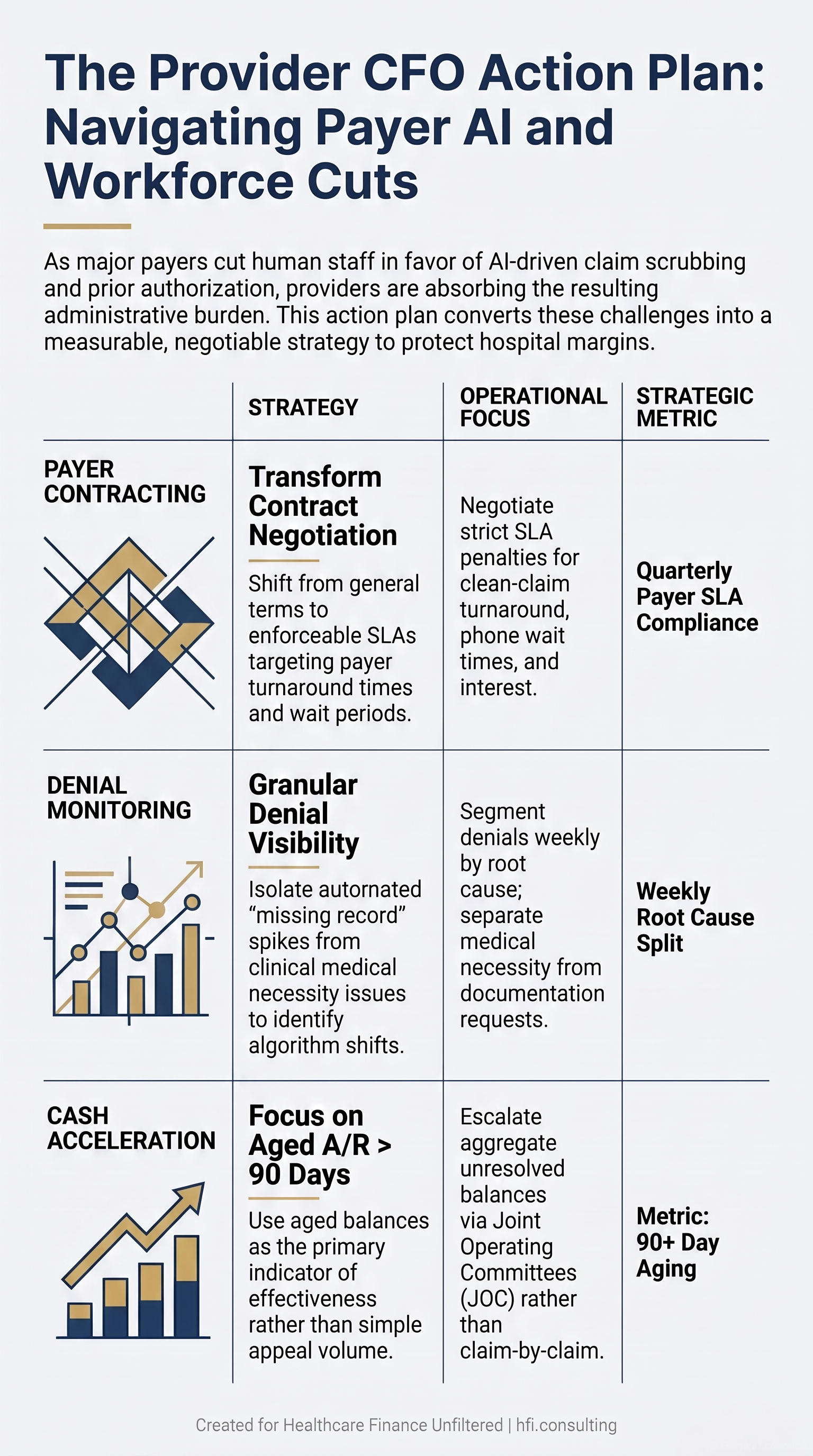
Table titled Provider CFO Action Plan showing payer contracting, denial monitoring, and cash acceleration tactics with their strategic metrics.
Where This Leaves You
Payer workforce cuts are not going to slow down heading into 2027. Neither is the AI replacing that headcount, on either side of the table. The provider organizations that come out ahead will be the ones who stopped treating cost to collect as background noise and started treating it as a number they can name, track, and negotiate against. That shift does not require a bigger revenue cycle department. It requires deciding, deliberately, which three numbers you are going to watch by payer starting this quarter.
If you want help building that framework for your organization, that is the work I do at HFI Consulting. Visit hfi.consulting to start the conversation.
P.S. Where is your organization feeling this first: denial volume, prior authorization turnaround, or a lost escalation contact you cannot replace? Reply and tell me.
