
Medicaid Work Requirements Are a CFO Problem, Not Just a Policy Debate
The January 1, 2027 compliance deadline is 124 days away. The financial exposure for both plan and provider CFOs is already calculable. Here is what the numbers actually look like.
The MedPage Today piece published today by Dr. David Hill, a pulmonologist and former American Lung Association board chair, opens with a sentence that should stop every healthcare finance leader cold: "My job has become mounds of paperwork."
He is not exaggerating. And that paperwork does not stay in the exam room. It migrates directly to your balance sheet.
The Medicaid work reporting mandate, enacted under Public Law 119-21 and currently being implemented through a CMS Interim Final Rule, requires non-disabled adults ages 19 through 64 on Medicaid expansion to complete 80 hours per month of qualifying activity or document why they cannot. The public comment period closed July 31, 2026. The statutory deadline is January 1, 2027.
Finance leaders on both sides of the payer-provider divide have approximately four months to model what this does to their operations.
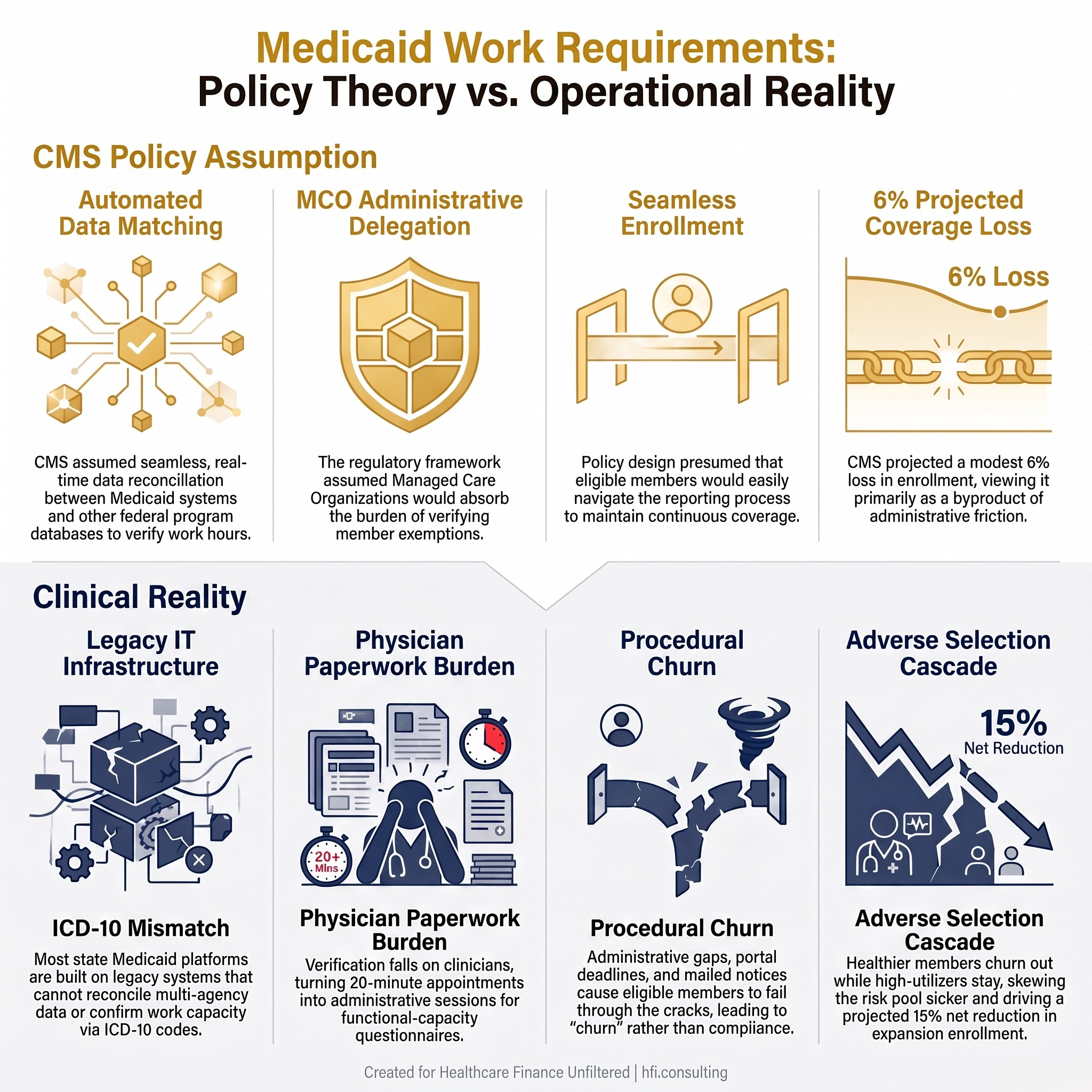
Diagram comparing CMS Medicaid work requirement policy assumptions to clinical and operational reality across four stages of implementation breakdown.
What CMS Was Trying to Do (And Why the Theory Did Not Survive Contact with Reality)
CMS did not design this rule to be unworkable. The regulatory framework assumed three things would function in practice: automated data matching between Medicaid systems and other federal programs, seamless cross-agency data sharing, and managed care organizations absorbing the administrative burden of exemption verification.
None of those assumptions have held.
State Medicaid IT infrastructure is largely built on legacy platforms that cannot reconcile multi-agency databases in real time. ICD-10 billing codes record diagnoses, not functional work capacity. A claims system can confirm that a patient carries a severe COPD diagnosis. It cannot tell a state eligibility system whether that patient can safely perform warehouse work for 80 hours a month.
That gap falls on physicians. Specifically, it falls on the 15 to 20 minute clinical appointment, which now has to accommodate legalistic functional-capacity questionnaires before the physician can bill for the visit.
CMS projected approximately 6 percent of Medicaid enrollees would lose coverage due to administrative friction rather than actual ineligibility. That projection is a line item on your uncompensated care budget if you operate on the provider side. On the payer side, it is an adverse selection scenario playing out in real time.
This is the same administrative cost dynamic I covered in the compliance tax piece: CMS burden is never free, and it never stays where policymakers intend it to land. The compliance tax framework applies directly here.
The Medicaid MCO CFO's Exposure
For a Medicaid managed care plan, the primary financial threat is top-line revenue erosion compounded by adverse selection risk that compounds faster than state actuarial cycles can adjust.
Capitation revenue contraction. Medicaid managed care organizations are paid per-member-per-month. CMS modeling projects a 15 percent net reduction in expansion enrollment, combining genuine noncompliance with procedural administrative churn. For a plan with 200,000 expansion members and a $450 PMPM capitation rate, a 15 percent enrollment loss is $162 million in annualized revenue before any cost adjustment. Fixed administrative overhead spreads across a smaller base. Operating margin compresses immediately.
Adverse selection as a budget driver. The members most likely to successfully navigate work reporting requirements or obtain exemptions are the ones with serious chronic illnesses, behavioral health complexity, and significant utilization. They know the system, have care teams helping them, and understand the documentation requirements. Healthier, lower-cost young adults are the ones most likely to miss a mailed notice, miss a portal deadline, or fall through an administrative gap. The residual risk pool skews sicker. Medical cost trend accelerates. Your Medical Loss Ratio moves before state actuaries have time to recalibrate capitation rates.
Rate-setting lag. State Medicaid actuarial cycles typically lag 12 to 24 months behind actual utilization patterns. If the January 2027 enrollment changes produce a meaningfully sicker residual population by Q2 2027, plan CFOs absorb higher per-member medical costs out of pocket until state rate-setters can respond.
SG&A escalation. Federal rules prohibit MCOs from making final eligibility determinations. Plans cannot prevent procedural disenrollment. They can only invest in member tracking, outreach, predictive analytics, and clinical data mining to identify members who qualify for medical frailty exemptions before a state renewal window triggers. That investment is not optional. It is the difference between retaining members who should not have churned and watching them fall off your risk roster.
This is not a future scenario. If you have not modeled it against your current enrollment mix, the budget conversation is already late.
From my time in payer operations, I watched how enrollment volatility tied to policy changes cascades through every downstream operational assumption: staffing ratios, utilization management capacity, pharmacy spend projections, quality measure baselines. The 2027 work requirement enrollment disruption will not behave like typical seasonal churn. It will land as a structural shift.
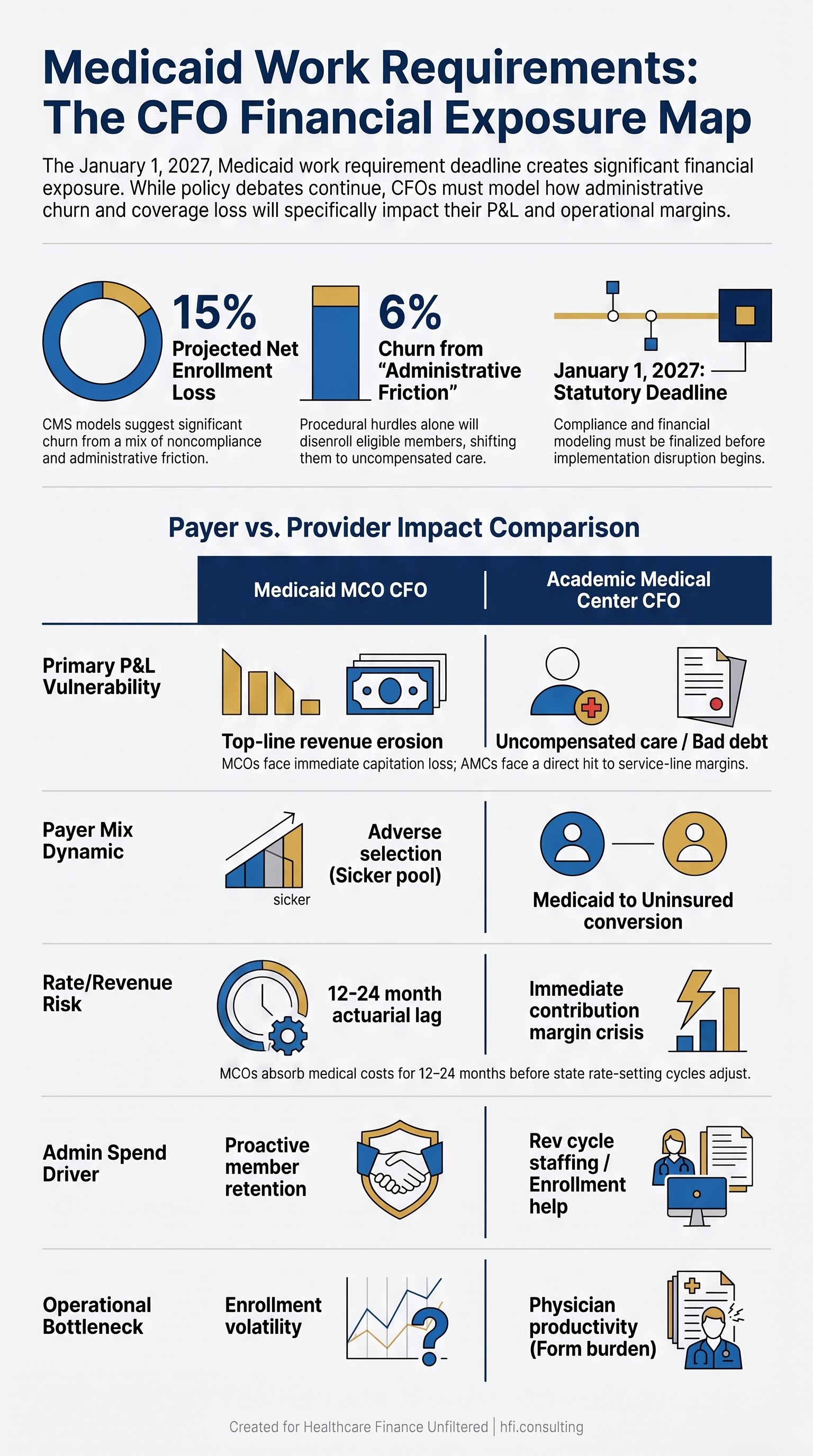
Comparison table showing Medicaid work requirement financial impacts on Medicaid MCO CFOs versus Academic Medical Center CFOs across five key operational dimensions.
The Academic Medical Center CFO's Exposure
For provider-side finance leaders, the mechanism is different but the math is comparably damaging. Medicaid coverage loss does not reduce demand for care. It converts covered Medicaid encounters into self-pay or uninsured encounters.
EMTALA does not care about work requirements. The Emergency Medical Treatment and Labor Act requires hospitals to screen and stabilize every patient regardless of coverage status. Patients who lose Medicaid due to administrative churn still present to your emergency department. They arrive sicker because they have delayed care. The encounter that would have been a covered outpatient visit becomes an uninsured inpatient admission.
Payer mix deterioration is a contribution margin crisis. Academic medical centers depend on specialty service lines where Medicaid reimbursement covers at least variable costs. Pulmonology. Oncology. Cardiology. Complex surgery. When the same patient arrives without coverage, the AMC absorbs the full inpatient cost with no payer backstop. This is not a small-volume problem at safety-net hospitals. It is a volume and margin problem at every hospital with significant Medicaid expansion enrollment.
Revenue cycle costs go up as revenue goes down. To protect cash flow, provider organizations must staff up patient access, financial counseling, and eligibility operations. Registration teams need to identify patients who have lost coverage at the point of service, initiate emergency retroactive Medicaid enrollments, and help patients document medical frailty exemptions before discharge. That is additional headcount and technology expense in the revenue cycle budget at the exact moment that reimbursable encounters are converting to bad debt.
Physician productivity falls. When a clinician spends 20 minutes of a 20-minute appointment completing state functional-capacity forms, relative value units drop. No wRVUs means no productivity-based compensation credit. The work happens but does not generate revenue. Across a large academic medical faculty, the aggregate productivity loss is measurable in the tens of millions of dollars annually.
Working at UF Health Jacksonville, a Level 1 Trauma and Level 3 NICU safety-net facility, I saw what happens when insured encounters convert to uncompensated care at scale. The financial pressure compounds in ways that are not always linear. Safety-net hospitals running on thin margins do not have a reserve buffer to absorb a multi-percentage-point shift in payer mix. Some are already running at negative operating margin before the first work requirement disenrollment hits their books.
The facilities most exposed are the ones already operating at the margin. That analysis connects directly to the rural hospitals piece from earlier this year, where the same thin-margin vulnerability shows up before any new policy pressure is added.
What Is Actually Expected to Change Before January 1
CMS cannot reverse the statutory mandate. Congress enacted it. But because state IT platforms cannot build verification portals in time and physician organizations are warning of care disruptions, several operational guardrails are expected before full enforcement begins.
Expanded ICD-10 auto-exemption lists. Rather than requiring manual functional-capacity questionnaires, CMS is expected to expand the diagnostic code sets that trigger automatic medical frailty exemptions. Nebraska has already built multi-hundred-page code registries that auto-exempt patients based on past claims data. Broader adoption of that approach keeps clinics out of the verification loop.
Extended self-attestation grace periods. The rule limits unverified self-attestation, but CMS is expected to grant states maximum flexibility during the first 12 to 24 months of implementation. Patients would be able to temporarily self-declare hardship while state systems catch up. This does not prevent enrollment disruption. It delays the worst of it.
MCO delegation for exemption verification. Finalized operational guidance is expected to shift administrative burden to Medicaid managed care plans. MCOs would mine encounter and pharmacy data proactively to flag eligible exemptions before a coverage redetermination packet reaches a patient.
Phased state rollouts with extended cure periods. Several states are requesting phased enforcement with 60 to 90 day cure periods rather than immediate benefit termination.
The post-midterm window, November through December 2026, is the most likely period for CMS to publish formal responses to the public comment period and codify broader safe harbor exemptions. Finance leaders should be watching that window closely.
This is the same planning posture that proved useful during the ACA subsidy expiration. The community benefit strategy framework from that piece applies directly to the coverage modeling challenge here.
The CFO Planning Framework for the Next 90 Days
Whether you sit on the plan side or the provider side, the operational response has the same first step: quantify your exposure before the January deadline rather than after.
For Medicaid MCO finance teams:
Run a segmentation analysis of your current expansion enrollment. Identify members by claim pattern and demographic profile who represent the highest administrative churn risk under work reporting requirements. Separate that from your genuine high-risk, medically complex population. Model your capitation revenue under a 10, 15, and 20 percent enrollment contraction scenario.
Build the SG&A investment case for proactive member retention before disenrollment locks in. A point-of-care renewal specialist embedded in high-risk clinic settings is more cost-effective than a post-disenrollment reenrollment workflow.
Talk to your actuary now. Not in Q1 2027. The rate-setting lag means you need documentation of your enrollment shift patterns from the first quarter of implementation, not six months later.
For provider-side finance teams:
Model your payer mix under two scenarios: a 10 percent Medicaid to uninsured conversion and a 20 percent conversion. Project what each does to your DSH payment utilization, your charity care allowance, and your bad debt reserve.
Expand days of cash on hand proactively. AMC CFOs are modeling 2 to 5 percent of gross revenue as uncompensated care exposure from Medicaid churn. If you are running your DCOH targets for a stable payer mix environment, revise those assumptions before Q4 budget finalization.
Build the revenue cycle staffing and technology budget for enrollment navigation. This is not optional expense. It is a cost of protecting cash flow in an environment where coverage status is becoming unstable.
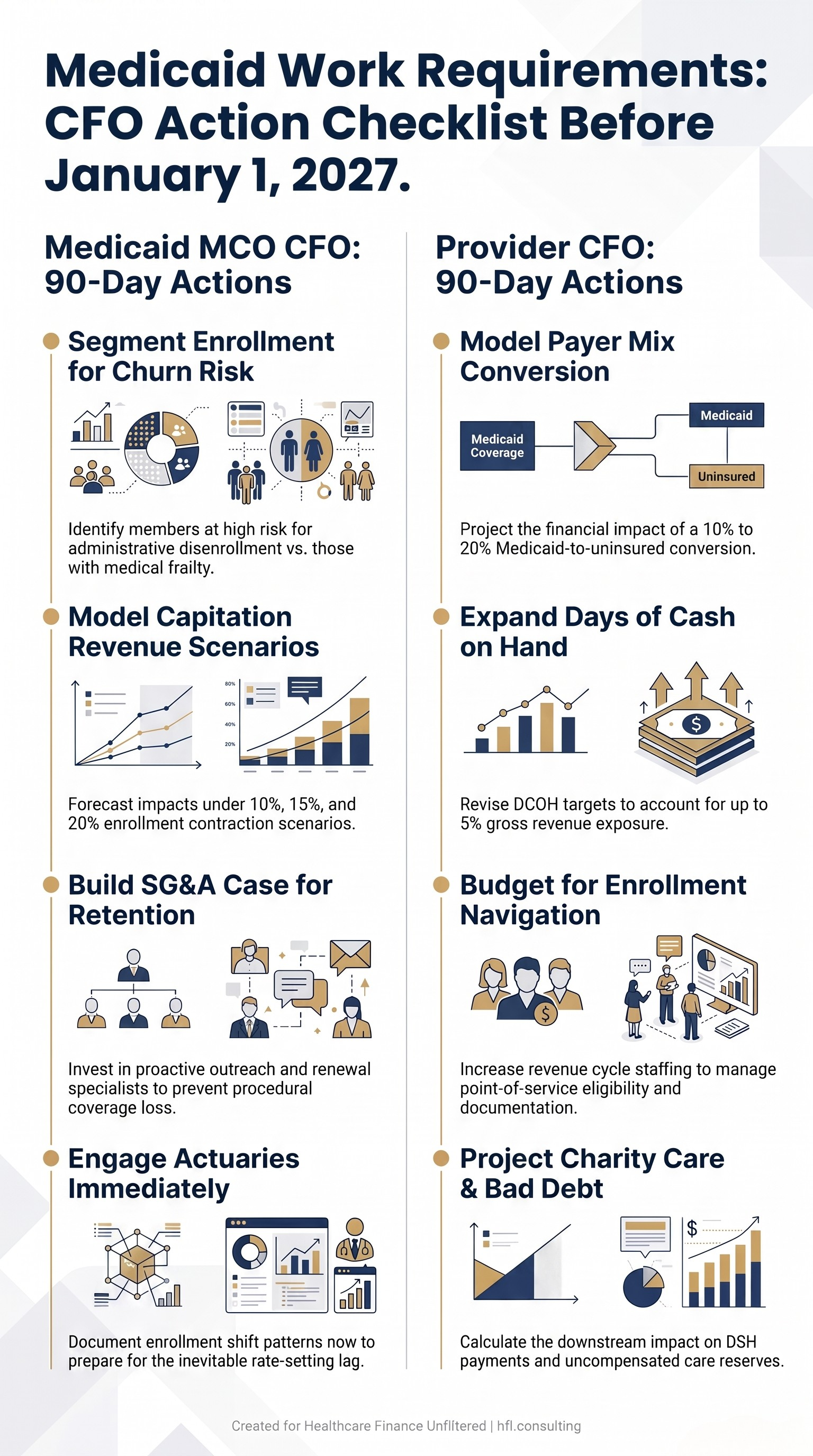
Two-column CFO action checklist separating 90-day planning steps for Medicaid MCO finance leaders and provider-side CFOs before the January 2027 Medicaid work requirement deadline.
If you are working through the financial modeling for Medicaid work requirements and want a framework for the payer mix scenario analysis or the SG&A investment case, that is exactly the kind of CFO-level work we do at HFI Consulting. Reach out through hfi.consulting and let's talk through your specific situation.
The Physician Organization Perspective and What It Means for Finance
Physician groups are not opposing work requirements because they want to protect fraud. They are opposing them because the verification mechanism turns clinical encounters into administrative clearance events.
The American Medical Association, the American Lung Association, and state medical societies are pressing for four specific changes: diagnosis-based automatic exemptions using ICD-10 codes, automated data matching through existing federal program databases, self-attestation safe harbors without mandatory clinical sign-off, and multi-year exemption periods for irreversible chronic conditions.
Each of those requests, if adopted, reduces the administrative burden on providers and reduces the procedural churn risk for plans. Finance leaders on both sides have aligned interests in advocating for those operational guardrails, even if they have different P&L reasons for doing so.
This is the same dynamic covered in the compliance tax piece. Administrative burden is never free, and it never stays where policymakers intend it to land. See the full framework for how CMS administrative burden becomes a hidden budget line item.
The Post-Midterm Variable
The timing of this rule creates an unusual planning environment. CMS is unlikely to issue major policy reversals before the November midterm elections. The post-election window, before the January 1 statutory deadline, is where the most significant operational adjustments are expected.
Finance leaders who build their models now around the worst-case enrollment scenario have the flexibility to revise upward if CMS expands exemption protections in November or December. Finance leaders who wait for policy clarity before modeling have no runway to adjust before the deadline.
The ACA subsidy expiration created a comparable planning challenge earlier this year. The organizations that modeled multiple coverage scenarios before the subsidy changes took effect were better positioned than those who waited for certainty that never came.
The Medicaid work requirement debate will continue in policy circles and congressional hearings. The January 1, 2027 deadline will not.
Your budget does not care who wins the argument. It cares whether you have modeled the exposure before the disruption arrives.
HFI Consulting works with health system CFOs and payer finance leaders on contribution margin analysis, service line financial assessment, and strategic scenario planning. If the work requirement implementation is creating modeling questions you do not have capacity to work through internally, connect with us at hfi.consulting.
P.S. For CFOs and finance leaders on either the plan or provider side: have you started modeling your Medicaid enrollment exposure for January 2027? Is the biggest gap in your analysis the enrollment scenario, the revenue cycle cost, or the timing of CMS operational guidance? Hit reply and tell me where you are on this. I am tracking the most common planning gaps for a follow-up piece.
