
Two CMS final rules change what you pay providers on January 1. Here is what payer finance leaders can do in the next 53 days.
CMS finalized the CY 2027 Physician Fee Schedule and Home Health payment rules on November 4. Both take effect January 1, which is 53 days from today.
Your 2027 Medicare Advantage payment rates were finalized in April. These rules do not reopen them. They change what you pay providers and how your claims engine prices a visit.
Most of the work is decisions, not technology. Those decisions can start this week.
Title graphic reading CMS CY 2027 Final Rules: What Payer CFOs Can Do in 53 Days, with the subtext Claims, Contracts, and Cost.
A Fee-for-Service Rule Becomes Your Cost Trend
The Physician Fee Schedule and the Home Health payment system are Original Medicare rules. They do not set what you pay a provider. Your contract does.
But many MA provider contracts point back to Medicare. When the Medicare rate moves, your cost can move with it. Whether it does depends on the words in the contract.
I covered the revenue side of 2027 in my earlier piece on what MA finance leaders must plan for in the CY 2027 final rule. That article was about what you receive. This one is about what you pay out.
Working on the payer side of Medicare Advantage, I read a final rule by asking one question first. Who has to act before the effective date? It is rarely the person who reads the headline.
What CMS Finalized
Five changes matter most to payer operations.
Conversion factor: $32.63 for most clinicians, down 2.31%. $32.95 for qualifying APM participants, down 1.83%. Both cuts are deeper than the July proposal.
G2211: it retires as a flat add-on. Modifier B1 adds 16% to the office or outpatient E/M payment. Modifier B2 adds 32% for Shared Savings Program and LEAD ACO participants.
Same-day services: when an E/M visit billed with modifier -25 falls on the same day as a 0-day global procedure, the lower-paid service is paid at 80%. The proposal was 50% and reached 10-day and 90-day globals.
Remote monitoring: a face-to-face initiating visit is required, and RTM is limited to established patients, starting January 1. The employed-staff requirement is delayed to January 1, 2029.
Home health: aggregate payments rise 2.4%, about $415 million. A 3% temporary adjustment continues, the fixed-dollar loss ratio drops from 0.37 to 0.29, and all 432 PDGM case-mix weights are recalibrated.
Physician groups are already pushing back. MGMA's Anders Gilberg said the cuts would "further degrade an already fragile payment system."
Congress has historically stepped in on physician pay before cuts take effect. Carry both outcomes until the picture clears. I lay out three cases below.
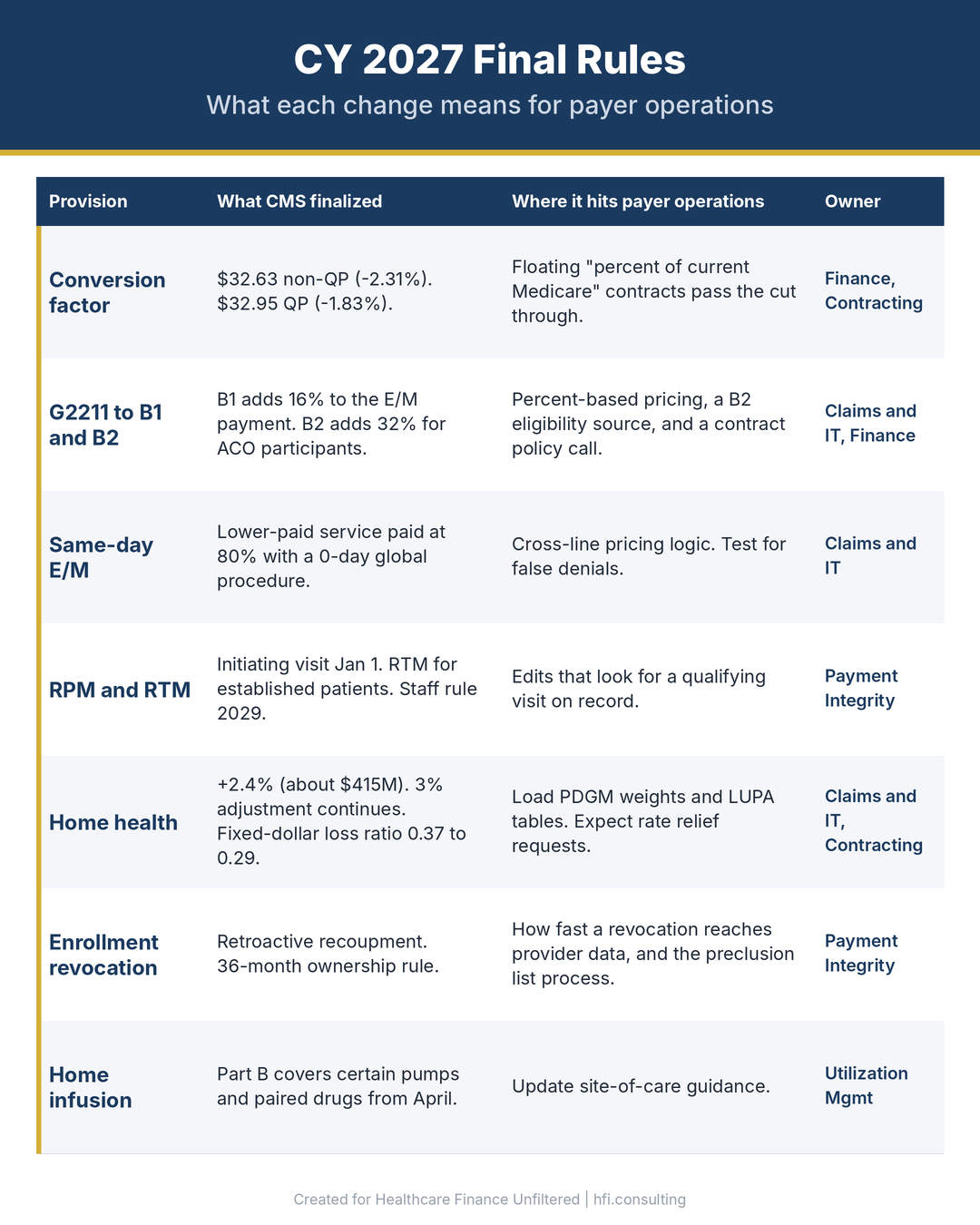
Table mapping seven CY 2027 CMS final rule provisions to the payer operations they affect and the department that owns each one.
Contract Language Decides Who Pays
Pull your contracts before you pull the rule. Three constructions drive most of the exposure.
Percent of current Medicare allowable: it floats with the conversion factor. The cut flows through.
Percent of Medicare as of a fixed date: it does not move. Neither does anything else CMS changes.
Silent on add-on codes and modifiers: this is where B1 and B2 get argued.
Here is a rough scale. For every $100 million of professional spend tied to current Medicare allowables, a 2.31% cut moves about $2.3 million. That is illustrative.
It comes before service mix and RVU changes. Your number will differ by specialty.
Modifier B2 needs its own line in your model. CMS says it can be billed for any beneficiary an ACO participant sees, not only ACO-assigned patients. That makes the volume harder to forecast from attribution data alone.
Whether your contracts or payment policies recognize B1 and B2 is your decision. If they do, model three adoption cases: low, base, and high. If they do not, document that position before providers ask.
Ask compliance and legal how these changes apply to non-contracted providers. Do not assume the answer.
The ACO incentive structure behind B2 connects to the value-based models I covered in my strategy guide to TEAM and CJR-X. If your network includes ACO participants, that piece still applies.
The provider side reads this rule differently. A procedural group that loses 20% on same-day lines will look for the recovery in your next rate negotiation.
Specialties that pair a visit with a minor procedure feel it first. Expect that conversation.
Three Scenarios to Carry Into Budget Review
Your budget review will ask for a number. Give it a range with named drivers instead.
Cut as finalized, low B2 adoption: floating contracts pass the conversion factor cut through. Savings are real, but provider pushback at renewal will offset part of them.
Cut reduced or delayed by Congress: floating-contract savings shrink. The claims work does not, because the modifier and same-day changes are separate policies in the same rule.
Cut as finalized, high B2 adoption: if your contracts recognize B2, ACO participants can raise your cost on E/M visits even as the conversion factor falls.
Tie every assumption to the scenario it belongs to. A range with named drivers is easier to defend than a single number.
Claims Configuration: Three Builds That Fail Quietly
Pricing errors do not announce themselves. Claims adjudicate. The variance shows up in the close.
B1 and B2 pricing: G2211 was a flat add-on. B1 and B2 are percentages of the base E/M payment, so logic built for flat dollars has to change. B2 also needs an eligibility source, because someone has to decide which practitioners qualify.
Same-day logic: the 80% rule works across claim lines. The system has to find the 0-day global procedure, compare values, and reduce the lower-paid line. Test for false denials and manual review queues before go-live.
Home health tables: load the recalibrated PDGM case-mix weights, the updated LUPA thresholds, and the new 0.29 fixed-dollar loss ratio.
Build test cases in pairs. One claim should reduce and one should not. A same-day E/M with a 0-day global procedure should reduce.
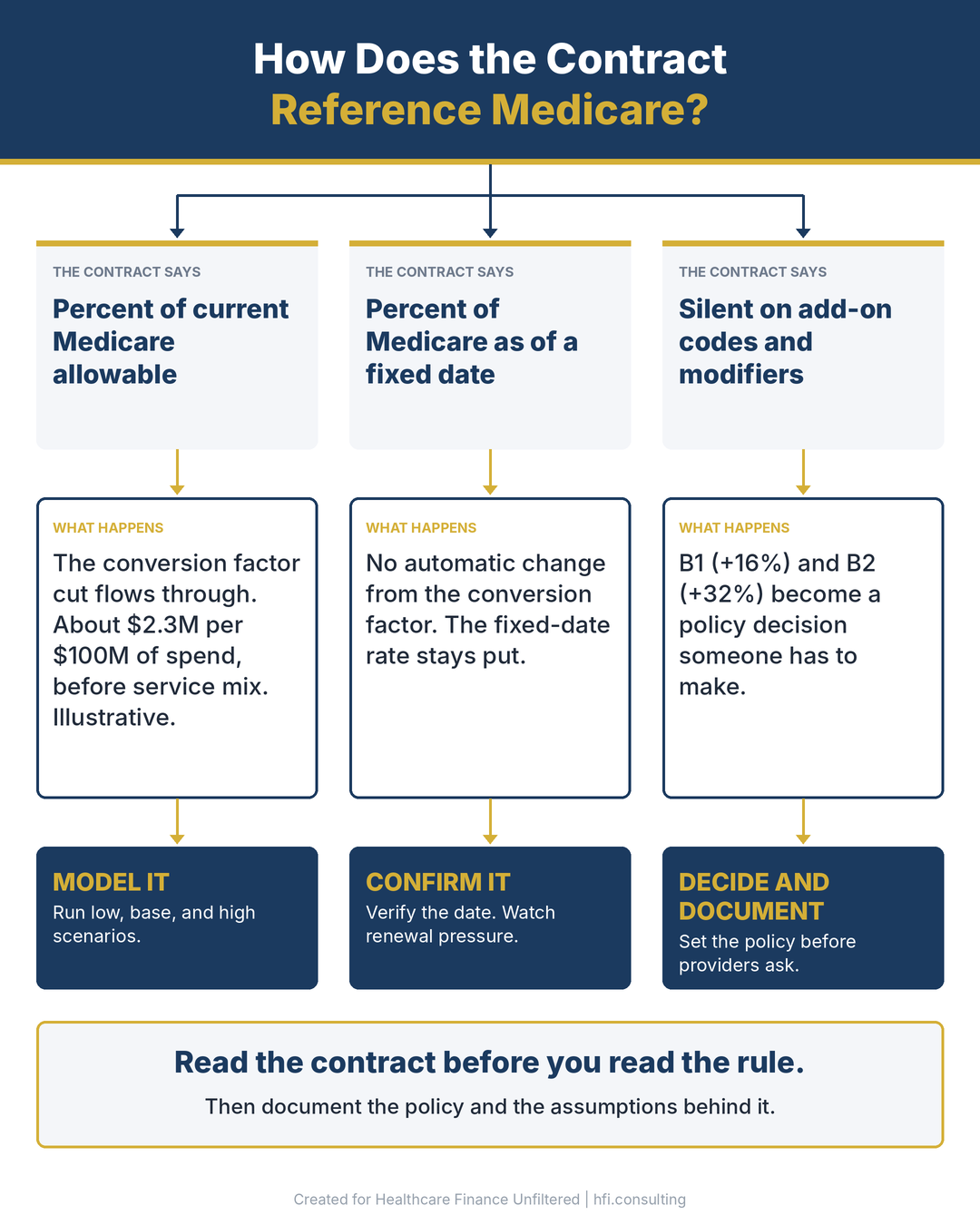
Decision tree sorting provider contracts by Medicare reference type and showing which ones pass through the CY 2027 cut or need a B1 and B2 decision.
A same-day E/M with a 10-day global procedure should not. If it reduces, your logic is reading the July proposal instead of the final rule.
Your claims team is not starting from an empty queue. The January 1 prior authorization API date sits in the same window. I covered that timeline in my guide to the CMS interoperability and prior authorization rule.
Both builds compete for the same IT and vendor capacity. Sequence them now.
Payment Integrity and Network: Where Retroactivity Bites
CMS expanded its ability to recoup payments retroactively from providers with revoked Medicare enrollment. It can also deny or revoke enrollment for home health, hospice, and DMEPOS businesses sold within 36 months if the new owner does not enroll as a new provider and complete accreditation or a state survey.
Ask how a CMS revocation reaches your provider data and how fast. Ask compliance how it connects to your preclusion list process. A revocation you learn about late is a payment you may struggle to recover.
Remote monitoring changes start January 1. Payment integrity can test whether RPM and RTM claims have a qualifying initiating visit on record. The employed-staff requirement is delayed to 2029, so do not rebuild vendor strategy around it yet.
Home infusion and home health need attention too. Beginning in April, Medicare Part B covers certain infusion pumps and their paired home drugs. Utilization management teams can revisit site-of-care guidance, because home routing can shift cost away from outpatient facility claims.
A 2.4% aggregate home health increase, offset by a continuing 3% temporary adjustment, leaves many agencies with little relief. Plan for requests for rate relief or risk-sharing.
If you are working through a contract inventory right now, I would like to hear which constructions are giving your team the most trouble. Reply to this email, or start the conversation at hfi.consulting. It is easier to size exposure with a second set of eyes.
The 53 Days: What to Do and When
Work backward from January 1. Five windows cover it.
November 9 to 20, inventory: pull every provider and facility contract that references Medicare rates. Tag each as floating, fixed-date, or silent on add-ons. Name an owner.
November 23 to December 4, decide: set your policy on B1, B2, and same-day reductions. Document the assumptions. Get contracting and legal sign-off. This window includes Thanksgiving week.
December 7 to 18, build and test: configure, load the home health tables, and run test claims for each scenario. Include the claims that should not reduce.
December 21 to 31, verify and freeze: check your change-freeze calendar now, because many IT organizations restrict production changes at year-end. Finance signs off on expected variance by driver.
January 1 to March 31, monitor: compare weekly actuals to the model. Watch B2 uptake against your low, base, and high cases.
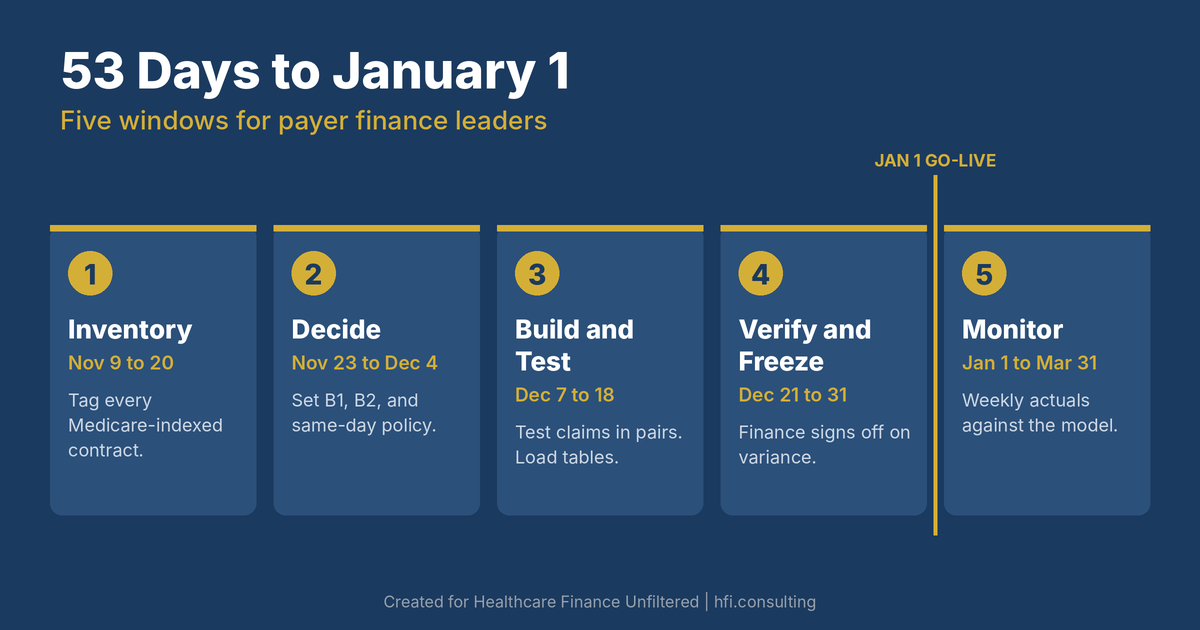
Timeline of five windows from November 9 to March 31 covering inventory, decisions, build and test, freeze, and monitoring for the January 1 go-live.
Who Needs to Be in the Room
This is not a single-department project. Five groups own a piece.
Finance: contract exposure model, scenarios, variance tracking
Claims and IT: pricing logic, test claims, table loads
Provider contracting: contract inventory, renewal pressure, carve-out requests
Payment integrity and SIU: revocation feeds, remote monitoring edits
Utilization management: home infusion and site-of-care guidance
Finance should chair the first meeting. The dollar exposure is what gets the other four groups to move.
Measure It So You Can Explain It
If every effect lands in one professional claims expense line, you cannot separate rule-driven variance from utilization and membership trend. Give each driver its own tag. Set up sub-accounts or cost-center tags for the conversion factor effect, B1 and B2 payments, same-day adjustments, and home health table changes.
The same logic applies to chart of accounts design. I wrote about how poor structure hides variance in my piece on healthcare chart of accounts errors, from the medical practice side. The principle holds at plan scale.
Document expected variance by driver before January. Q1 actuals need something to be compared against.
Report it monthly with three columns: modeled, actual, and driver. Whether that model lives in Anaplan, Pigment, Cube, or a well-built Excel workbook matters less than having one.
What to Watch After January 1
Two items belong on your radar. Starting April 1, 2027, approved ACOs can reduce or eliminate Part B cost sharing for assigned beneficiaries. Your market strategy team should watch how that shapes the Medicare comparison in your counties.
The 2029 remote monitoring date could also be revisited in future rulemaking. Do not treat it as settled.
The Rule Is Final Enough to Start
None of this requires waiting for the Federal Register or for Congress.
Inventory the contracts. Make the policy calls. Give finance a model that explains what moves.
Fifty-three days is enough time if the decisions start this week. If you want a sounding board on contract exposure or on sequencing the January 1 workload, start the conversation at hfi.consulting.
P.S. Which contract construction worries you most: floating percent of Medicare, fixed-date references, or silence on add-on codes? Reply and tell me. I read every response.
