Families are questioning insurance and employers are routing around it. Here is what each option means for your margin
The average family premium for employer coverage reached $28,303 this year, and workers now pay $7,471 of it, up 9% from 2025. On the Marketplace, KFF estimated that subsidized enrollees who kept the same plan faced a 114% jump in what they pay after the enhanced tax credits expired. When the price of coverage climbs that fast, people start asking whether insurance is the right way to pay for care at all.
Their answers are already showing up in your payer mix, your bad debt, and your membership counts.
This article walks through the major alternatives now in use, from direct primary care to health sharing. For each one, I cover how the money moves and what it means for provider and payer finance. First, I separate two ideas that keep getting blurred together.
Title graphic reading Alternative Ways to Pay for Healthcare, with the 2026 average family premium of $28,303 noted at the top edge.
Premiums are up, so people are asking a different question
Here is the headline. Employer premiums keep rising, and the standard response is a higher deductible. Marsh projects a 2027 cost increase of 8.2% per employee, the steepest in 24 years, and 59% of employers plan cost-cutting changes with higher deductibles as the main lever.
Here is what finance leaders actually face. Higher deductibles push employees to defer care, and deferred care can raise claim severity later. On the Marketplace, KFF found that net premium payments rose 58% on average, while deductibles rose 37%, about $1,000 more per person, because many enrollees bought down to cheaper plans.
That is the opening for alternatives. People are not only asking what coverage costs. They are asking what they get for it.
I covered the subsidy side of this in my earlier piece on how ACA subsidy expiration reshapes your community benefit strategy. This piece looks at what people are buying instead.
Direct contracting and functional medicine are not the same thing
Two ideas keep getting blurred in this conversation. Direct contracting describes how care is paid for and accessed. Functional medicine describes how care is delivered clinically.
Direct contracting, also called direct care, means a patient or an employer pays a practice directly instead of the practice billing insurance. The structure removes the insurer from the contracted services. Practices say that lets them offer longer visits, better access, transparent pricing, and less administrative burden.
Functional medicine is a clinical approach. It emphasizes root causes of chronic symptoms, detailed histories, nutrition and lifestyle interventions, and often more extensive testing. It says nothing about who pays.
They overlap in practice. Many independent functional medicine practices use membership or cash-pay models, because long visits and specialized testing are poorly reimbursed under traditional billing. Some direct primary care practices now add lifestyle and functional medicine as a differentiator.
The payment model does not follow automatically from the clinical approach. Cleveland Clinic opened a Center for Functional Medicine in 2014, and the Institute for Functional Medicine describes its model as mostly insurance-based. It is a choice, not a rule.
For a CFO, the distinction changes the question. Direct care is a pricing and contracting decision. Functional medicine is a service-line decision, and Cleveland Clinic's own materials say its center is still working to establish the evidence base.
One naming note. CMS ran a Medicare model called Global and Professional Direct Contracting, since renamed ACO REACH. That is a separate risk-sharing program and not what I describe here.
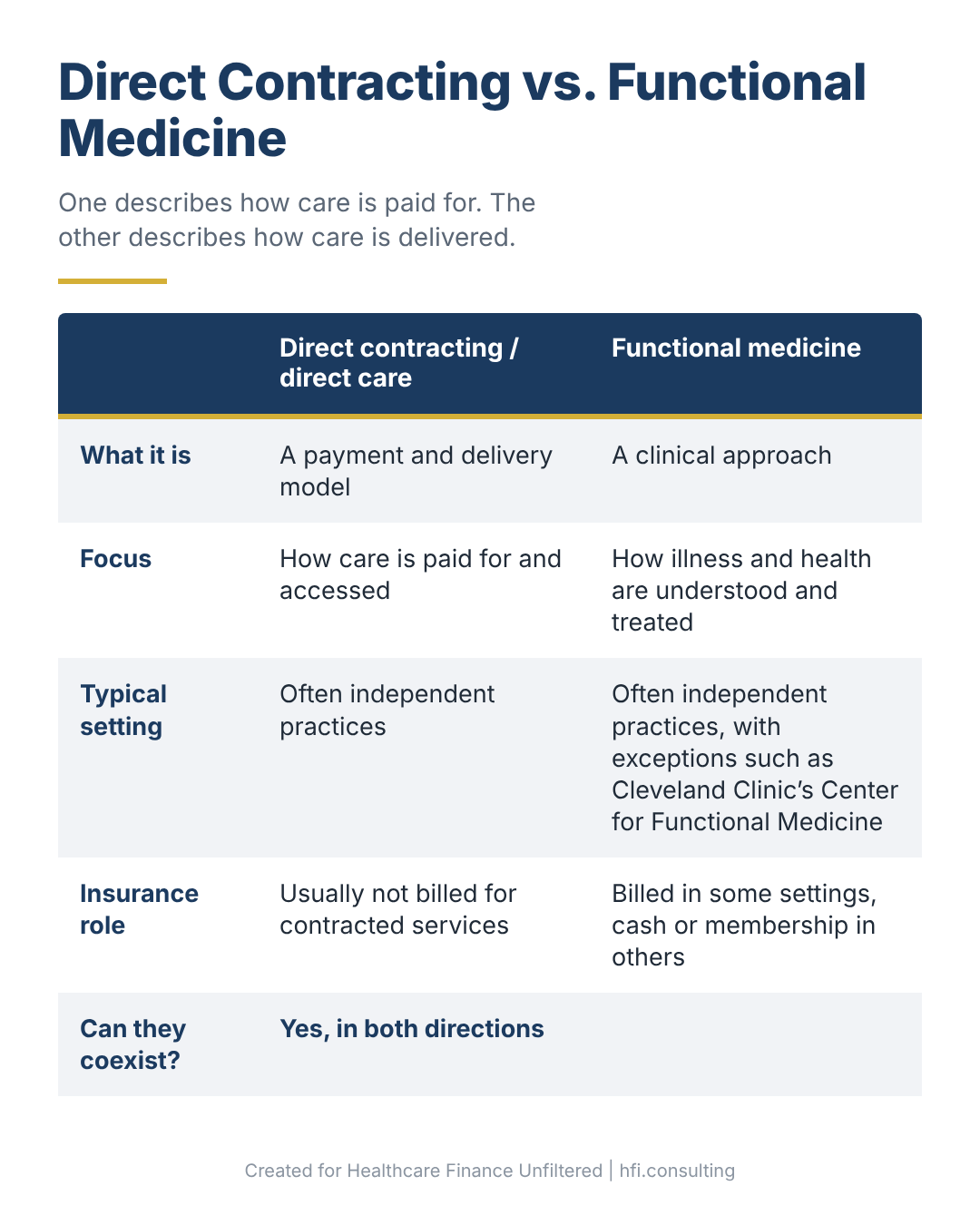
Table comparing direct contracting, a payment and access model, with functional medicine, a clinical approach, across five rows including insurance role.
Direct primary care: a flat fee for access, not a replacement for coverage
In direct primary care (DPC), a patient or employer pays a flat monthly membership for primary care. The practice does not bill insurance for those services. The national average is about $99 per member per month, from roughly $113 in the West to $80 in the Midwest, according to the 2026 State of DPC survey.
Memberships usually include unlimited visits, direct messaging with the physician, preventive care, chronic disease management, and basic in-office procedures. They exclude emergency care, hospital stays, surgery, specialists, and advanced imaging. That is why DPC sits on top of a separate plan.
Growth is real but small in absolute terms. Hint Health reports 837% membership growth from 2017 to 2025, and employers fund 60% of active memberships on its platform. Its 1.4 million members still equal roughly 0.4% of the U.S. population by my math.
Tax rules changed in 2026. Under the One Big Beautiful Bill Act, a qualifying DPC arrangement no longer blocks HSA eligibility if fees stay at or below $150 a month for an individual or $300 for a family. Those caps hold for 2027.
Be careful with the savings claims. A Michigan DPC group and its benefits administrator reported cost growth of 0.9% a year over five years against an expected 6.2%, with inpatient admissions down 71%. Medical Economics noted the release did not say who ran the analysis, how many employers took part, or where the 6.2% trend came from.
A 2020 Milliman study for the Society of Actuaries adjusted for health status and found DPC users relied less on emergency and facility services. Even so, the employer's net cost came out an estimated 1.3% higher, within a range from a 5.2% reduction to a 7.8% increase. The employer paid the membership fees and waived the deductible for everyone in the DPC option.
Direct specialty care applies the same logic to higher-cost visits
Direct specialty care works like DPC for endocrinology, psychiatry, rheumatology, and functional medicine. A patient or employer buys a membership or package price. The practice does not bill insurance for those services.
The new HSA rule covers primary care only. A specialty membership does not get the same treatment.
Employer direct contracting moves the deal to the employer's table
Employer direct contracting works at a larger scale. A self-insured employer negotiates prices and access directly with physician groups, hospitals, surgery centers, or primary care practices. The contract limits or bypasses the insurer's network for those services.
The examples are getting bigger. Northwell Health and the 32BJ Health Fund, which represents more than 100,000 building service workers in New York City, finalized what was billed as the largest direct contracting arrangement of its kind in December. AdventHealth enrolled more than 18,000 of its own workers in a narrow network and plans to sell a version to employers in its area.
Reference-based pricing is a related tool. It drops the network and pays providers a percentage of Medicare.
The shift to self-funding supports all of it. Among small employers, self-funded enrollment rose from 17% to 27% over the decade, and level-funded coverage grew from 7% in 2019 to 37% in 2025. I wrote about the provider side of self-funding in my earlier piece on auditing a self-insured health system employee health plan.
Advisory Board's analysis for health systems is blunt about the economics. It advises treating direct-to-employer work as "a defensive, cost-aligned capability, not a growth engine."
Here is why. These models shrink the demand pool rather than expand it, and bundled discounts reduce revenue per case. The net is often break-even at best.
Payers are responding. UnitedHealthcare expects its self-funded membership to grow by up to 750,000 this year as it shifts its commercial book toward administrative services. Anthem launched a designated orthopedic network in Indiana as a counter-offer, and CareFirst is launching an ICHRA model.
Network-free models mostly sit in self-funded plans, which ERISA exempts from state network rules. Becker's reports that CMS will also allow non-network plans on the ACA marketplace beginning in 2028.
ICHRA flips the employer model from a group plan to an allowance
An individual coverage HRA, or ICHRA, reverses the usual setup. The employer funds an account that reimburses employees tax-free for individual-market premiums, instead of offering a group plan to that class of employees.
The employer sets the allowance. There is no statutory dollar cap, and the amount can vary by defined employee class.
Two rules matter for planning. The affordability threshold is 9.96% of household income for 2026 and 10.22% for 2027. Accepting an affordable ICHRA generally makes the employee ineligible for Marketplace premium tax credits.
You may see ICHRA called a CHOICE arrangement. That name came from House legislation that would have written ICHRA into statute. It was dropped from the final One Big Beautiful Bill Act, so ICHRA remains a creation of regulation.
Adoption is growing from a small base. The HRA Council counts more than 20,000 employers offering an ICHRA or QSEHRA.
Its data comes from member organizations, and Mercer cautions that vendor-reported growth rates are a poor measure of overall enrollment. An EBRI and Morgan Health survey found just over one-third of employers are evaluating ICHRAs.
The QSEHRA is the small employer version, for employers with fewer than 50 full-time equivalent employees. Its 2026 IRS caps are $6,450 for self-only coverage and $13,100 for family coverage.
For payers, an ICHRA moves lives from the group market to the individual market. That changes who prices the risk and what the pool looks like.
High-deductible plans and catastrophic coverage have more room than before
The traditional high-deductible plan with an HSA has more flexibility in 2027 than many employers realize. Telehealth before the deductible is now a permanent safe harbor. Bronze and catastrophic Marketplace plans have been HSA-eligible since 2026, whatever their deductible design.
The 2027 HSA limits rise to $4,500 for self-only coverage and $9,000 for family coverage. An employer can pair a higher-deductible plan with first-dollar telehealth and a DPC arrangement and keep HSA eligibility intact, within the IRS design limits.
Catastrophic plans carry very low premiums and a deductible equal to the out-of-pocket maximum. Eligibility is limited to people under 30 and people with a hardship exemption, and premium tax credits generally cannot be used on them. In July, a federal court stayed CMS's attempt to open the hardship exemption based on income alone, and found it likely unlawful.
More than 20,000 consumers who were ineligible for tax credits had enrolled under that expanded exemption in the prior open enrollment. Eligibility for 2027 is narrower than CMS planned.
If you want help mapping these alternatives to your own numbers
If you want to map these alternatives to your own payer mix, service-line margins, and chart of accounts, that is the work I do at Healthcare Finance Innovations. Reply to this post or visit hfi.consulting to start the conversation.
Gap, short-term, and sharing products fill holes and carry different risks
Gap and supplemental products pay cash when a defined event happens. Hospital indemnity pays per day or per admission. Critical illness pays a lump sum on diagnosis.
Accident and fixed indemnity pay scheduled amounts. They are designed to sit on top of a high-deductible plan, and they are not major medical coverage.
For a provider, these benefits usually pay the policyholder, not your claim. They can help a patient meet a deductible. They do not guarantee payment.
Short-term limited-duration insurance is temporary coverage. It is usually medically underwritten, can exclude pre-existing conditions, and does not have to cover the essential health benefits. The 2024 federal rule limits new plans to three months, or four with renewals.
Since August 2025, the federal agencies have said they will not prioritize enforcing that definition while they reconsider it. Duration now depends heavily on state law. As of my last check, I could not find a final replacement rule.
Health care sharing ministries are not insurance. Members pay a monthly contribution, and the funds go toward other members' eligible bills.
In the model WeShare Health describes, the member presents a card and pays a set fee at the visit. The organization reviews the bill and pays the provider once the household meets a threshold.
The organization does not guarantee payment. Insurance Business reports that these ministries are largely exempt from state insurance regulation and from ACA protections such as guaranteed coverage of pre-existing conditions.
Sizing is messy. The Alliance of Health Care Sharing Ministries counts 107 HHS-certified ministries and more than 692,000 participants. Promoter-sourced estimates run as high as 1.7 million.
Liberty HealthShare's enrollment doubled in two years, and Medi-Share, based in Melbourne, Florida, says it serves almost half a million Americans.
Price claims come from promoters. WeShare says contributions run 30% to 60% below comparable coverage. Treat that as a marketing figure until you see the guidelines and the claims history.
For providers, the issue is collection. A sharing member can look like a self-pay account until the organization pays, and sharing can be denied for ineligible items.
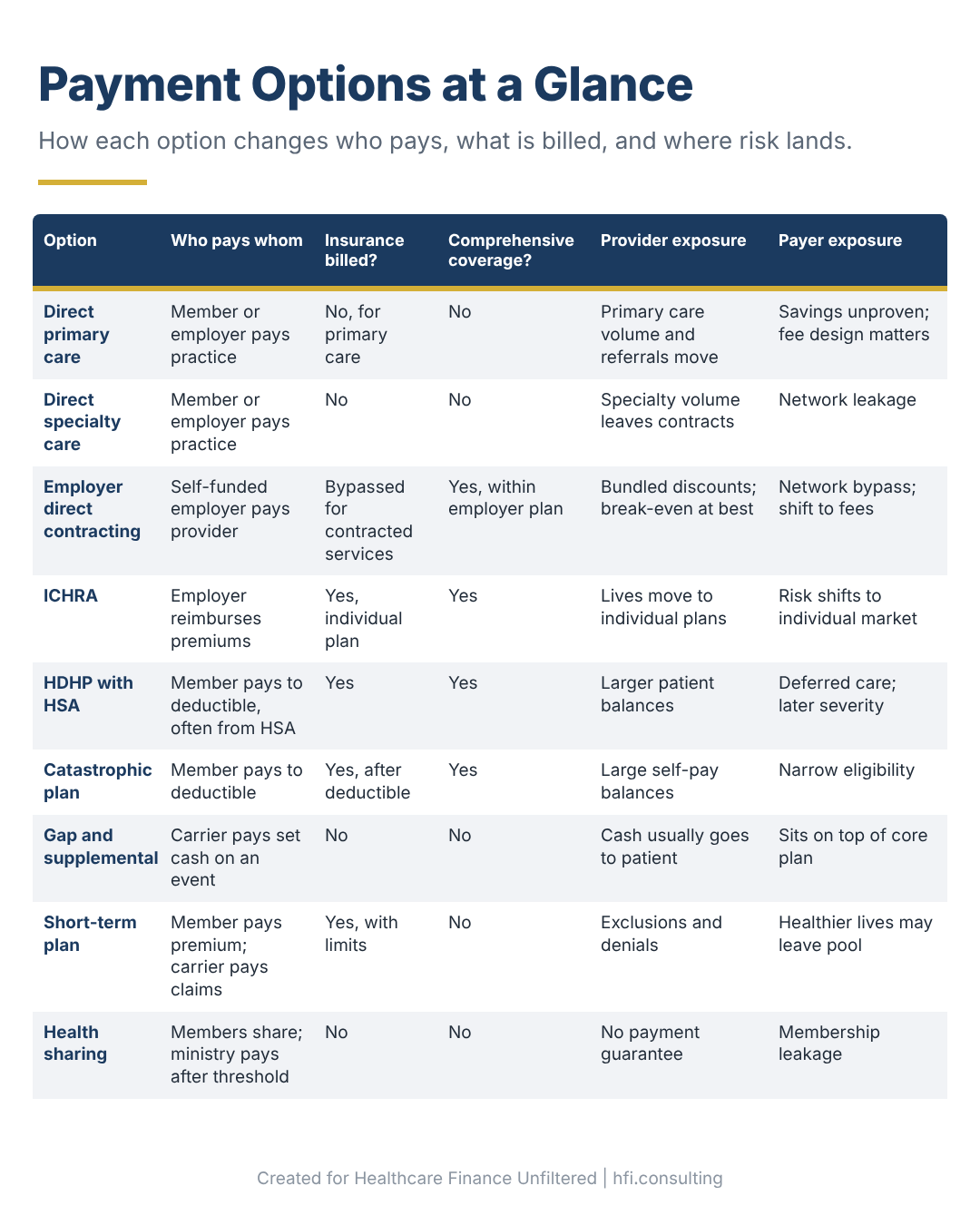
Table of nine alternative payment options showing who pays whom, whether insurance is billed, coverage status, and provider and payer exposure.
What this does to your numbers
I have worked both sides of this table. Most of my career was provider budgeting and cost accounting. Today I work on the payer side, in Medicare Advantage population health and risk adjustment.
For provider CFOs, here is what to act on:
Make leakage visible. Add payer classes or financial classes for DPC referrals, sharing ministry members, ICHRA individual plans, and direct-contract employers. If your ledger runs on Oracle, Sage Intacct, or NetSuite, that is a chart of accounts decision. Smaller practices on QuickBooks or Xero can use classes or tags.
Model bad debt and charity care at higher deductibles. The 37% Marketplace deductible increase KFF reported is a planning input, not a forecast.
Price cash and bundle rates from cost, not charges. If you cannot cost an orthopedic episode, you cannot price a direct contract.
Decide where direct contracts fit. The evidence says defensive and break-even, so set a margin floor before the first employer calls.
Watch referral patterns from DPC practices. Advisory Board notes that primary care models aim to reduce downstream referrals.
For payer CFOs, here is what to act on:
Track risk pool movement from ICHRA, catastrophic, and short-term plans. Healthier lives may choose differently, and you will see it in the individual market first.
Watch the revenue mix as employers move to self-funding. Premium becomes administrative fees, and the margin math changes.
Review network strategy against direct contracting. A designated network is one counter-offer. Others will follow.
Treat DPC as benefit design, not a proven cost saver. The Milliman result shows why the fee and deductible design decide the outcome.
Decide whether you will cover functional medicine, and on what evidence standard.
Run three scenarios before your next budget cycle
These are planning inputs, not advocacy for or against any policy. The rules changed several times in the last year, and they may change again.
Deductibles keep climbing. Model deferred care, bad debt, and the shift of dollars from payer to patient.
Employers in your market move to ICHRA or direct contracts. Model the share of commercial lives that leave your contracts.
Federal rules move again. Model a range for short-term plans, catastrophic eligibility, and any future ICHRA legislation.
None of this replaces insurance for hospital stays, emergencies, or major specialty care. It changes who pays, when, and how much of the risk lands on your books. If you want a second set of eyes on your exposure, reply here or visit hfi.consulting.
This article is general information, not insurance, tax or legal advice.
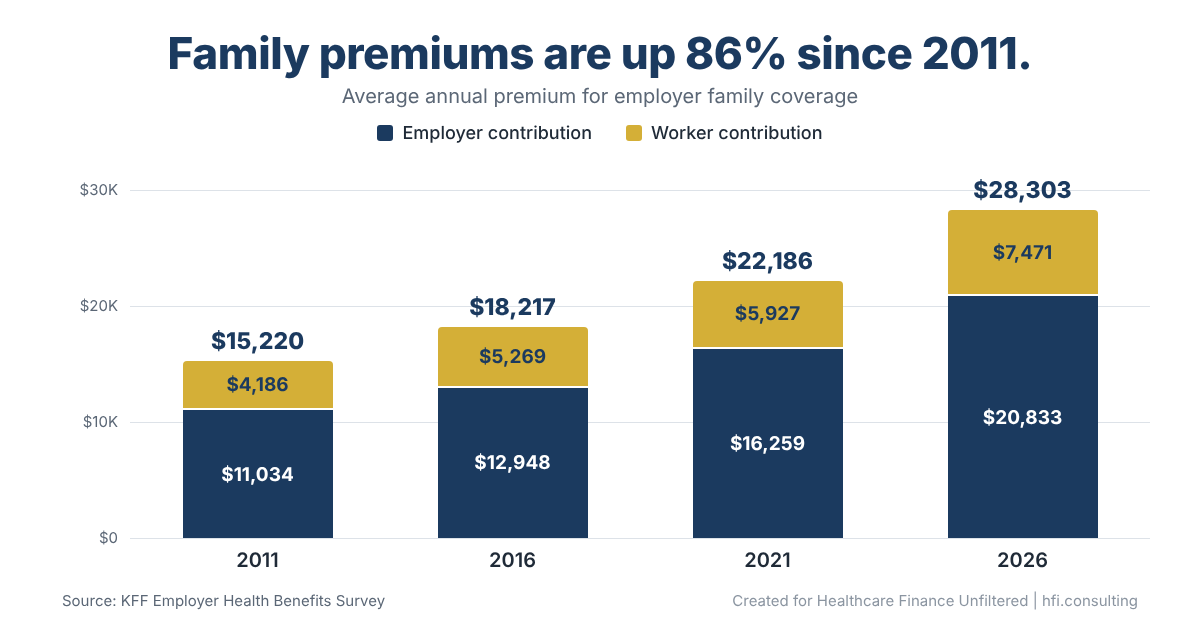
Chart of average annual family health premiums rising from $15,220 in 2011 to $28,303 in 2026, split into employer and worker contributions.
P.S. Which of these are you seeing first in your own payer mix: DPC members, sharing ministry members, or ICHRA plans? Reply and tell me. I read every response.
