
Oracle Health Layoffs 2026: What the AI Staffing Reversal Means for Hospital CFOs
Oracle's mass cuts at Cerner expose the real cost of AI-driven workforce decisions — and create a rare talent opportunity for health systems.
Oracle Health sent termination emails to thousands of employees on the morning of March 31, 2026. By afternoon, internal Slack user counts at the former Cerner campus in Kansas City had dropped by more than 5,000.
If your hospital runs on Oracle Health — or what you still call Cerner — this is not just a tech industry story. It is a vendor stability event, a talent market shift, and a case study in what happens when large organizations treat AI as a workforce replacement strategy rather than a workforce augmentation tool.
Finance leaders have about 90 days to get ahead of this before the operational impact shows up in your vendor's service levels.
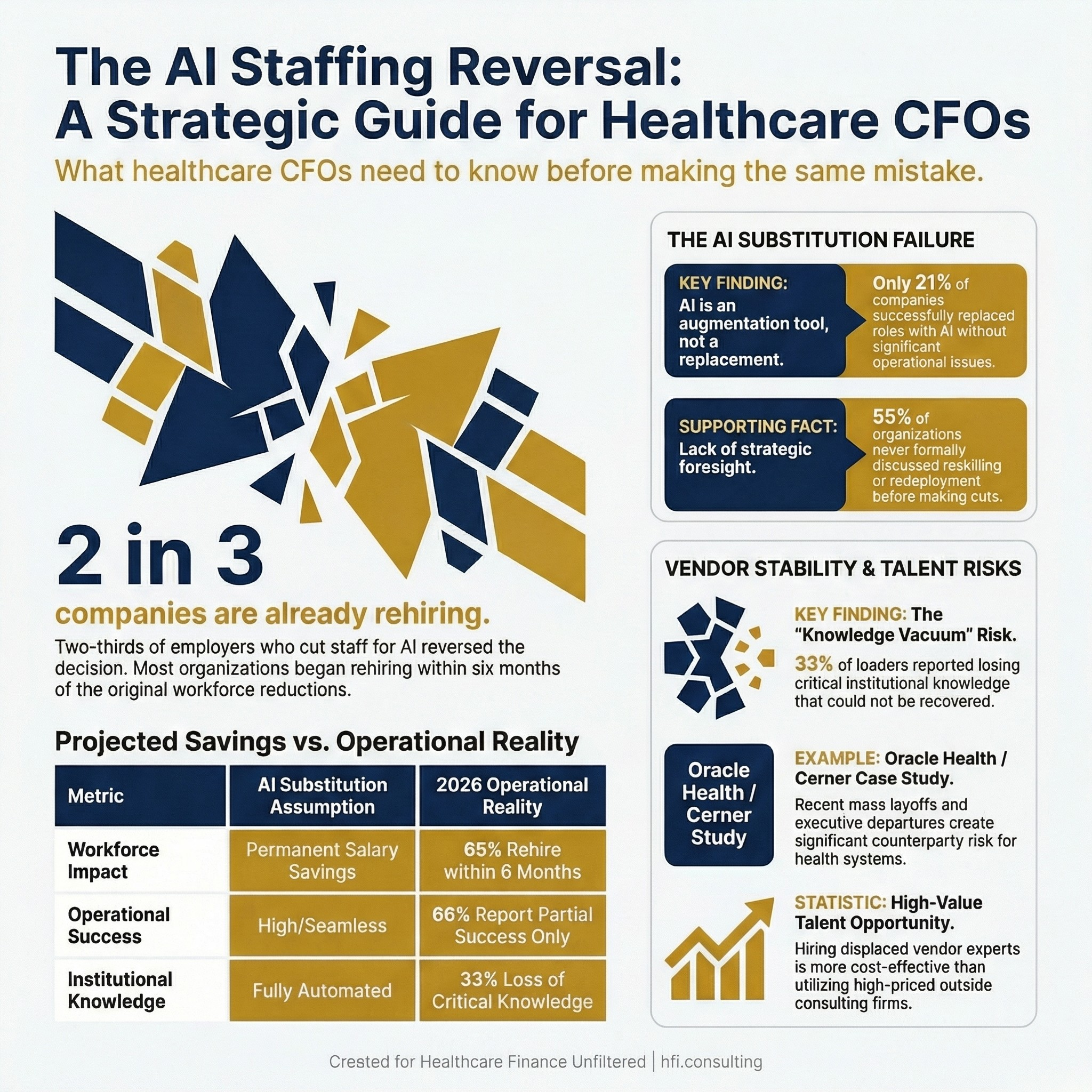
Infographic showing that two-thirds of employers who made AI-driven layoffs are rehiring within six months, with key data points for healthcare CFOs.
What Actually Happened at Oracle Health
Oracle filed a WARN Act notice for 539 employees at the former Cerner campus in Kansas City, with dismissals scheduled for late May and early June 2026. Reports from CNBC and social media posts from affected employees suggest the total reduction across Oracle's business units is in the tens of thousands, though Oracle has declined to comment.
Oracle's stock tells part of the story. After reaching an all-time high of $345.72 per share in September 2025, the stock has fallen nearly 26% year to date, sitting around $145 as of April 2026. The company took on significant debt to build out its AI infrastructure for the Stargate data center initiative with OpenAI. The layoffs appear to be as much about financial pressure as they are about technology strategy.
Several Oracle Health and AI executives have also departed, including the senior VP of product management for clinical and healthcare AI and the executive VP of health and AI. Leadership continuity matters when you are managing an enterprise EHR relationship.
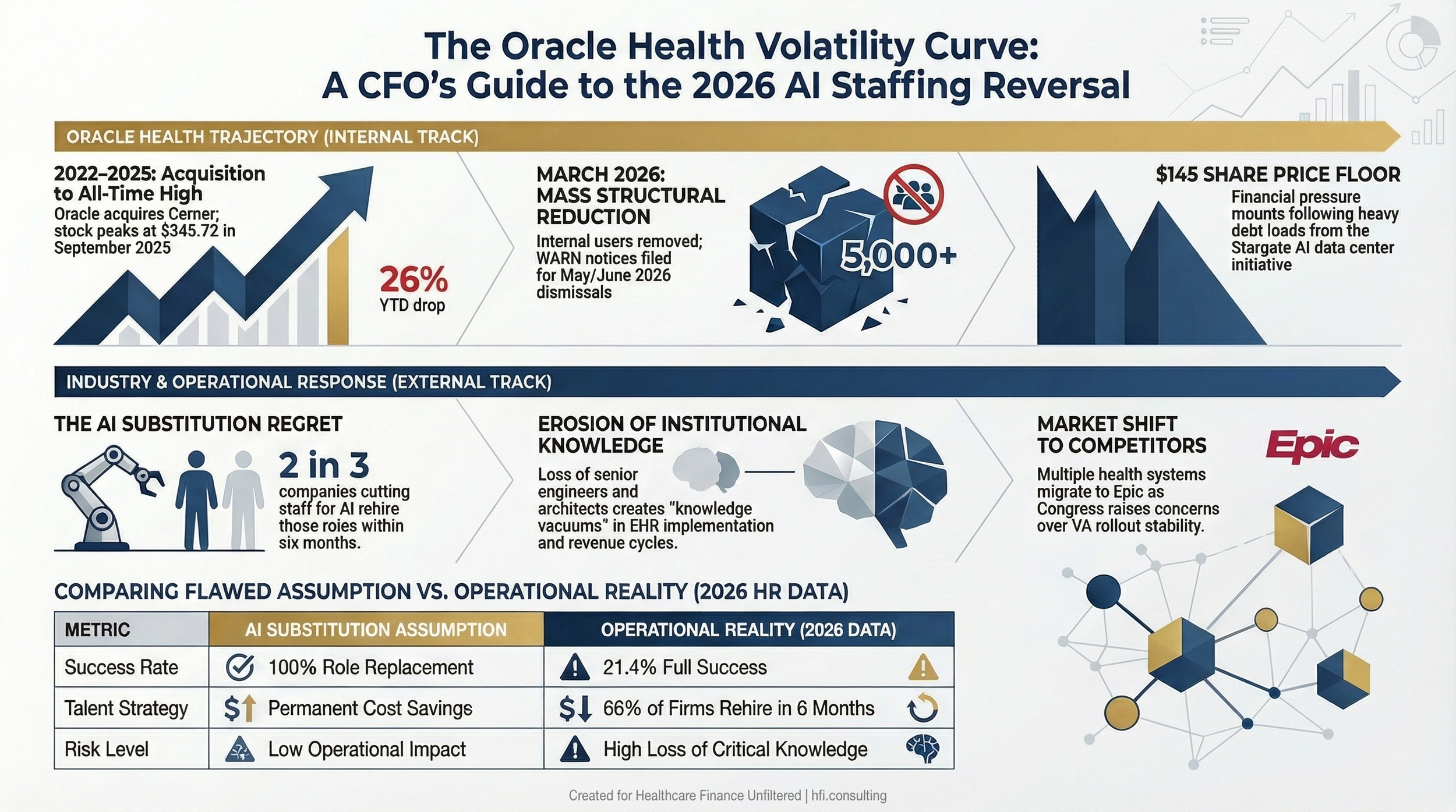
Dual timeline showing Oracle Health's trajectory from the 2022 Cerner acquisition through the 2026 layoffs alongside industry response events.
The Broader Pattern: AI Substitution Regret Is Real
Oracle's situation does not exist in isolation. A February 2026 Careerminds study of 600 HR professionals found that two in three employers who reduced headcount because of AI are already rehiring those laid-off roles. More than half of those organizations rehired within six months of the original cuts.
The data gets more specific. Only 21.4% of respondents said AI fully replaced roles with no operational issues. The majority — 66.1% — said only some roles were replaced successfully. More than half of HR leaders reported that AI required more human insight than they had anticipated. A third said the cuts led to the loss of critical skills and institutional knowledge they could not easily recover.
Nearly half of the HR leaders surveyed said they would approach the reductions differently, and another 50% said they would make selective changes rather than broad cuts. Perhaps most telling: 55% said reskilling and redeployment were never formally discussed before the layoffs happened.
This is not a small sample finding. This is a pattern playing out across sectors, and healthcare is not immune to the same organizational reasoning errors.
What This Means If You Are on Oracle Health
Several large health systems have already made the move from Oracle Health to Epic over the past few years. If you have stayed on Oracle Health, you are now managing a vendor that is simultaneously cutting staff, losing executive leadership, and under financial pressure to monetize its AI investments faster than the technology is performing.
That combination creates four specific risks for your finance team to assess now.
Support and implementation continuity. The people who were laid off include senior engineers, architects, operations leaders, and technical specialists with deep product knowledge. Your account team and implementation contacts may be gone. If you have open service tickets, pending upgrades, or contract renewals on the horizon, the counterparty risk just increased.
Product roadmap credibility. Oracle Health's GM announced a new acute care EHR product at the company's 2025 summit. That roadmap now needs to be evaluated against the reality of a workforce that has been significantly reduced. Promised features have different probability weights when the team building them is materially smaller.
VA rollout scrutiny as a signal. The Department of Veterans Affairs has been rolling out Oracle Health's EHR to VA medical centers. Congressional oversight letters are now asking whether Oracle can guarantee uninterrupted care for veterans given the reductions. When lawmakers are asking vendor stability questions, finance leaders should be asking the same questions about their own contracts.
Contract leverage timing. If your Oracle Health contract is up for renewal in the next 12 to 24 months, you are negotiating from a position of strength right now. The vendor needs stable, committed client relationships. That is leverage worth using.
The Talent Opportunity Your Peers Are Not Thinking About Yet
Here is the strategic angle most healthcare finance leaders will miss in the next 30 days.
The employees being let go from Oracle Health and the former Cerner organization know your systems. They built the workflows, documented the integrations, trained the end users, and managed the implementations at health systems that look a lot like yours. They understand revenue cycle processes, clinical documentation workflows, charge capture logic, and the specific failure modes that take years of institutional knowledge to recognize.
In my work at Ascension across seven hospitals, the most operationally painful moments were not the technology failures — they were the knowledge vacuums created when experienced people left and took their system expertise with them. Hiring someone who already knows the platform your organization runs on is not just faster. It eliminates an entire category of implementation risk.
The window here is short. These employees are active on LinkedIn and Reddit. Health systems that move quickly will get first access to a talent pool that will not be available six months from now. The roles to target include EHR implementation specialists, revenue cycle analysts with Oracle Health or Cerner experience, clinical informatics staff, and IT project managers who have managed enterprise health system rollouts.
The finance case is straightforward. A contract implementation specialist with five years of Cerner experience commands a lower salary than what you would pay an outside consulting firm to provide the same depth of knowledge on a time-and-materials basis. This is a cost containment opportunity dressed as a staffing decision.
The CFO Lesson That Goes Beyond Oracle
The Careerminds data and the Oracle situation together make a clear argument that finance leaders need to be making to their boards and C-suite peers right now.
AI does not eliminate the need for human judgment. It changes where human judgment is needed.
When 66% of organizations report that only some AI-driven role eliminations worked as planned, the implication for healthcare CFOs is not that AI is a bad investment. It is that the ROI analysis for AI projects needs to explicitly model the cost of the human expertise you are retaining alongside the technology, not replacing.
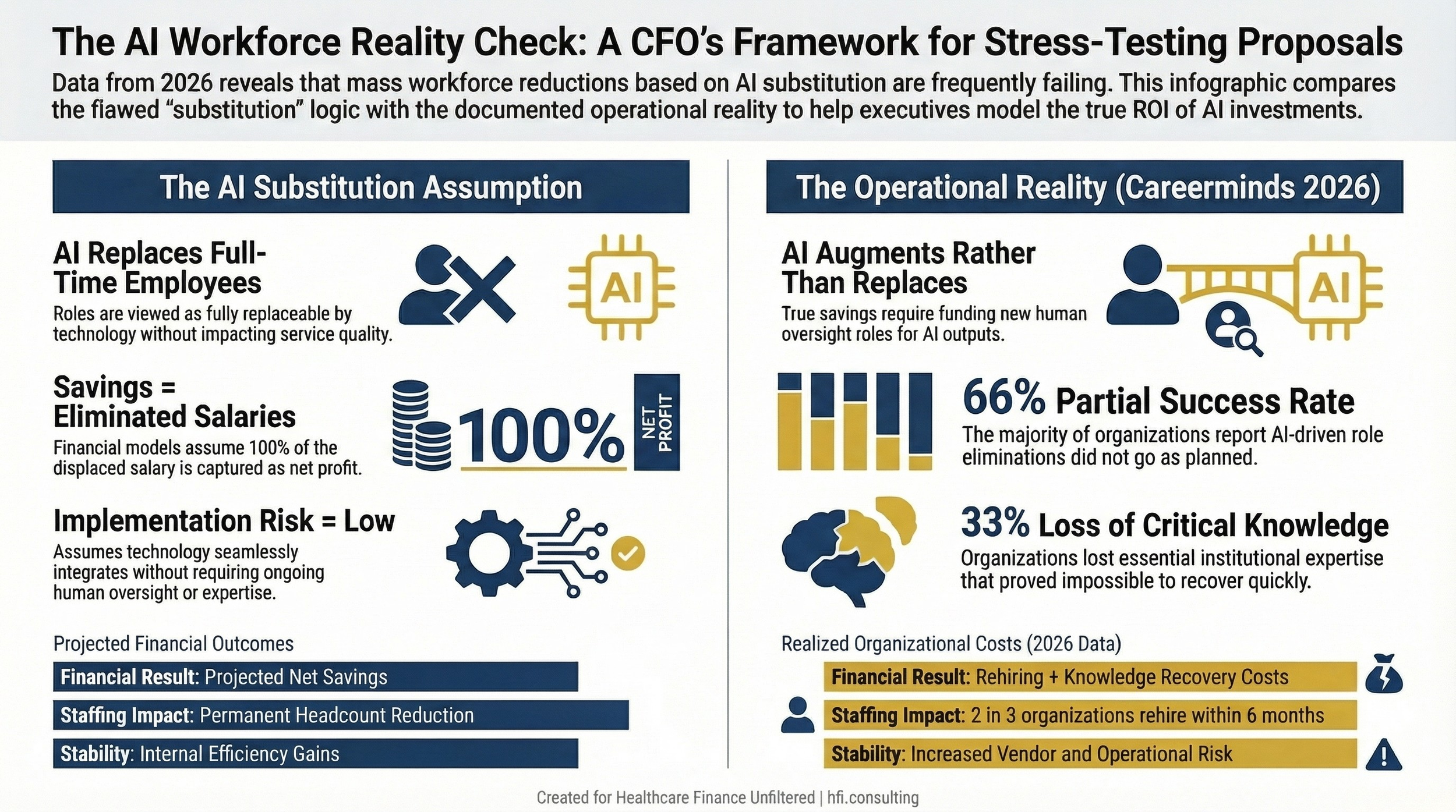
Comparison table contrasting the assumed AI workforce savings model against 2026 data showing partial success rates and hidden rehiring costs.
Healthcare has specific constraints that make the AI substitution error more costly than in other industries. Clinical workflows have regulatory requirements. Revenue cycle processes have compliance dependencies. EHR integrations have failure modes that are not obvious until they appear in your denial rates six months after the fact. The human expertise that understands these interdependencies is not recoverable quickly.
The organizations in the Careerminds study that struggled most were described as making significant, irreversible decisions without a full picture of AI capabilities or what workforce reductions would do to their operations. That description should sound familiar to anyone who has watched a technology vendor pitch cycle inside a health system.
A Framework for Finance Leaders Right Now
If you run a health system on Oracle Health or Cerner, the action items are concrete.
Convene a vendor stability review with your CIO within the next 30 days. Document your open service requests, your implementation timeline dependencies, and your contract renewal dates. Assess whether your current Oracle Health support contacts are still employed.
Review your contract for force majeure and material adverse change provisions. This is not about terminating the relationship. It is about understanding what your options are if service levels decline in a material way over the next 12 months.
Engage your recruitment and HR teams about the Oracle Health talent pool now. Establish the roles you would benefit from, set salary parameters, and move before your regional competitors do. Health systems in markets with large Oracle Health or Cerner footprints — including Kansas City and surrounding Midwest markets — should act first.
For your board and CFO peers, build a standing AI workforce review into your annual budget process. For every AI-driven FTE reduction proposal that comes across your desk, require a documented analysis of: which human oversight roles are retained, what the institutional knowledge transfer plan is, and what the rehiring cost model looks like if the AI underperforms in year two.
If you are navigating vendor contract renegotiations or AI investment decisions and want a framework specific to your organization's situation, I am happy to connect. Reply to this email and let me know where you are in the process.
The 30,000-Foot View
Oracle bet heavily on AI infrastructure at a moment when the technology's capabilities were still developing. The financial pressure from that debt load is now showing up as workforce reductions that include people with deep healthcare domain expertise. The health systems that run on Oracle's platform are collateral effects of a vendor's capital allocation decision.
From a pure finance perspective, this is a case study in the risk of single-vendor dependency for mission-critical clinical infrastructure. It is also a reminder that the organizations advertising the fastest AI adoption timelines are not always the ones managing the best long-term outcomes.
Two-thirds of companies that cut staff for AI are already rebuilding those teams. The question for healthcare finance leaders is not whether AI is valuable — it is. The question is whether the organizations making large, fast workforce decisions to fund AI bets are modeling the full cost of what they are eliminating.
The answer, according to February 2026 data, is that most are not.
If your organization is on Oracle Health and you are looking at this situation from the finance side, I want to hear from you. What is your biggest concern about vendor stability right now? Hit reply and tell me — I read every response.
P.S. If you are a CFO or VP of Finance currently evaluating an EHR contract renewal or AI workforce proposal, what does your board want to see in terms of risk documentation before approving? I am building a framework based on real CFO responses and would love your input.
